


Nordic Unveils Cellular-Based Cloud Location Service
 Published2021.08.12 18:50
nRF9160 SiP-based cellular IoT device location tracking
Provides single and multi-cell, A·P-GPS positioning capabilities
Nordic Semiconductor today announced the launch of its nRF Cloud Location Services , which will enable customers to access detailed, fast, and accurate commercial location services for cellular IoT devices powered by Nordic's nRF9160 SiP through cloud-based products.
The nRF Cloud positioning service is built on Nordic's versatile cellular IoT connectivity solution, nRF Cloud. Deploying this service on nRF9160 SiP-based cellular IoT products provides access to all commercial positioning services. nRF Cloud also provides wireless firmware update capabilities for field devices.

The new service provides positioning based on Assisted GPS (A-GPS) and Predicted GPS (P-GPS) for indoor and outdoor applications, as well as positioning using single and multi-cells.
Single-cell mode identifies the cell containing the device to be tracked, then references the base station's geographic location database to identify the cell. This eliminates the need for a GPS modem, extending battery life and providing kilometer-level accuracy. Multi-cell mode builds on single-cell technology by referencing the positions of surrounding base stations, providing accuracy down to hundreds of meters.
GPS offers excellent location accuracy, typically in the tens of meters. However, cellular IoT devices can consume significant battery capacity due to the GPS modem's cold-start time-to-first-fix (TTFF) of several minutes within a satellite constellation.
A-GPS connects to cellular before the GPS modem is turned on, providing position data from satellites near the IoT device. This typically reduces TTFF to 5 seconds. P-GPS provides the device with data from supported satellites predicted for more than two weeks based on A-GPS. Compared to A-GPS, IoT devices request assistance data from the cellular network less frequently, resulting in shorter TTFF, more accurate positioning, and greater power savings.
Nordic is working with third-party vendors to provide services for its devices and nRF Cloud customers. Partners provide easily accessible location history, including GPS-enabled data and timestamps for customers' IoT devices. nRF Cloud also interfaces with customer-specific applications and clouds via easy-to-use REST APIs, enabling integration with third-party applications.
“nRF Cloud allows customers to choose only the services they need without the hassle of setting up new cloud service providers,” says Ville-Veikko Helppi, Product Manager for Nordic Cloud Solutions. “nRF Cloud positioning services provide a familiar user experience and the long-term, high-quality commercial support needed to deploy a large number of cellular IoT devices.”
Comments
Related news
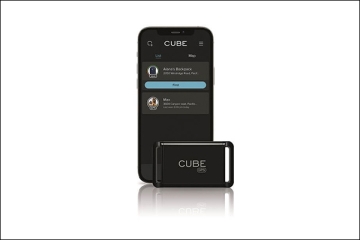
Nordic Provides SiP Equipped with 'GPS-Supported' LTE-M/NB-IoT Modem
Nordic's nRF9160 low-power SiP, which integrates LTE-M/NB-IoT modem and GPS functionality, has been adopted in the C7004 Cube GPS tracking device from U.S. startup Cube Trackers. The Cube GPS is a device measuring approximately 70×40×16mm that periodically transmits the location of tracked objects to the cloud through a cellular network, maintaining battery life of approximately 10 to 60 days depending on GPS update intervals.
2021.03.10by 이수민 기자

u-blox Launches AEC-Q104 Grade Positioning Tracking Module
u-blox announced on the 14th the launch of the AEC-Q104 grade positioning tracking NEO-M9L module, which operates at a maximum temperature range of 105°C. The new module and M9140-KA-DR chip are based on u-blox's M9 GNSS platform and provide accurate position information using dead reckoning technology when satellite signals are degraded or unavailable.
2021.07.14by 명세환 기자
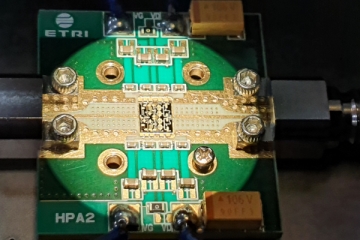
DMC Convergence Research Group Localizes GaN-Based AESA Radar PA
The AESA radar mounted on the latest fighter jets rapidly and accurately detects the distance, location, and shape of targets, which is made possible by thousands of transceiver modules attached to the front of the radar. The transceiver modules integrate switches, PAs, and LNAs. NST DMC Convergence Research Unit has successfully achieved localization of GaN PA MMIC technology, a core component of AESA radar.
2021.07.28by 이수민 기자
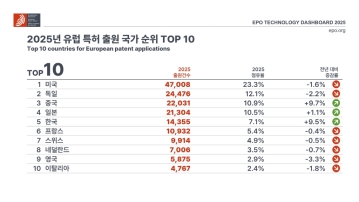
European Patent Applications Surpass 200,000 for the First Time… South Korea Maintains 5th Place, Led by Batteries and Telecommunications
According to the European Patent Office (EPO)'s 'Technology Dashboard 2025', European patent applications last year reached 201,974, surpassing 200,000 for the first time. Korean companies and inventors filed 14,355 applications, representing a 9.5% increase from the previous year and maintaining 5th place by country. Battery, digital communication, and semiconductor technologies led the growth, with Samsung ranking as the top EPO applicant for the second consecutive year and LG reaching 3rd place. The presence of major domestic cities such as Seoul, Suwon, and Yongin was also confirmed. It was also revealed that Korea's European patent strategy is expanding beyond individual technologies to span the entire industry.
2026.03.24by 명세환 기자

SK Telecom First Applies AI-Based Network Operations at Gwanghwamun K-Pop Concert
SK Telecom announced that it applied an AI-based network operation system for the first time at a large-scale K-pop concert held in the Gwanghwamun area of Seoul on March 21st, managing communication quality throughout the event. Mobile data usage during the three hours before and after the concert reached 12.15TB, approximately doubling compared to the same time slot the previous weekend. SK Telecom monitored traffic using the AI system 'A-One' in five-minute and 50-meter units to respond to potential overload situations, while also operating temporary communication facilities and on-site personnel in parallel. This case is interpreted as confirmation of the practical applicability of AI-based autonomous network operation in an environment where demand from dense events and foreign users increases simultaneously.
2026.03.23by 명세환 기자











