



KIMM Develops Carbon-Free 'Green Ammonia' Process
 Published2021.08.20 08:55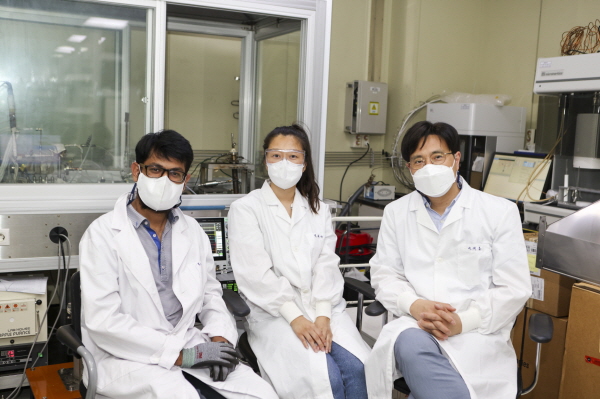
The Korea Institute of Machinery and Materials (KIMM), under the Ministry of Science and ICT (President Park Sang-jin), has developed an innovative process to produce ammonia at room temperature and pressure using renewable energy. This ammonia production process, which emits no carbon at all, is expected to be an innovative technology that will make a groundbreaking contribution to achieving carbon neutrality in the future.
A research team led by Principal Researcher Lee Dae-hoon of the Plasma Research Laboratory at the Korea Institute of Machinery and Materials (KIMM) has succeeded in developing an innovative process for carbon-free ammonia production and published their findings in the prestigious energy science journal 'ACS Energy Letters' on August 5.
The organic synthesis of ammonia (Haber-Bosch process), developed by Fritz Haber and Carl Bosch in 1913, is regarded as a discovery that formed the basis of agricultural innovation by significantly increasing agricultural productivity through the use of ammonia as fertilizer. In particular, ammonia has recently been attracting attention as an eco-friendly fuel that does not emit carbon. This is because ammonia, composed of nitrogen and hydrogen atoms, does not emit carbon dioxide when burned.
On the other hand, synthesizing ammonia using the Haber-Bosch process requires high-temperature conditions of over 200 atmospheres of pressure and over 400°C. Furthermore, because fossil fuels such as natural gas are used to obtain hydrogen, energy consumption is high and carbon dioxide emissions are significant.
According to a 2020 report by the Royal Society, the Haber-Bosch process uses 1.8% of the world's energy to produce ammonia, and the carbon dioxide emitted during this process accounts for 1.8% of global emissions.
The research team developed a process to produce hydrogen and nitrogen oxides by supplying and decomposing water into a nitrogen plasma, and then using these as a catalyst to produce ammonia. More than 99% of the nitrogen oxides produced by this plasma reaction are converted into nitric oxide, which can be easily synthesized into ammonia. The synthesized nitric oxide reacts with the co-generated hydrogen to synthesize ammonia with a high selectivity of over 95%, and the heat required for this reaction is utilized from the heat generated during the plasma decomposition process.
This process is a technology capable of producing 'green ammonia' that does not use separate fossil fuels and emits no carbon dioxide, and can achieve a yield 300 to 400 times higher than various electrochemical ammonia production methods proposed as alternatives to the Haber-Bosch process.
In addition, it has the advantage of enabling the production of ammonia using only water and nitrogen under ambient temperature and pressure conditions, rather than the conventional high-temperature and high-pressure processes, and allows for relatively easy large-scale expansion of the process through a modular system. In addition, aqueous nitrate solutions, a byproduct generated during ammonia production, can be usefully applied as agricultural nutrient solutions, oxidizing agents, etc.
The research team plans to improve ammonia production costs and efficiency through the development of scale-up and commercialization technologies, and seek to enter the ammonia plant sector—particularly the small to medium-sized plant sector capable of atmospheric pressure and room temperature operation—in collaboration with domestic and international engineering firms.
"We have developed an eco-friendly ammonia production process that is theoretically carbon-free when using renewable energy-based electricity and is suitable for actual facility application," said Principal Researcher Lee Dae-hoon. "We will dedicate ourselves to follow-up research and development to help drastically reduce global carbon emissions in the future."
Meanwhile, this research was conducted with support from the Korea Institute of Machinery and Materials' basic project and the National Science and Technology Council's convergence research project.
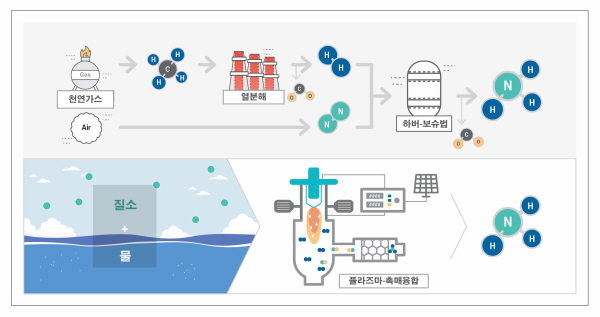
▲ Schematic diagram of the ammonia production process

Comments
Related news
.jpg)
Korea Institute of Machinery and Materials (KIMM) looks at hydrogen machine technology
The Korea Institute of Machinery and Materials will hold the "2021 Global Forum on Mechanical Engineering" online on September 8th with the theme of "Hydrogen Mechanical Engineering as the Foundation for Carbon Neutrality."
2021.08.09by 배종인 기자
KIMM Successfully Localizes 400nm-Class Lithography Equipment
The Korea Institute of Machinery and Materials (Director Park Sang-jin) under the Ministry of Science and ICT has successfully localized the manufacturing of a 400㎚ (nanometer)-class laser direct lithography equipment for the first time in Korea. The technology is drawing expectations as it can dramatically improve semiconductor productivity.
2021.08.13by 배종인 기자
Korea Mechanical Engineering and Materials Institute, Localization of 2D Lidar Sensor
A 2D lidar sensor for semiconductor wafer transfer equipment, which had been entirely dependent on foreign imports, has achieved localization, and expectations are gathering that future import substitution and domestic commercialization will become possible.
2021.08.18by 배종인 기자
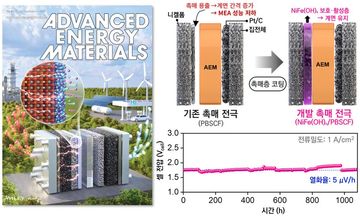
Materials Research Institute Develops Ultra-thin Coating Water Electrolysis Catalyst Technology
The Korea Institute of Materials Science has simultaneously resolved the performance and durability trade-off problem in water electrolysis catalysts by applying ultra-thin surface coating technology. Achieving 1.9 times higher performance compared to conventional catalysts while demonstrating 1,000-hour long-term stability, the institute has developed technology scalable to industrial water electrolysis systems through a simple process.
2026.10.07by 배종인 기자
Gigaphoton Develops Neon Gas Recycling System for ArF Excimer Lasers...Achieves 50% Recycling Rate
Gigaphoton announced that it has developed a gas recycling system for ArF excimer lasers and achieved a 50% neon gas recycling rate.
2026.10.02by 배종인 기자











