



The 'Smartphone Big 3' Samsung, Xiaomi, and Apple: What Are Their Winning Moves for the Second Half?
 Published2021.08.23 10:30
Samsung Electronics strengthens premium strategy led by foldables
Apple Prepares 90 Million iPhones with Enhanced Camera Features
Xiaomi's leap forward in the smartphone market is notable. In the second quarter of this year, Xiaomi ranked second in the global smartphone market with a 16% market share. It was positioned between first-place Samsung Electronics (18%) and third-place Apple (15%). Particularly in the European and Indian markets, Xiaomi is absorbing Huawei's market share and threatening Samsung Electronics through aggressive product launches that emphasize price competitiveness.
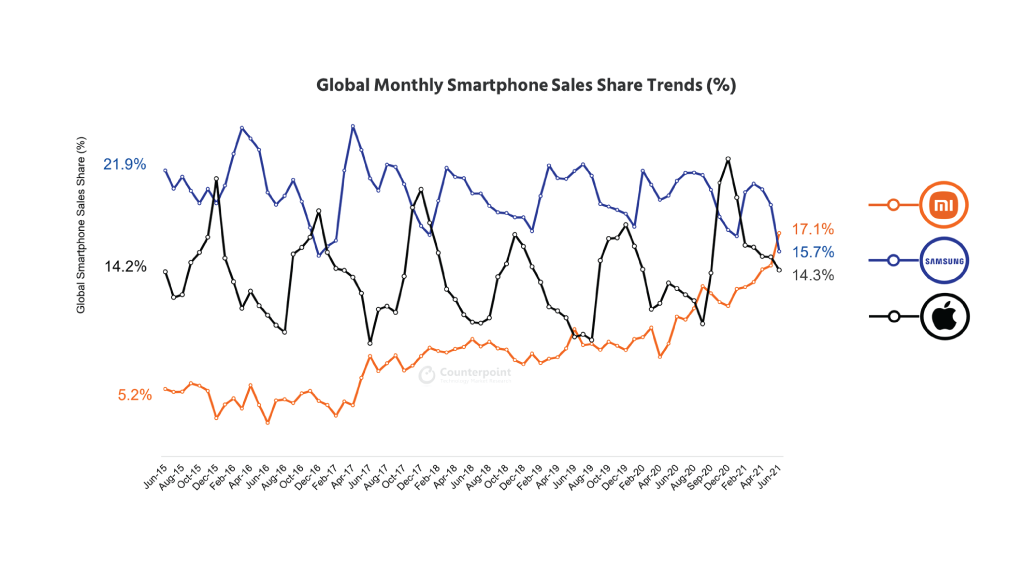
[Graph = Counterpoint Research]
In June, it recorded the top spot in the monthly smartphone market for the first time with 17.1%, surpassing Samsung Electronics (15.7%). Consequently, the market atmosphere is heating up as Samsung Electronics unveils strategic new products for the second half of the year, including a successor to its foldable phone, and Apple is also preparing to announce its next iPhone series.
◇ Samsung Electronics Focuses on the Foldable Market
Counterpoint Research projected that global foldable phone shipments will reach 9 million units this year. It predicted that Samsung Electronics will account for 88% of this total. In addition, the global foldable phone market in 2023, where Apple is known to enter the market, is predicted to reach 30 million units, and Samsung Electronics is expected to maintain a 75% market share.
On the 11th, Samsung Electronics unveiled its strategic smartphones for the second half of the year, the third-generation foldable phones 'Galaxy Z Fold3 (hereinafter Fold3)' and 'Galaxy Z Flip3 (hereinafter Flip3)', at the 'Galaxy Unpacked 2021' global live broadcast event.
Both products enhanced the foldable experience and improved durability compared to the previous generation.
Through the optimization of the display panel structure and the application of a stretched PET protective film, the durability of the main display has increased by approximately 80% compared to the previous model, and touch sensitivity has also been improved. It is also equipped with a new 'Hideaway Hinge' that allows the foldable phone to be unfolded and stood up for use at various angles, and a 'Sweeper' with improved aesthetics by reducing the length of the bristles.
.jpg)
In addition, it is the first foldable smartphone to support an IPX8 rating and uses an 'Armor Aluminum' chassis and Corning's 'Gorilla Glass Victus' reinforced glass to enhance safety against scratches and drops. The 3rd generation Galaxy Z series is lighter than its predecessor, and despite the addition of new features, it has been priced approximately 20% lower, thereby lowering the barrier to entry. This is interpreted as a strategy to maintain market leadership by expanding the base of the foldable market and popularizing it.
Meanwhile, on the 17th, Roh Tae-moon, President of Samsung Electronics’ Mobile Communications Business, announced the removal of advertisements from "default apps," which had been a source of controversy since last year. There was significant dissatisfaction among consumers regarding the fact that they had to watch ads in default apps despite purchasing high-end smartphones costing well over 1 million won. Criticism had also been raised that the company was undermining the premium image it had built up over the years.
Market analysts predict that this year's flagship 'Galaxy S21' series will sell much less than last year's flagship 'Galaxy S20' series, which suffered from sluggish sales due to the pandemic. Consumer dissatisfaction was high starting with the Galaxy S20 series due to blatant cost-cutting attempts even in flagship phones, and this reached its peak with the discontinued 'Galaxy Note 20' series.
The removal of default apps is interpreted as a strategy to overcome the crisis of falling behind Apple in premium image and Xiaomi in cost-effectiveness. It is reported that Samsung Electronics will suffer losses of hundreds of billions of won as a result of this measure. In the second quarter of this year, Samsung Electronics’ IM division recorded sales of 22.67 trillion won and an operating profit of 3.24 trillion won, marking decreases of 6.54 trillion won and 1.15 trillion won, respectively, compared to the previous quarter. Although the second quarter is typically an off-season, the decline was greater than in the first and second quarters of last year, which were hit hard by COVID-19.
◇ Xiaomi Reveals Ambition to Become Global No. 1 Within 3 Years
On the 10th, Xiaomi held a fall new product launch event and unveiled its new flagship product, the 'Mi MIX 4,' which is the first smartphone to be equipped with Qualcomm's latest application processor (AP), the 'Snapdragon 888 Plus.' The Mi Mix 4 is equipped with a higher quality Under Display Camera (UDC) than the one installed in Samsung Electronics' Fold 3.
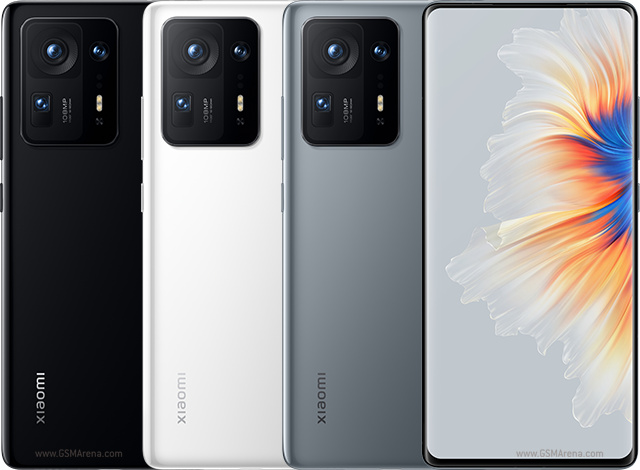
Although a one-to-one comparison of UDC quality is impossible because foldable smartphones have more films attached to the display than bar smartphones, it appears to have succeeded to some extent in building a premium image. Xiaomi, which has grown primarily through mid-range and low-end smartphones, plans to compete with Samsung Electronics and Apple in the premium market with the Mi Mix 4 in the second half of the year.
Xiaomi claimed the top spot in June sales for the first time in history, absorbing Huawei's recently sluggish market share in China and globally, and benefiting from the ripple effect of Samsung Electronics' supply shortages in June. At the event, Xiaomi CEO Lei Jun declared, "We will take the number one spot in the global smartphone market within three years." Although Xiaomi's image is poor in the domestic market, fierce competition with Samsung Electronics is expected in the European and Indian markets.
◇ Apple, having firmly established a premium image, sets its eyes on foldables
Apple is scheduled to announce the 'iPhone 13 (tentative name)' series this coming September, featuring differentiated camera functions such as video recording and editing. Last year, the announcement of the 'iPhone 12' series was delayed to October due to production disruptions caused by the COVID-19 pandemic, but this year, it is expected to be announced in September as in previous years. There is also a possibility that it will be released as '12S' due to the negative image associated with the number '13'.
The new iPhone is predicted to feature an AI-based filter system that enhances the shape and color of objects or people by applying filters to desired areas, as well as 'Cinematic Video,' a video version of Portrait Mode. Additionally, ProRes, a professional video editing feature, is also expected to be added.
In addition, the 'iPhone 13 Pro Max' is expected to feature a 4,352mAh battery for the first time, larger than its predecessor (3,687mAh), while the 'iPhone 13 Pro' is projected to be equipped with a 3,035mAh battery, an increase of 200mAh in capacity. The initial shipment volume for the next generation is expected to be approximately 90 million units, exceeding the 75 million units of the iPhone 12 series. Meanwhile, the foldable model is expected to be released in 2023.
Comments
Related news
Xiaomi Strengthens Competitiveness in Foldable Phone Market with Self-Developed Liquid Lens-Dedicated ISP!
Xiaomi is mounting its in-house designed ISP together with a liquid lens on its first foldable phone, making a full-scale push into the image chipset market including the premium smartphone segment. With the company having surged to the world's third-largest smartphone maker last year, successful entry into the image chipset market is expected to create new markets as well as generate additional revenue streams.
2021.03.31by 배종인 기자

Samsung Electronics' second-quarter sales reached KRW 63.67 trillion, the highest ever.
Samsung Electronics achieved record-high performance for the second quarter based on expanded semiconductor shipments and price increases, rising display selling prices, and sustained strong profitability in its wireless business.
2021.07.29by 배종인 기자
.jpg)
iPhone 14 expected to feature a titanium chassis
Apple's iPhone 14 is expected to be the first Apple iPhone to feature a titanium (Ti) material chassis.
2021.07.30by 배종인 기자
ESP32 Development Environment Selection and GPS Application Implementation
The ESP32 is a microcontroller that integrates Wi-Fi, Bluetooth, 12-bit ADC, capacitive touch, PWM, DAC, and UART in a single SoC. However, the abundance of features does not by itself solve the designer's problems. The real challenges lie in selecting the appropriate development environment, determining which pins can be used and which must be avoided, and converting raw data from modules into usable information. This document addresses ESP32 peripheral constraints (ADC2 and Wi-Fi coexistence limitation, UART1 occupancy, ADC non-linear regions), the trade-offs between Arduino IDE and ESP-IDF, and the process from connecting NEO-6M/NEO-M8N GPS modules to UART2, parsing NMEA sentences, and visualizing routes in Google Earth, all organized based on documented references.
2026.10.12by 편집부
MIPI CSI-2, DSI-2, C-PHY, D-PHY Test Solution Technical White Paper
The MIPI interface adopts a burst mode that transitions between low-power (LP) and high-speed (HS) states for low-power consumption, and in return, strict timing rules are imposed on state transitions. Additionally, the high-speed section operates as a packet-based protocol with headers, ECC, and CRC, so verification engineers must handle waveforms and protocols simultaneously. Traditional configurations combining general-purpose oscilloscopes and AWGs reveal limitations in setup complexity, measurement uncertainty, and lack of reproducibility when faced with these requirements. This white paper, based on webinar materials, organizes the structure of this problem and describes how the SV5C-DPTXCPTX generator for receiver testing and SV5C-DPRXCPRX analyzer for transmitter testing integrate state transition testing, stressed eye testing, and protocol analysis into a single bench, along with their application boundaries.
2026.10.12by 편집부











