


Korea Institute of Machinery and Materials (KIMM) says, "Human augmentation machines must be fostered as a new growth engine."
 Published2021.08.24 10:15
.jpg)
Amidst the global surge in investment in the development of augmentation technology, which combines the human body with mechanical technology, some have suggested that the Korean government should develop policies to foster the augmentation industry. Specifically, they cited Korea's world-class medical technology as a strength for the augmentation industry, adding that policy support and proactive legal reforms are needed to build on the relatively limited experience in commercializing related technologies.
The Korea Institute of Machinery and Materials (KIMM, President Sang-jin Park) under the Ministry of Science and ICT has published Machinery Technology Policy No. 104, “Trends and Prospects of Human Augmentation Machines,” which contains global market trends and national policies and future vision for human augmentation machines.
Augmentation devices refer to mechanical devices and systems that are inserted, attached, or worn within the human body to enhance the body's senses and abilities. Beyond simply restoring or replacing human functions and structures, the concept encompasses restoring lost functions or augmenting other functions. In terms of form, they are broadly divided into wearable types such as exoskeleton robots and muscle fabrics, attachable types such as artificial skin, and insertable types such as artificial joints.
Augmented reality machines are expected to not only improve the quality of life of the disabled and elderly by alleviating their physical discomfort, but also help them participate in productive activities, thereby contributing to solving social problems such as low birth rates and an aging population.
In addition, it is expected to contribute greatly to improving industrial productivity by being used as a universal technology for healthy people, such as assisting the physical activities of workers who perform repetitive specific movements, such as in delivery, construction, manufacturing, and caregiving, or enhancing the muscle strength of soldiers.
The human augmentation robot industry is a culmination of convergence and integration, representing the Fourth Industrial Revolution, requiring the convergence of diverse technological fields such as robotics and manufacturing engineering, biotechnology and bioengineering, information and communications technology, and electronics. According to market research firm MarketsandMarkets, the global human augmentation robot market is expected to grow at a compound annual growth rate of 12.7% from approximately $34 billion in 2019 to 2024.
The research team suggested that it is necessary to establish a policy classification system for the field of human augmentation and to suggest field-specific development measures. In particular, Korea is believed to have an advantage in activating the human augmentation machine industry as it possesses world-class medical staff.
He also emphasized that in the future, the concepts of treatment and augmentation will become increasingly blurred, leading to a hyper-personalized society where people will be able to access augmentation machines as easily as wearing glasses or changing tires on a car. He also emphasized that long-term and continuous policy investment is necessary as this is a field with a wide range of industries that can be utilized and that can create diverse industries.
To this end, he added that relevant laws should be preemptively revised to enable the accumulation of relatively insufficient experience in commercializing related technologies, thereby securing market competitiveness. He also suggested that demand for new industries should be strategically created through customized policy support for each field and research and development linked to commercialization, thereby securing competitiveness in the global market.
Lee Ji-eun, a senior researcher at the Korea Institute of Machinery and Materials, said, “In order to prevent delays in commercialization due to the long time it takes for step-by-step administrative procedures such as licensing and review, we need to consider training and deploying dedicated personnel, simplifying product modification reviews, and expediting the reflection of insurance premiums.” She added, “We need to make efforts such as periodically reviewing related guidelines, creating new items that do not exist in Korea, and reorganizing them to take into account the latest technologies.”
Meanwhile, the Korea Institute of Machinery and Materials is accelerating research and development on human augmentation machines, including muscle fabrics, robot suits, bioprinting for skin regeneration, flexible tactile sensors, robotic prosthetic arms and legs, brainwave and neural interfaces, rehabilitation robots, and biosignal detection and measurement sensors.
"Machine Technology Policy," a specialized journal analyzing trends in the machinery industry and proposing policies, is published at least four times a year. Subscriptions and downloads are available on the KIMM website.

Comments
Related news
KIMM Successfully Localizes 400nm-Class Lithography Equipment
The Korea Institute of Machinery and Materials (Director Park Sang-jin) under the Ministry of Science and ICT has successfully localized the manufacturing of a 400㎚ (nanometer)-class laser direct lithography equipment for the first time in Korea. The technology is drawing expectations as it can dramatically improve semiconductor productivity.
2021.08.13by 배종인 기자
Korea Mechanical Engineering and Materials Institute, Localization of 2D Lidar Sensor
A 2D lidar sensor for semiconductor wafer transfer equipment, which had been entirely dependent on foreign imports, has achieved localization, and expectations are gathering that future import substitution and domestic commercialization will become possible.
2021.08.18by 배종인 기자
KIMM Develops Carbon-Free 'Green Ammonia' Process
The Korea Institute of Machinery and Materials (KIMM), under the Ministry of Science and ICT, with director Park Sang-jin, has developed an innovative process for producing ammonia at room temperature and atmospheric pressure using renewable energy. The institute has devised an ammonia production process that emits no carbon whatsoever, and is expected to be an innovative technology that will significantly contribute to achieving carbon neutrality in the future.
2021.08.20by 배종인 기자
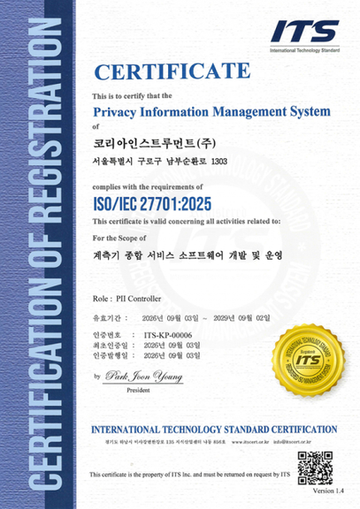
Korea Instrument, KOLAS Accredited Calibration Agency First to Simultaneously Acquire ISO/IEC 27,001·27,701
Korea Instrument has become the first among KOLAS accredited calibration agencies to simultaneously acquire ISO/IEC 27,001 and ISO/IEC 27,701 certifications. Through its proprietary platforms CWIZ Enterprise and CWIZ Partners, the company has embedded information security and personal data protection requirements across all business processes including customer information, equipment data, and calibration reports, with plans to continuously advance its management system through regular audits and security inspections.
2026.10.12by 배종인 기자
TeamViewer One, IT Incident Automation Workflow and Resolution Center Enhanced
TeamViewer has added IT incident automation capabilities and an advanced Resolution Center to its integrated digital workplace management platform 'TeamViewer ONE'. Recurrent service disruptions, configuration errors, and capacity shortages are automatically handled according to preset policies, and device status verification through script deployment can be managed in a unified interface, significantly reducing repetitive tasks for IT teams.
2026.10.12by 배종인 기자











