



KPTRI-NATM Secures Ultra-High Purity Molybdenum Refining Technology
 Published2021.08.24 17:10
Refining Technology and Equipment; Factory Demonstration in Progress
Expected to Reduce Dependence on Japan through Domestic Refining of Uzbek Raw Materials
Molybdenum is one of the essential materials for Korea's leading industries due to its excellent corrosion resistance, heat resistance, electrode properties, and stability, and is useful for semiconductors and display substrates. However, as a rare metal with extremely limited reserves, supply and demand have been unstable due to resource weaponization policies by countries possessing it.
On the 24th, the Korea Institute of Industrial Technology announced that it has secured overseas supply sources for molybdenum and jointly developed 99.995% high-purity refining technology and equipment with NATM, a domestic small and medium-sized enterprise.
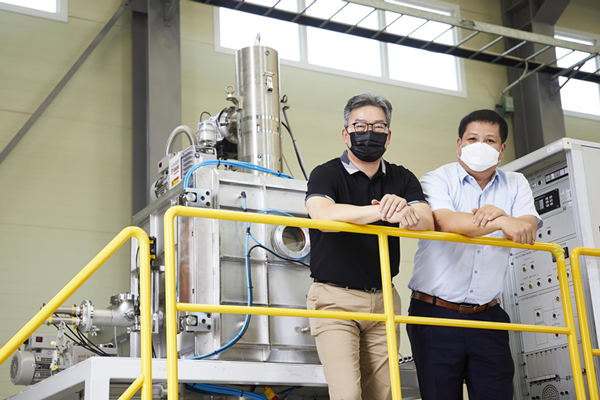
standing in front of the ultra-high purity molybdenum refining equipment [Photo=KPTRI]
Even when raw materials are imported into the country, molybdenum was difficult to utilize directly due to insufficient refining technology and equipment to increase purity. Furthermore, ultra-high purity molybdenum is being fully imported at an annual scale of approximately 700 billion won, of which 60-70% comes from Japan, creating significant supply stability issues.
In June 2019, KPTRI's Korean Rare Metals Industry Technology Center concluded a supply contract with Uzbekistan, a rare metals resource-rich nation, and established a molybdenum raw material supply chain. The plan was to establish a 'Korea-Uzbekistan Rare Metals Center' in the Kirchi region of Uzbekistan to create a hub for collaborative material development, while simultaneously securing stable supply of molybdenum from Uzbekistan.
Uzbek molybdenum is a byproduct of the copper refining process with intermediate-stage purity, so it needed to be refined to 99.99% or higher for use in domestic leading industries. Accordingly, Dr. Park Kyung-tae's team at KPTRI's Korean Rare Metals Industry Technology Center embarked on localization of 'high-melting-point molybdenum refining technology and equipment' in collaboration with rare metals material company NATM, successfully achieving 99.995% molybdenum.
The research team drew inspiration from overseas leading companies' ultra-high purity molybdenum refining processes, which use 'ultra-high-temperature electron beam' that does not require catalysts such as strong alkali or strong acid.
When electron beam is applied inside a vacuum chamber, the interior temperature rises to approximately 6,000℃, and the principle of accelerated gasification of internal materials is applied. In other words, during the electron beam irradiation process, impurities with boiling points lower than molybdenum's melting point of 2,600℃ vaporize and escape, leaving only 99.995% ultra-high purity liquid molybdenum, which is then molded into ingot form.
Currently, laboratory-scale research has been successful, and pilot factory demonstration tests are underway with NATM's equipment manufacturing expertise to enable ingot production in 12cm × 1m sizes. The research team has modified and adjusted numerous process variables and has entered the optimization stage for mass production. They project that prototype production will be possible within the next year.
Comments
Related news
.jpg)
"Securing mass production technology to popularize titanium" Interview with MTI's Vice President Lee Hyeong-min
To utilize high-utility resources more effectively, it is necessary to manufacture products at affordable prices, and recycling technology is needed to recycle by-products and waste generated during product manufacturing or use. MTI Group, established in 2006, is a competitive company in materials, particularly in the titanium sector. We met with Lee Hyung-min, Vice President of MTI Group, to inquire about the progress of business related to titanium and tantalum, and future objectives and aspirations.
2021.06.01by 이수민 기자
KETI Accelerates Commercialization of All-Solid-State Batteries with Zeolite
The Electronics and Telecommunications Research Institute has developed a material technology that reduces hydrogen sulfide gas generation from sulfide-based solid electrolytes, a key material for all-solid-state batteries.
2021.08.10by 배종인 기자
‘High nickel-based final boss’ has emerged… Ni 98% cathode material
Cobalt-containing cathode materials, which are expensive, account for 40% of electric vehicle battery costs. To reduce prices, less cobalt must be used while maintaining higher capacity. A UNIST faculty spin-off company has presented an optimal alternative: the 'Ni98 NCMA (NiCoMnAl) single-crystal material,' which is expected to be the ultimate 'high-nickel-based' solution.
2021.08.18by 배종인 기자
Schneider Aims for Building Energy Savings and Operational Stability with Next-Generation HVAC Drives
Schneider Electric has unveiled its next-generation HVAC drive product line 'Altivar HVAC'. The new product line's key features center on enhanced energy savings, system operational stability, and building management system integration. The products are divided into 'ATH200' for OEM and small equipment applications, and 'ATH600' for environments requiring continuous operation and advanced control. The company plans to expand the application scope from commercial buildings to facilities where HVAC system stability is critical, such as hospitals, airports, and data centers. The announcement includes over 30% energy savings, operation from -10°C to +60°C, Modbus and BACnet support, and compatibility with low global warming potential refrigerants.
2026.03.26by 명세환 기자
Ecolab Expands AI Data Center Cooling Business Through Acquisition of CoolIT
Ecolab has agreed to acquire CoolIT Systems, a liquid cooling company for AI data centers, for approximately $4.75 billion. The transaction is expected to close by Q3 2026, subject to regulatory approvals. CoolIT has been supplying direct-to-chip cooling-based coolant distribution units, cold plates, and manifolds, serving hyperscale data centers and colocation operators as customers. This acquisition is a measure to address the high-heat and high-density server environments created by AI proliferation. Ecolab plans to combine its water management and digital monitoring capabilities with CoolIT's hardware technology to expand its data center cooling business.
2026.03.26by 명세환 기자











