


Samsung's "Semiconductor Heat Reduction Material" Gains Global Recognition
 Published2021.08.25 09:59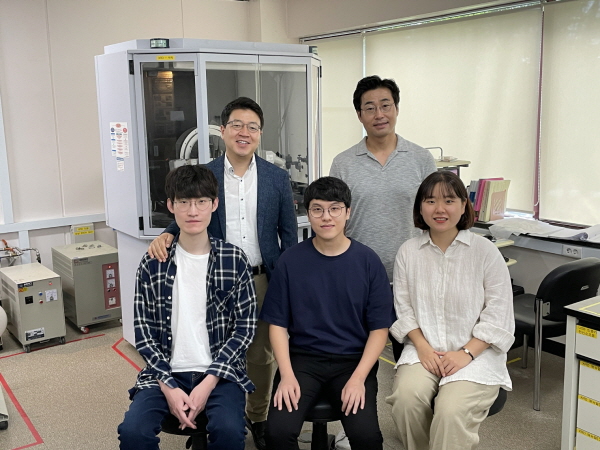
▲Professors Son Jun-woo and Choi Si-young (from left, back row) and the research team that led this study
Growth of vanadium oxide single crystals on titanium oxide
The research on next-generation semiconductor materials by a domestic university research team supported by the 'Samsung Future Technology Promotion Project' has been recognized and published in an international academic journal.
A research team led by Professors Son Jun-woo and Choi Si-young of the Department of Materials Science and Engineering at POSTECH has developed next-generation material technology to solve the thermal problem, which is becoming increasingly important as semiconductors become smaller.
The research team was selected as a Samsung Future Technology Promotion Project research project in July 2017 and received support for three years. This research was also supported by the Basic Research Laboratory of the National Research Foundation of Korea.
The research results were recognized as an achievement in developing a new material that can be used for high-density semiconductors, and were recently published (August 18, UK local time) in the international academic journal 'Nature Communications'.
Technological innovation in the semiconductor field has been progressing toward increasing the integration of transistor circuits through miniaturization.
As semiconductor integration increases, power consumption decreases and operating speeds increase, but the possibility of new problems, such as malfunctions due to heat generated during semiconductor device operation, increases.
The solution to this problem is to lower the operating voltage of the transistor, develop new materials to replace existing silicon, or bond silicon with new materials. Academia and industry have been making great efforts to solve this problem.
Among the representative new materials, phase transition oxide semiconductors, which rapidly change their phase from an insulator to a metal when a certain voltage is reached, are attracting attention.
The research team focused on the fact that single-crystal vanadium oxide (a compound made by combining metal vanadium and oxygen), a type of phase-transition oxide semiconductor, requires less voltage to flow current than conventional silicon and generates less heat, and developed a technology that can layer single-crystal vanadium oxide on a silicon wafer.
On the other hand, single-crystal vanadium oxide has a different crystal structure from silicon, so electrical defects may occur when it is directly layered and grown on a wafer.
Accordingly, the research team first layered titanium oxide with the same crystal structure on a silicon wafer, and then succeeded in growing vanadium oxide in a single crystal state on top of it.
The research team developed this material to use it in the production of actual semiconductor devices, and tested the resistance between the oxide semiconductor and the electrode. We are researching related technologies such as reduction and electrical characteristic control according to device size.
Professor Son Jun-woo said, “Through this research, we have been able to apply the excellent properties of single-crystal phase-transition oxides, which are attracting attention as next-generation materials, to existing silicon semiconductor materials,” and “We will strive to develop next-generation semiconductor devices that can overcome existing limitations, such as ultra-low-power, ultra-high-density memory.”
Meanwhile, the 'Samsung Future Technology Promotion Project' is a research support public interest project that Samsung Electronics has been implementing since 2013 with a contribution of 1.5 trillion won, with the goal of fostering and supporting science and technology that will be responsible for the future of our country.
Each year, we select projects to support in the fields of basic science, materials, and ICT in the first and second half of the year, and through the 'Designated Theme Project Competition' held once a year, we designate future technology fields that are of national importance and support the corresponding research.

Comments
Related news
Brain health maintenance mechanisms, artificial intelligence, etc. selected for Samsung Future Technology Development Project
Samsung Electronics has selected 40 research projects for the first half of 2017 under its Future Technology Development Program, which is supported by research funding from Samsung Electronics. A total of 18 projects are being supported in the basic science field through the Samsung Future Technology Foundation, and 22 projects are being operated in the materials technology and ICT fields through Samsung Electronics' Future Technology Development Center. The Samsung Future Technology Development Program, which commenced in 2013, is a program that supports the cultivation of national future technologies by contributing a total of 1.5 trillion won over 10 years across three research areas: basic science, materials technology, and ICT.
2017.04.07by 신윤오 기자

Samsung Electronics Selects Projects for Future Technology Development Support, Including Research on Treatments for Dementia and Intractable Cancer
Samsung Electronics has selected 31 projects to be supported through the Future Technology Development Project in the first half of 2018, funded by Samsung's research contributions. The 'Samsung Future Technology Development Project' began in 2013 and is a program that selects supported projects three times annually across three research fields—basic science, materials technology, and ICT—contributing a total of 1.5 trillion won over 10 years to support the development of national future technologies. The fields selected this time consist of 10 projects in basic science, 10 in materials technology, and 11 in ICT, with 50.1 billion won in research funding to be provided over the next five years.
2018.04.05by 김지혜 기자
.jpg)
Samsung Electronics Supports 46.4 Billion Won for 27 Future Technology Development Projects in the First Half
Samsung Electronics has selected 27 research projects in the fields of basic science, materials, and ICT for the first half of 2021 'Samsung Future Technology Development Project' and will provide a total of 46.4 billion won in support.
2021.04.05by 배종인 기자

Intel Unveils Next-Generation 'Core Ultra Series 3' and vPro Platform for Enterprise PCs
Intel has officially unveiled the "Intel Core Ultra Series 3" for next-generation enterprise PCs and the latest vPro platform, addressing a wide range of demands from enterprise notebooks to high-performance workstations.
2026.03.26by 배종인 기자

ROHM Launches ESD Protection Diode Compatible with High-Speed Interfaces of 10Gbps or Higher
Semiconductor specialist ROHM has developed the 'RESDxVx series' of ESD (electrostatic discharge) protection diodes capable of responding to next-generation high-speed data communication environments exceeding 10Gbps, simultaneously enhancing both signal quality maintenance required in high-speed interfaces and IC protection performance.
2026.03.26by 배종인 기자











