



Korea Electrotechnology Research Institute transfers battery cathode material technology worth 1.1 billion won.
 Published2021.08.30 09:39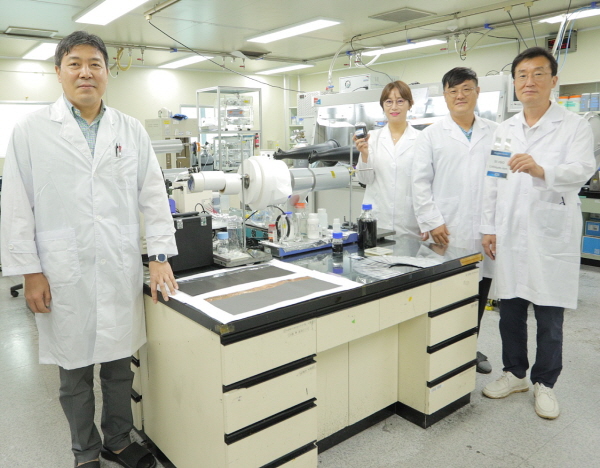
▲Korea Electrotechnology Research Institute's silicon-graphene composite cathode material development team (from left: Dr. Lee Geon-woong, Yang Seon-hye, Jeong Seung-yeol, and Dr. Kim Ik-jun)
The Korea Electrotechnology Research Institute (KERI), a government-funded research institute under the National Research Council of Science and Technology of the Ministry of Science and ICT, has achieved the feat of developing a technology for mass-producing battery cathode materials that complements the shortcomings of silicon with graphene, and transferring the technology for 1.1 billion won.
The Korea Electrotechnology Research Institute (KERI) announced on the 30th that it recently developed a 'mass manufacturing technology for silicon/graphene composite anode materials for high-capacity lithium-ion batteries' and transferred the technology to HNS Co., Ltd. (CEO Nam Dong-jin) for 1.1 billion won.
This technology, jointly developed by the Nano Convergence Research Center's Dr. Lee Geon-woong and Dr. Jeong Seung-yeol's team, and the Next-Generation Battery Research Center's Dr. Kim Ik-jun and Dr. Yang Seon-hye's team, both under the Electric Materials Research Division of KERI, is a groundbreaking composite anode material manufacturing technology that complements the shortcomings of silicon (Si), the anode material for lithium-ion batteries used in eco-friendly electric vehicles and smartphones, and is easily accessible to domestic small and medium-sized companies at a low price.
Silicon, which is attracting attention as the next-generation cathode material for lithium-ion batteries, has the advantage of having an energy density 10 times higher than that of the graphite used previously and a fast charge/discharge speed, but it has charging/discharging problems.;Discharge volume expansion (approximately three times) and low electrical conductivity are drawbacks. Furthermore, silicon particles can break, electrode delamination, and continuous electrolyte decomposition reactions can rapidly reduce battery performance, posing significant obstacles to commercialization. For these reasons, active research is being conducted both domestically and internationally to develop composite materials that complement silicon's strengths while mitigating its shortcomings.
The material KERI focused on was graphene. Graphene, a two-dimensional carbon nanomaterial, boasts exceptional conductivity and electrochemical stability, effectively protecting silicon from electrolytes. Furthermore, the graphene coating layer, with its mesh structure and excellent mechanical strength, can suppress performance degradation due to silicon volume expansion. Based on these principles, KERI developed a technology to manufacture ideal high-capacity cathode materials for lithium-ion batteries through the composite of silicon and graphene.
The research team, which has been dedicated to graphene research for over 10 years, has developed a technology to manufacture 'oxidized/reduced graphene (GO, rGO)' with high crystallinity and electrical conductivity based on KERI's specialized oxidation/reduction process, and has even developed a 'graphene aqueous dispersion technology' in the form of a high-concentration paste that can effectively disperse it and facilitate bonding with other substances.
Furthermore, we have secured mass production process technology that can be combined with the existing lithium secondary battery active material manufacturing process to lead to commercialization.
Through this, the amount of silicon (addition amount) used in existing lithium secondary battery negative electrodes was increased from the existing level of 5% or less to 20%, resulting in the stable production of high-capacity, high-quality negative electrodes.
Above all, the greatest strength of this technology is its outstanding price competitiveness, making it easily accessible even to small and medium-sized businesses. Compared to the existing expensive nano silicon, we utilized inexpensive micron-sized silicon and applied KERI's unique high-crystalline graphene dispersion technology, which is the result of extensive research know-how, to successfully develop a technology capable of mass-producing composite anode materials with a core-shell structure (a structure in which graphene surrounds the silicon core like a shell).
Afterwards, the research team manufactured a prototype, a 'pouch-type full cell' based on a silicon/graphene composite cathode material, completed electrochemical property tests, and completed domestic and international patent registration for the technology.
The achievement was recently transferred to HNS Co., Ltd., a company specializing in electrical and electronic materials and components, for 1.1 billion won in recognition of its high technological prowess.
The KERI research team reports that commercialization through this technology transfer will enable the production of silicon/graphene composite powder in quantities exceeding 10 tons (t) per month. Converted to energy density, this is equivalent to producing batteries for approximately 36,000 smartphones and 600 MWh of electric vehicles.
Dr. Lee Geon-woong, the project manager, said, “The silicon/graphene composite cathode material technology will be able to dramatically improve the performance of high-capacity lithium-ion batteries used in various fields such as eco-friendly electric vehicles, energy storage systems (ESS), the defense industry, and space and aviation.” He added, “In particular, when applied to electric vehicles, we expect that it will be possible to increase the driving range by about 20% or more by improving the performance of the battery.”
In the future, KERI plans to secure world-class research capabilities for high-quality silicon/graphene composite anode materials to secure technological superiority in the field of anode materials for lithium secondary batteries, and to secure production process and mass production technologies for developed materials to support commercialization and commercialization.
Meanwhile, according to market research firm SNE Research, global demand for anode active materials for lithium secondary batteries is projected to reach 1.36 million tons by 2025, growing at an average annual rate of 39%. Silicon anode materials are projected to account for 11% of the market, representing a rapid annual growth rate of over 70%. Furthermore, the global market for lithium secondary battery anode materials is expected to grow at an average annual rate of 30%, reaching USD 540 million by 2023.

Comments
Related news
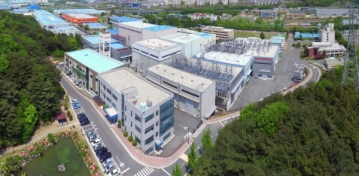
The Korea Electrotechnology Research Institute (KERI) is building an internationally accredited testing infrastructure for HVDC power equipment, worth 18.5 billion won.
The Korea Electrotechnology Research Institute (KERI, Acting Director Yoo Dong-wook), a government-funded research institution under the National Research Council of Science and Technology (NST) under the Ministry of Science and ICT, is establishing the nation's first large-scale infrastructure in the Changwon area of South Gyeongnam Province for testing and certification of power equipment in the field of Ultra-High Voltage Direct Current (HVDC) transmission, which is recognized as a next-generation power transmission technology, thereby contributing to strengthening the export competitiveness of domestic power equipment manufacturers through the provision of fast and highly reliable testing and certification services.
2021.07.27by 배종인 기자
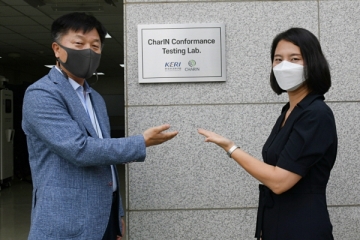
KERI Globally Recognized for Solving EV-Charger Compatibility Issues
The Korea Electrotechnology Research Institute (herein KERI, Acting Director Yoo Dong-wook), a government-funded research institute under the National Research Council of Science and Technology within the Ministry of Science and ICT, has been designated as the world's first electric vehicle global interoperability conformity assessment body. This is expected to resolve user inconveniences through compatibility error verification between electric vehicles and chargers.
2021.07.29by 배종인 기자
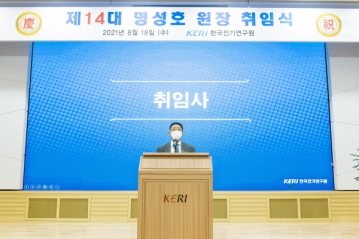
Myeong Seong-ho, New President of KEPRI, “Will Build an Organizational Culture to Prepare for the Future”
Myeong Seong-ho, newly appointed president of the Korea Electrotechnology Research Institute (hereinafter KERI), stated in his inauguration remarks that he will create an organizational culture to prepare for the future era, emphasizing bottom-up organizational innovation and the discovery of projects with tangible benefits for citizens and businesses.
2021.08.18by 배종인 기자
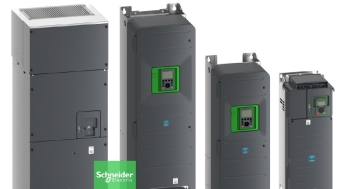
Schneider Aims for Building Energy Savings and Operational Stability with Next-Generation HVAC Drives
Schneider Electric has unveiled its next-generation HVAC drive product line 'Altivar HVAC'. The new product line's key features center on enhanced energy savings, system operational stability, and building management system integration. The products are divided into 'ATH200' for OEM and small equipment applications, and 'ATH600' for environments requiring continuous operation and advanced control. The company plans to expand the application scope from commercial buildings to facilities where HVAC system stability is critical, such as hospitals, airports, and data centers. The announcement includes over 30% energy savings, operation from -10°C to +60°C, Modbus and BACnet support, and compatibility with low global warming potential refrigerants.
2026.03.26by 명세환 기자
Ecolab Expands AI Data Center Cooling Business Through Acquisition of CoolIT
Ecolab has agreed to acquire CoolIT Systems, a liquid cooling company for AI data centers, for approximately $4.75 billion. The transaction is expected to close by Q3 2026, subject to regulatory approvals. CoolIT has been supplying direct-to-chip cooling-based coolant distribution units, cold plates, and manifolds, serving hyperscale data centers and colocation operators as customers. This acquisition is a measure to address the high-heat and high-density server environments created by AI proliferation. Ecolab plans to combine its water management and digital monitoring capabilities with CoolIT's hardware technology to expand its data center cooling business.
2026.03.26by 명세환 기자











