



DNP Develops Reflector Array to Expand 5G Communication Transmission and Reception Areas
 Published2021.09.01 08:40
5G shadowing with more flexible radio wave reflection angle settings
Area coverage is possible and installation space is easy to secure.
On the 31st, DNP announced the development of a Reflect Array, which flexibly reflects millimeter waves used in 5G communication systems, expanding their coverage area. Compared to standard metal reflectors, this array reflects millimeter waves in a more targeted manner, reducing installation restrictions. This improves communication in areas where radio waves are difficult to reach, such as areas obscured by buildings.
[Image = DNP]
High-speed, high-capacity 5G communications radio waves above 24 GHz feature millimeter-wave bands and higher data capacity than 4G radio waves. Furthermore, their directivity and short range make them difficult to maintain communication quality in areas such as buildings, where signals are blocked. To address this, new base stations and repeaters are being installed, but this increases the burden and occupies limited space.
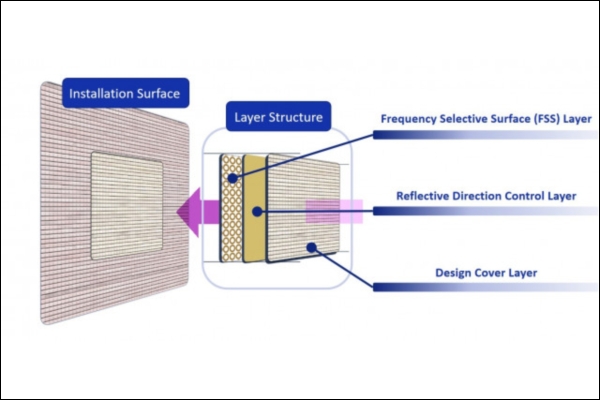
DNP developed a reflective array that separates the Frequency Selection Reflection Layer, which selectively reflects certain frequency bands while allowing other radio waves to pass through, and the Reflective Direction Control Layer, a special inductive layer that determines the inflow and reflection paths of radio waves, and allows for easy management of the characteristics of each layer. It costs less than installing a base station or repeater, and does not require a power source, so it can be installed in various areas.
Unlike metal reflectors that directly reflect radio waves like a mirror, this reflective array asymmetrically reflects radio waves of a specific frequency range. It can flexibly set the frequency range to be reflected, the angle of incidence of radio waves received from the base station, the angle of reflection to transmit radio waves, and the propagation of the reflected waves, so it can effectively transmit radio waves to areas where radio waves were difficult to reach.
DNP's reflective array consists of a triple-layer structure: a frequency selective surface layer (FSR), which selectively reflects a set frequency range while allowing other waves to pass through; a reflective direction control layer (DCR), which determines the inflow and reflection paths of waves; and a design cover layer. Various patterns can be printed on the surface of the design cover layer, allowing for the addition of external designs.
A growing number of companies and organizations are adopting 5G to implement smart cities and smart factories utilizing robots and the Internet of Things (IoT). DNP anticipates that Reflect Arrays will continue to be installed in the following scenarios and locations where radio conditions are expected to deteriorate due to obstacles, and is exploring ways to integrate them with various 5G initiatives.
DNP Reflect Array was selected as a Japanese national project for fiscal year 2021, and its functions will be verified in collaboration with various telecommunications companies, with commercialization planned for fiscal year 2023.
Comments
Related news
Daehyun Cable's First Step as a Hoban Family Member, Expanding Optical Cable Business
Optical cables are experiencing a surge in global demand due to increasing ultra-high-speed, high-capacity internet, expansion of 5G infrastructure, and acceleration of the Fourth Industrial Revolution based on IoT and AI. Daehyun Cable announced that it will establish optical cable production facilities in Dangjin, Chungcheongnam-do and Kuwait, and will begin full-scale operations.
2021.08.05by 이수민 기자
LG Electronics Successfully Transmits "6G THz" Communication Signal Over 100m
6G mobile communications, expected to be commercialized in 2029, will enable faster wireless transmission speeds, lower latency, and highly reliable communication compared to 5G. It is regarded as a means to enable the Artificial Intelligence of Everything (AIoE), where people, objects, and spaces are closely and organically connected, and global companies are rushing into R&D. LG Electronics announced that it successfully transmitted communication signals over 100 meters or more in the 6G THz band in outdoor conditions in collaboration with Germany's Fraunhofer Institute.
2021.08.19by 이수민 기자

Samsung Electronics Secures Two Additional 3GPP Chairperson Seats
Samsung Electronics secures two additional 3GPP leadership positions, taking the lead in telecommunications standards to expand the 5G ecosystem.
2021.08.30by 배종인 기자
European Patent Applications Surpass 200,000 for the First Time… South Korea Maintains 5th Place, Led by Batteries and Telecommunications
According to the European Patent Office (EPO)'s 'Technology Dashboard 2025', European patent applications last year reached 201,974, surpassing 200,000 for the first time. Korean companies and inventors filed 14,355 applications, representing a 9.5% increase from the previous year and maintaining 5th place by country. Battery, digital communication, and semiconductor technologies led the growth, with Samsung ranking as the top EPO applicant for the second consecutive year and LG reaching 3rd place. The presence of major domestic cities such as Seoul, Suwon, and Yongin was also confirmed. It was also revealed that Korea's European patent strategy is expanding beyond individual technologies to span the entire industry.
2026.03.24by 명세환 기자

SK Telecom First Applies AI-Based Network Operations at Gwanghwamun K-Pop Concert
SK Telecom announced that it applied an AI-based network operation system for the first time at a large-scale K-pop concert held in the Gwanghwamun area of Seoul on March 21st, managing communication quality throughout the event. Mobile data usage during the three hours before and after the concert reached 12.15TB, approximately doubling compared to the same time slot the previous weekend. SK Telecom monitored traffic using the AI system 'A-One' in five-minute and 50-meter units to respond to potential overload situations, while also operating temporary communication facilities and on-site personnel in parallel. This case is interpreted as confirmation of the practical applicability of AI-based autonomous network operation in an environment where demand from dense events and foreign users increases simultaneously.
2026.03.23by 명세환 기자











