


KIMS, Hyundai Heavy Industries, and Pusan National University Join Hands for Carbon Neutrality
 Published2021.09.07 10:03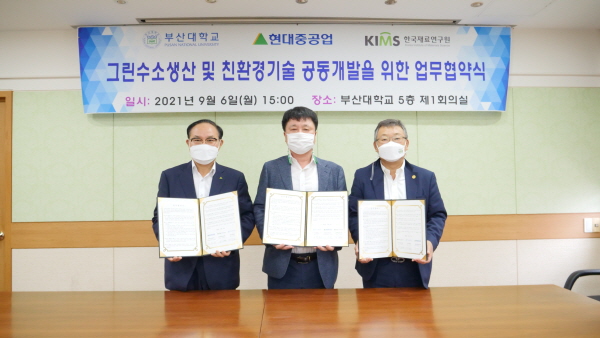
▲ (From left) Ahn Kwang-heon, Business Representative of Hyundai Heavy Industries, Park Hong-won, Vice President for Education at Pusan National University, and Lee Jeong-hwan, President of the Korea Institute of Materials Science, are posing for a commemorative photo after signing an MOU.
The Korea Institute of Materials Science (KIMS, President Lee Jeong-hwan), a government-funded research institute under the Ministry of Science and ICT, is embarking on the realization of a carbon-neutral era centered on green hydrogen together with Hyundai Heavy Industries Engine & Machinery Division (Business Representative Ahn Kwang-heon) and Pusan National University (President Cha Jeong-in).
Three institutions, including the Korea Institute of Materials Science, held a signing ceremony for a business agreement at the main building of Pusan National University on September 6 and pledged to jointly develop green hydrogen production systems and eco-friendly technologies.
Water electrolysis systems currently available in the hydrogen fuel market utilize fresh water.
The Korea Institute of Materials Science has pioneered the low-cost production of high-purity hydrogen from seawater by developing non-precious metal-based anion exchange membrane seawater electrolysis technology. The joint research team aims to develop the world's first hydrogen production system using seawater in the future.
In addition, there is a continuously increasing global demand for cryogenic eco-friendly fuels such as LNG and hydrogen. The research team will also pursue the localization of expensive overseas cryogenic equipment.
This MOU aims to jointly develop core technologies for green hydrogen production, marine engines, eco-friendly energy, and performance enhancement by combining source technologies from universities, commercialization technologies from national research institutes, and business development technologies from industries. Moving forward, the three institutions plan to establish a virtuous cycle structure in which, alongside the development of source technologies, trained research personnel are produced at universities and research institutes and subsequently recruited by the industry.
Specifically, the Korea Institute of Materials Science will be responsible for the technology and demonstration for commercialization and scaling up based on the developed electrode catalyst, Hyundai Heavy Industries will lead the demonstration and commercialization of a MW-class green hydrogen production system utilizing surplus electricity, and Pusan National University, which possesses electrode catalyst technology—a core technology for water electrolysis systems—will develop source technology for high-efficiency, low-cost catalysts that surpass European water electrolysis systems based on this.
Lee Jung-hwan, President of the Korea Institute of Materials Science, stated, “To usher in a carbon-neutral era quickly and efficiently, a high level of cohesion is required for industry, academia, and research institutes to pool their respective strengths and unite,” adding, “I pledge that the three institutions will do their utmost to cooperate on research to ensure the stable establishment of the green hydrogen production system.”

Comments
Related news
Materials Research Institute and Gyeongnam Provincial Police Agency Integrating Science and Technology into Security Fields
The Korea Institute of Materials Science (KIMS, Director Lee Jeong-hwan), a government-funded research institute under the Ministry of Science and ICT, and the Gyeongnam Provincial Police Agency (Commissioner Lee Mun-su) have joined hands to enhance investigative capabilities by integrating science and technology into law enforcement operations.
2021.06.30by 배종인 기자
Materials Research Institute Expands Investment in Future Mobility Technology
The Korea Institute of Materials Science (KIMS, Director Lee Jung-hwan), a government-funded research institute under the Ministry of Science and ICT, has announced the recruitment and selection of demand companies in the 'future mobility new industry sector' and committed to investment support for resolving core technical challenges and commercialization.
2021.07.07by 배종인 기자
Materials Research Institute Uses AI to Identify Ultra-Fine Defects
The research team led by Dr. Kang Sung-hun at the Materials Artificial Intelligence and Big Data Research Center of the Korea Institute of Materials Science (KIMS, Director Lee Jung-hwan), a government-funded research institute under the Ministry of Science and ICT, has developed a technology that can accurately detect ultra-fine defects on product surfaces that are difficult for humans to distinguish using artificial intelligence (AI) technology.
2021.07.19by 배종인 기자
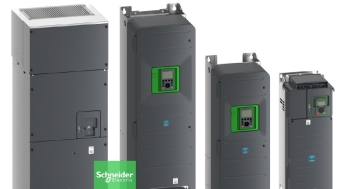
Schneider Aims for Building Energy Savings and Operational Stability with Next-Generation HVAC Drives
Schneider Electric has unveiled its next-generation HVAC drive product line 'Altivar HVAC'. The new product line's key features center on enhanced energy savings, system operational stability, and building management system integration. The products are divided into 'ATH200' for OEM and small equipment applications, and 'ATH600' for environments requiring continuous operation and advanced control. The company plans to expand the application scope from commercial buildings to facilities where HVAC system stability is critical, such as hospitals, airports, and data centers. The announcement includes over 30% energy savings, operation from -10°C to +60°C, Modbus and BACnet support, and compatibility with low global warming potential refrigerants.
2026.03.26by 명세환 기자
Ecolab Expands AI Data Center Cooling Business Through Acquisition of CoolIT
Ecolab has agreed to acquire CoolIT Systems, a liquid cooling company for AI data centers, for approximately $4.75 billion. The transaction is expected to close by Q3 2026, subject to regulatory approvals. CoolIT has been supplying direct-to-chip cooling-based coolant distribution units, cold plates, and manifolds, serving hyperscale data centers and colocation operators as customers. This acquisition is a measure to address the high-heat and high-density server environments created by AI proliferation. Ecolab plans to combine its water management and digital monitoring capabilities with CoolIT's hardware technology to expand its data center cooling business.
2026.03.26by 명세환 기자











