



KERI develops high-efficiency lithium storage technology for lithium metal batteries
 Published2021.09.09 08:22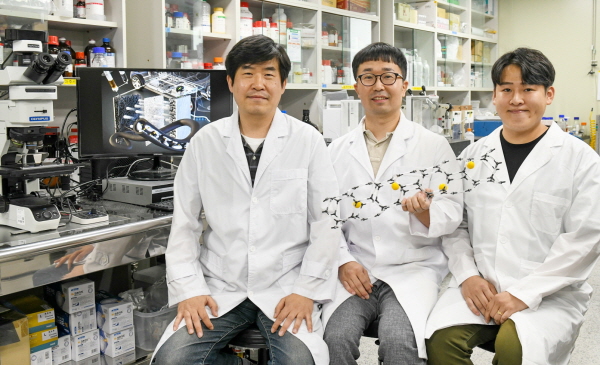
▲Lithium metal battery lithium storage technology research team at Korea Electrotechnology Research Institute (from left: Dr. Lee Sang-min, Dr. Kim Byung-gon, Researcher Kang Dong-woo)
Dr. Kim Byung-gon (Senior Researcher) of the Next-Generation Battery Research Center at the Korea Electrotechnology Research Institute (KERI, President Myung Sung-ho) has successfully improved safety and performance by effectively storing lithium metal for anode applications.
KERI announced on the 9th that Dr. Kim Byung-gon's research team has developed high-efficiency lithium storage technology for lithium metal batteries, and related papers have been published in a renowned international academic journal.
The conventional lithium-ion battery familiar to us has a structure where lithium ions are inserted and extracted from an anode made of graphite to generate energy, and has been widely used as a power source for electronic devices such as smartphones and laptops. However, the weight and volume of graphite itself have imposed significant limitations on securing high energy storage capacity.
The lithium metal battery that replaces this uses lithium metal itself as the anode. Compared to the conventional graphite anode (372mAh/g), the lithium metal anode theoretically has a storage capacity more than 10 times higher (3,860mAh/g), and is attracting significant interest in fields requiring large-capacity batteries such as electric vehicles.
On the other hand, lithium metal also has a critical problem in that with repeated charging and discharging, tree-shaped dendrite crystals form, increasing volume and leading to reduced battery lifespan and risks such as fire and explosion. Many researchers have made efforts to prevent dendrite formation by storing lithium in specially structured materials, but efficiency was poor, and there were also difficulties from a mass production perspective.
To solve these problems, Dr. Kim Byung-gon of KERI fabricated carbon nanofibers with a core-shell structure containing a small amount (1% by weight) of gold nanoparticles, which are lithium-philic materials. By selectively storing lithium within the core, he employed a method to improve lithium electro-deposition and dissolution efficiency.
Gold nanoparticles, due to their lithium-philic characteristics, facilitate the insertion and extraction of lithium within the structure and also suppress the growth of dendrite crystals on the exterior of the structure.
In particular, rather than resulting in small-scale production through difficult synthesis processes, mass production is possible through electrospinning synthesis, greatly enhancing practical applicability.
This research result received recognition for its high technical level, and the paper was published in Chemical Engineering Journal, an international academic journal ranking in the top 2.8% of Journal Citation Reports (JCR).
The technology is expected to be applicable in the future to fields requiring high-capacity batteries such as electric vehicles, drones, and energy storage systems (ESS). Since recently released electronic devices require significantly higher energy and power than current systems, this technology is expected to dramatically extend the usage time of these devices and reduce their weight.
Dr. Kim Byung-gon of KERI stated, "The significance is tremendous in that we have developed a technique for mass production of high-efficiency lithium storage materials, which are the key to commercializing lithium metal batteries, a leading next-generation secondary battery," and added, "Through continuous research, we will develop lithium storage materials with improved performance compared to our current prototypes."
This research was conducted as part of the Korea Research Foundation's Climate Change Response Technology Development Project (Project Manager Lee Sang-min) and KERI's basic project (Project Manager Kim Byung-gon).
Meanwhile, KERI is an electricity-specialized government-funded research institute under the National Research Council of Science and Technology, Ministry of Science and ICT.

Comments
Related news
KERI Globally Recognized for Solving EV-Charger Compatibility Issues
The Korea Electrotechnology Research Institute (herein KERI, Acting Director Yoo Dong-wook), a government-funded research institute under the National Research Council of Science and Technology within the Ministry of Science and ICT, has been designated as the world's first electric vehicle global interoperability conformity assessment body. This is expected to resolve user inconveniences through compatibility error verification between electric vehicles and chargers.
2021.07.29by 배종인 기자
Myeong Seong-ho, New President of KEPRI, “Will Build an Organizational Culture to Prepare for the Future”
Myeong Seong-ho, newly appointed president of the Korea Electrotechnology Research Institute (hereinafter KERI), stated in his inauguration remarks that he will create an organizational culture to prepare for the future era, emphasizing bottom-up organizational innovation and the discovery of projects with tangible benefits for citizens and businesses.
2021.08.18by 배종인 기자
Korea Electrotechnology Research Institute transfers battery cathode material technology worth 1.1 billion won.
The Korea Electrotechnology Research Institute (KERI), a government-funded research institute under the National Research Council of Science and Technology within the Ministry of Science and ICT, has achieved a major milestone by developing mass production technology for a battery anode material that compensates for silicon's limitations with graphene, and successfully transferring the technology for 1.1 billion won.
2021.08.30by 배종인 기자
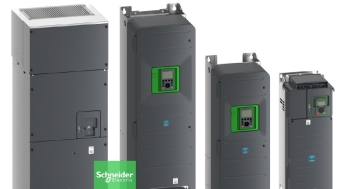
Schneider Aims for Building Energy Savings and Operational Stability with Next-Generation HVAC Drives
Schneider Electric has unveiled its next-generation HVAC drive product line 'Altivar HVAC'. The new product line's key features center on enhanced energy savings, system operational stability, and building management system integration. The products are divided into 'ATH200' for OEM and small equipment applications, and 'ATH600' for environments requiring continuous operation and advanced control. The company plans to expand the application scope from commercial buildings to facilities where HVAC system stability is critical, such as hospitals, airports, and data centers. The announcement includes over 30% energy savings, operation from -10°C to +60°C, Modbus and BACnet support, and compatibility with low global warming potential refrigerants.
2026.03.26by 명세환 기자
Ecolab Expands AI Data Center Cooling Business Through Acquisition of CoolIT
Ecolab has agreed to acquire CoolIT Systems, a liquid cooling company for AI data centers, for approximately $4.75 billion. The transaction is expected to close by Q3 2026, subject to regulatory approvals. CoolIT has been supplying direct-to-chip cooling-based coolant distribution units, cold plates, and manifolds, serving hyperscale data centers and colocation operators as customers. This acquisition is a measure to address the high-heat and high-density server environments created by AI proliferation. Ecolab plans to combine its water management and digital monitoring capabilities with CoolIT's hardware technology to expand its data center cooling business.
2026.03.26by 명세환 기자











