


Ministry of Trade, Industry and Energy: "To Establish 403 Types of Materials, Parts, and Equipment Testbeds by Next Year"
 Published2021.09.14 09:20
Sharing Case Studies on Localization, Investment Expansion, and Entry into Global Supply Chains
Establishment of roadmap for five major materials, parts, and equipment testbeds this year
On the 13th, Joo Young-joon, Head of the Industrial Policy Office at the Ministry of Trade, Industry and Energy, visited the site of the Korea Automotive Research Institute’s ‘100 Key Strategic Items Testbed for Materials, Parts, and Equipment’ (hereinafter referred to as the ‘Sobujang Testbed’) to inspect the construction status and presided over a meeting with major public research institutions participating in the construction.
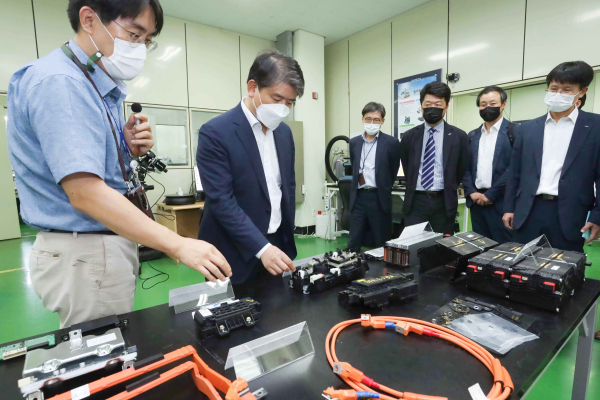
The meeting was held to discuss ways to strengthen support for materials, parts, and equipment companies by public research institutes and to share the achievements of corporate support utilizing the materials, parts, and equipment testbeds of five major public research institutes, including the Korea Automotive Research Institute. A materials, parts, and equipment testbed is an essential infrastructure for demonstrating and evaluating reliability and mass producibility during the commercialization process of a company's developed products.
In July 2019, immediately after Japan's export restrictions, the Ministry of Trade, Industry and Energy identified 566 types of equipment necessary for the demonstration and evaluation of 100 key strategic items in materials, parts, and equipment, and is promoting the establishment of testbeds at 15 public research institutions that possess corporate support capabilities and equipment operation know-how.
The 15 public research institutes include: ▲Metal sector - Korea Institute of Materials Science, Pohang Institute of Industrial Science and Technology ▲Chemical sector - Korea Research Institute of Chemical Technology, Chemical Convergence Testing & Research Institute, Korea Construction & Living Environment Testing Institute ▲Textile sector - FITI Testing & Research Institute, DYETEC ▲Ceramics & Electronics sector - Korea Electronics & Technological Institute, Korea Industrial Technology Testing Institute, Korea Ceramic Technology Institute, Korea Testing Laboratory for Machinery & Electrical & Electronic Equipment ▲Machinery sector - Korea Institute of Machinery & Materials, Korea Automotive Research Institute, Korea Construction Machinery Parts Research Institute, etc.
The Ministry of Trade, Industry and Energy has decided to establish a total of 403 testbeds for materials, parts, and equipment from July of this year to March of next year, which is 71.2% of the final target. Joo Young-jun, Head of the Industrial Policy Office, stated, “We will announce a testbed roadmap for specialized complexes in the five major future growth sectors within the year,” adding, “We will strengthen the linkage between future growth engines and key policies for materials, parts, and equipment.”
The five major specialized complexes for materials, parts, and equipment are semiconductors (Yongin, Gyeonggi-do), secondary batteries (Cheongju, Chungbuk), displays (Cheonan and Asan, Chungnam), carbon materials (Jeonju, Jeonbuk), and precision machinery (Changwon, Gyeongnam).
Director Joo stated, “We will complete the establishment of a testbed for 100 key items and support the entire technology development process, from R&D to the deployment of actual production facilities, for public research institutes and materials, parts, and equipment companies.”
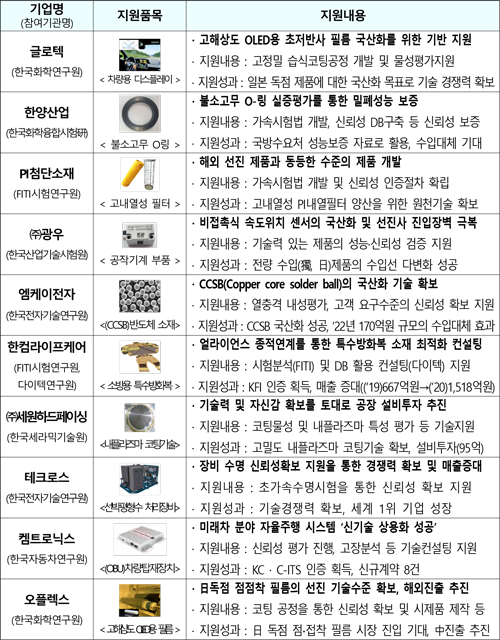
During the subsequent meeting, major success stories utilizing the materials, parts, and equipment testbed were presented.
Glotech faced difficulties in securing localization technology for premium ultra-low reflection films, which are monopolized by foreign companies. However, with support utilizing the Korea Research Institute of Chemical Technology's pilot wet coating equipment, the company succeeded in product development and is currently considering investing in mass production facilities.
MK Electronics has succeeded in the first mass production of copper solder balls (CCSB) in Korea by utilizing thermal resistance measurement equipment from the Korea Electronics Technology Institute, and has succeeded in localizing semiconductor materials that were previously entirely imported, and is pursuing a facility investment of 2 billion won.
Techross, a ballast water treatment equipment company, has become the world's number one company in the field thanks to continuous reliability improvement support from the Korea Electronics Technology Institute, such as ultra-accelerated life testing and design support.
Meanwhile, at the meeting held on this day, through the strengthening of the 'Materials, Parts, and Equipment Convergence Alliance,' [the following were discussed]: ➊ strengthening testbeds by expanding testbeds by institution and fostering mutual cooperation; ➋ enhancing service linkages between institutions, such as the joint establishment of testbeds; ➌ opening up information, such as sharing intellectual property rights and establishing an information-based accumulation system; ➍ promoting commercialization, such as revitalizing corporate technology commercialization; and ➎ joint online and offline promotion, including major academic conferences and exhibitions. Various policies were proposed, including discussions to proceed with them.
Comments
Related news
"How Were the Results of the Materials, Parts, and Equipment R&D Support Policy on Its 2nd Anniversary?"
On the occasion of the second anniversary of the full-scale implementation of the parts, materials, and equipment (SME) policy, the Ministry of Science and ICT held a performance report meeting to share policy support achievements to date and discuss future support directions. Currently, the Ministry of Science and ICT is directing the inter-ministerial SME R&D policy and promoting major product R&D support. Accordingly, it is supporting the National Core Materials Research Group to achieve technological independence in 100+85 key R&D product technologies. Additionally, it is expanding support for Future Technology Research Institutes to secure next-generation SME leading products and respond to emerging materials issues, with the goal of capturing the market in five to ten years.
2021.07.13by 이수민 기자
.jpg)
Materials Research Institute takes a step toward domestic production of ultra-small beads, a raw material for MLCCs.
A high-hardness, high-density ceramic microparticle manufacturing technology capable of producing ultra-fine beads used in multilayer ceramic capacitors (MLCC) and secondary battery components has been developed, raising expectations that it will reduce import dependency and enhance competitiveness in materials, parts, and equipment.
2021.07.26by 배종인 기자
Korea Mechanical Engineering and Materials Institute strengthens the credibility of small business owners through online and offline infrastructure.
The Korea Institute of Machinery and Materials (KIMM, Director Park Sang-jin) under the Ministry of Science and ICT is establishing online and offline infrastructure to strengthen the reliability of Korea's materials, components, and equipment industries, and is moving forward with initiatives to achieve synergies.
2021.07.29by 배종인 기자
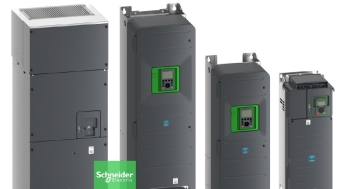
Schneider Aims for Building Energy Savings and Operational Stability with Next-Generation HVAC Drives
Schneider Electric has unveiled its next-generation HVAC drive product line 'Altivar HVAC'. The new product line's key features center on enhanced energy savings, system operational stability, and building management system integration. The products are divided into 'ATH200' for OEM and small equipment applications, and 'ATH600' for environments requiring continuous operation and advanced control. The company plans to expand the application scope from commercial buildings to facilities where HVAC system stability is critical, such as hospitals, airports, and data centers. The announcement includes over 30% energy savings, operation from -10°C to +60°C, Modbus and BACnet support, and compatibility with low global warming potential refrigerants.
2026.03.26by 명세환 기자
Ecolab Expands AI Data Center Cooling Business Through Acquisition of CoolIT
Ecolab has agreed to acquire CoolIT Systems, a liquid cooling company for AI data centers, for approximately $4.75 billion. The transaction is expected to close by Q3 2026, subject to regulatory approvals. CoolIT has been supplying direct-to-chip cooling-based coolant distribution units, cold plates, and manifolds, serving hyperscale data centers and colocation operators as customers. This acquisition is a measure to address the high-heat and high-density server environments created by AI proliferation. Ecolab plans to combine its water management and digital monitoring capabilities with CoolIT's hardware technology to expand its data center cooling business.
2026.03.26by 명세환 기자











