



ETRI Usheres in a New Era of Data-Centric Networks
 Published2021.09.23 11:33
.jpg)
▲ETRI researchers are checking the status of data-centric networking demonstration cables in the Korea Research and Development Network (KOREN).
Verification of the feasibility of commercializing a nationwide test bed
A domestic research team has successfully developed new infrastructure technology to address the exploding data volume and changing Internet usage environment.
The Electronics and Telecommunications Research Institute (ETRI) announced that it has developed a data-centric networking (DCN)-based technology that enables the Internet to go beyond simple connections and provide optimal information processing while also enhancing security and search convenience.
The core of the new Internet technology developed by ETRI is to 'name and embed security (signature)' in data and to integrate networking and computing.
As new Internet technologies are applied, real-time data obtained from CCTV, black boxes, and Internet of Things (IoT) terminals will be given names.
Thanks to this, you can easily search for data and safely and automatically receive information as it is called in the application stage.
For example, fire departments can easily develop a notification service that receives data consisting of sensor location, sensor name, and occurrence time from sensors installed throughout the city and obtains relevant information in real time, enabling efficient response to fires.
Previously, cloud dataSensor data had to be collected and analyzed from a platform located at the center.
By applying ETRI technology, related information such as fire location and time can be automatically transmitted from the data name, eliminating the need for additional analysis processing.
By embedding security in data, it is now possible to detect any manipulation or errors that may occur during data transmission.
Thanks to this, malfunctions can be prevented in advance and hacking by unauthorized users can be prevented.
The research team simplified the network structure by integrating data transmission and computing.
This method optimally processes services based on requirements, such as allocating computing resources close to the sensor and fire station for urgent fire analysis and high-performance cloud computing resources remotely for processing for AI learning.
This is expected to increase data utilization and develop services more efficiently.
The research team applied the developed technology to the Korea Research and Development Network (KOREN) to demonstrate stable operation and prove its commercial viability.
In addition, the company revealed that it possesses the world's best data-centric network SW technology by recording forwarding performance, a router performance verification metric, at 300 Gbps on a general-purpose server.
The current Internet architecture, developed in 1975, is designed solely for data transfer, with host-to-host connections based on IP addresses.
This limits the mobility of mobile environments, the accuracy of content sources, and the integrity of data to ensure it matches the original.
In particular, recently, large-scale content consumption such as virtual and augmented reality (VR/AR), metaverse, transportation systems, remote control, etc., and services that cannot have errors or malfunctions, as well as basic data, are important.As artificial intelligence services proliferate, network innovation is needed to utilize data more efficiently.
ETRI is also actively pursuing service verification of new technologies.
Currently, we are conducting a verification of data distribution infrastructure for real-time environmental monitoring in Busan with Busan Metropolitan City and the Korea Institute of Science and Technology Information (KISTI), and we have confirmed that it can be applied to the V2X infrastructure of ETRI's autonomous driving shuttle AutoVe to improve the safety and efficiency of autonomous driving.
Kim Seon-mi, Director of ETRI's Network Research Division, said, "We have secured essential technologies for future digital infrastructure and verified their practical application, laying the foundation for a leap forward into a new internet era. We plan to further refine this technology by applying it to a variety of future-oriented environments."
This study was conducted as part of the Ministry of Science and ICT's 'Hyper-connected intelligent infrastructure source technology research' project.
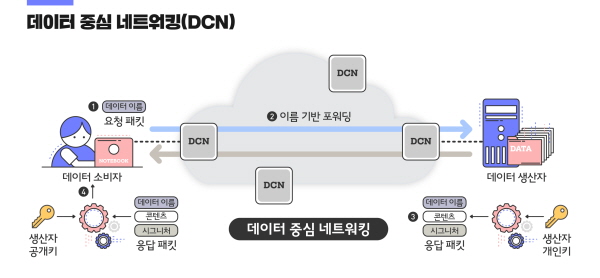
▲Data-Centric Networking (DCN) technology concept diagram

Comments
Related news
ETRI Unveils 121 New Technologies to Promote Commercialization by SMEs
Domestic research teams are proactively disclosing technologies under development in advance to accelerate technology commercialization for small and medium-sized enterprises. By providing early access to the latest information and communication technology (ICT), it is expected that the industrial competitiveness of small and medium-sized enterprises will be further strengthened.
2021.08.18by 배종인 기자
ETRI Successfully Helps People with Disabilities from Vocational Training to Employment Using ICT Technology
Domestic researchers have developed warm information and communication technology (ICT) to support vocational training for people with disabilities, achieving results that lead to actual employment.
2021.08.24by 배종인 기자
ETRI surpasses 141 technology startups, with three companies listed on KOSDAQ.
Domestic government-funded research institutions are attracting attention by achieving high commercialization results, including spinning out numerous startups based on information and communications technology (ICT) and listing on KOSDAQ.
2021.09.17by 배종인 기자
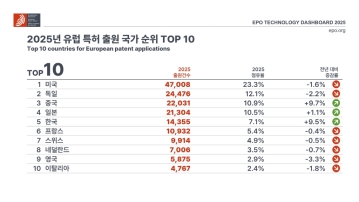
European Patent Applications Surpass 200,000 for the First Time… South Korea Maintains 5th Place, Led by Batteries and Telecommunications
According to the European Patent Office (EPO)'s 'Technology Dashboard 2025', European patent applications last year reached 201,974, surpassing 200,000 for the first time. Korean companies and inventors filed 14,355 applications, representing a 9.5% increase from the previous year and maintaining 5th place by country. Battery, digital communication, and semiconductor technologies led the growth, with Samsung ranking as the top EPO applicant for the second consecutive year and LG reaching 3rd place. The presence of major domestic cities such as Seoul, Suwon, and Yongin was also confirmed. It was also revealed that Korea's European patent strategy is expanding beyond individual technologies to span the entire industry.
2026.03.24by 명세환 기자
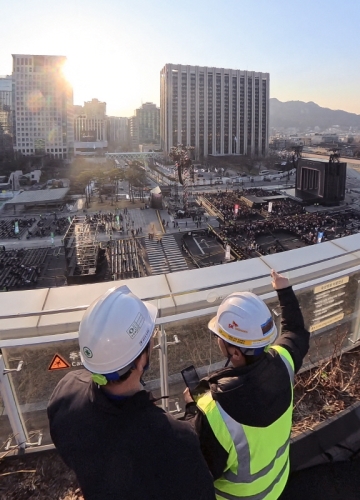
SK Telecom First Applies AI-Based Network Operations at Gwanghwamun K-Pop Concert
SK Telecom announced that it applied an AI-based network operation system for the first time at a large-scale K-pop concert held in the Gwanghwamun area of Seoul on March 21st, managing communication quality throughout the event. Mobile data usage during the three hours before and after the concert reached 12.15TB, approximately doubling compared to the same time slot the previous weekend. SK Telecom monitored traffic using the AI system 'A-One' in five-minute and 50-meter units to respond to potential overload situations, while also operating temporary communication facilities and on-site personnel in parallel. This case is interpreted as confirmation of the practical applicability of AI-based autonomous network operation in an environment where demand from dense events and foreign users increases simultaneously.
2026.03.23by 명세환 기자











