



Toshiba Unveils Technology to Cut Automotive Semiconductor Verification Time by 90%
 Published2021.09.24 10:50
Toshiba Reduces Automotive Semiconductor Verification Time by 90%
Accu-ROM Unveils MBD Simulation Technology
As electric vehicles grow in popularity and advanced driver assistance systems (ADAS) become standard, electronic components are becoming increasingly advanced and complex. Model-based development (MBD), a development methodology that uses software to simulate models and evaluate performance in real time, is enabling product developers to improve complex design processes. In the automotive industry, MBD accelerates development by simultaneously conducting design and verification before building prototypes.
MBD separates functions into multiple blocks and connects them to verify the overall vehicle operation. To verify thermal and electromagnetic interference (EMI), essential parameters for evaluating electrical components, detailed simulation models that include the semiconductor operation of individual blocks are required. However, as models become more detailed and precise, verification times increase.
Toshiba announced on the 23rd that it has developed MBD simulation technology that reduces automotive semiconductor verification time by approximately 90%. This 'Accu-ROM™' technology enables electronics developers to quickly evaluate designs using Toshiba's automotive semiconductors.
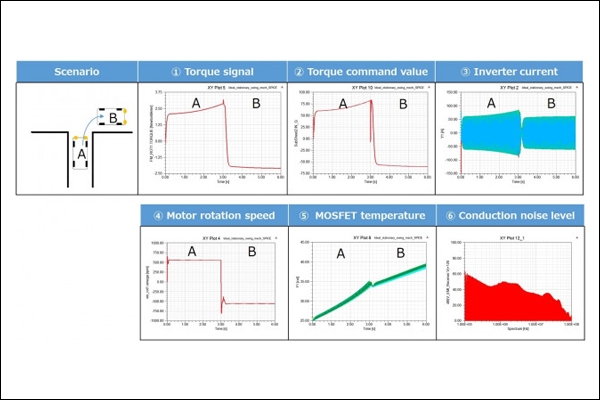
90% reduction [Image = Toshiba]
Subsystems like power steering consist of semiconductor-based electronic circuits that operate in microseconds, along with mechanical components, gears, and shafts that operate in milliseconds. Toshiba's current technology simultaneously simulates electronic circuits and mechanical components in microseconds, but this results in unnecessary and time-consuming calculations on the mechanical components.
It is also not simple because it adopts an electronic circuit simulation (SPICE) model that defines more than 100 parameters in semiconductor operation simulation.
Toshiba's new modeling technology, Accu-ROM, separates the electronic circuit and mechanical components for calculation. First, the mechanical components are verified, then the mechanical component model is simplified, and finally, the entire system, including the electrical circuit, is verified. This approach eliminates unnecessary calculations and automatically generates a VHDL-AMS model from the SPICE model when evaluating the electrical circuit.
The VHDL-AMS model reduces verification time by limiting the verification scope to essential parameters such as heat and EMI. With Toshiba's current technology, it takes 32 hours and 51 minutes to verify a power steering system, but with the new technology, that time is reduced to 3 hours and 27 minutes.
Accu-ROM technology accelerates the development of high-heat dissipation and low-noise automotive semiconductors, providing customers with a development environment that makes Toshiba products easier to use. Beyond automotive applications, it can also be applied to semiconductors for other industrial and consumer electronics applications.
Comments
Related news
Toshiba mass-produces 22 types of MCUs for BLDC motor and inverter control
Toshiba Electronic Devices & Storage Corporation has begun production of 12 types of M4K group motor control MCUs as the first product in the TXZ+ series Advanced Class. In August, Toshiba plans to begin additional production of 10 products in the M4M group. Both the M4K and M4M groups are manufactured using a 40nm process and belong to the TXZ4A+ series.
2021.07.30by 강정규 기자
"EMC, Cost Reduction is Possible if It is Caught from the Early Design Stage"
Electromagnetic noise must be sufficiently reviewed and evaluated from the early stages of product development to establish effective noise countermeasures with adequate margin. To accomplish this, it is necessary to understand the types and characteristics of noise and to effectively apply appropriate countermeasures tailored to each noise source and device. We consulted with Oh-Yong Song, Senior Researcher at Rohm Korea, on how engineers should approach EMI, EMC, and EMS issues related to electromagnetic noise.
2021.08.20by 이수민 기자
Infineon launches 22kW industrial motor drive reference design
Infineon Technologies has launched a pre-tested industrial reference design that significantly reduces time-to-market. The design is a general-purpose motor drive that delivers rated power of 22kW and can operate directly from a 380~480V three-phase grid. The reference design, suitable for pumps, fans, compressors, and conveyor belts, is fully reusable and allows evaluation of Infineon products under actual operating conditions.
2021.09.06by 강정규 기자

[e4ds Tech Day 2026 ⑨] Sim Sang-gyu, Autocrypt CTO: "In the Physical AI Era, Automotive Security Must Extend Beyond the Vehicle"
At e4ds Tech Day 2026, Sim Sang-gyu, CTO of Autocrypt, explained automotive cybersecurity strategies in the era of Physical AI and SDV (Software-Defined Vehicle). Automobiles are evolving as part of an ecosystem connected to AI, cloud, chargers, IoT, and robots, and he emphasized that the scope of security must expand beyond the vehicle interior to the entire connected environment. In particular, AI model tampering, adversarial attacks, OTA updates, and EV charger hacking were identified as major threats. He explained that response measures require zero trust, AI model integrity protection, intrusion detection, Security by Design and Default, and full lifecycle security management, and that proactive security system establishment beyond regulatory compliance is critical for securing future mobility competitiveness.
2026.10.12by 배종인 기자

Practical HIL Construction Strategy for Automotive and Off-Highway Controller Validation
As vehicle E/E architecture transitions to zonal structures and shifts to software-defined vehicles (SDV), the number of controllers (ECUs) requiring validation and software complexity are surging dramatically. Meanwhile, real vehicle testing cannot provide repeated verification under identical conditions and entails lead time and safety concerns. This white paper explains the principles of HIL (Hardware-in-the-Loop) validation and the structure of the NI platform composed of PXI, SLSC, and VeriStand, and through two actual implementation cases—Camera Record & Replay HIL for In-Cabin Monitoring Controller (ICMU) and Forklift Controller (VCU) HILS—describes how controller-level regression testing becomes possible. Additionally, it explicitly states application boundaries and limitations, such as lack of A2B support.
2026.10.12by 편집부











