



Semiconductor Waste Import Mineral Substitution
 Published2021.10.01 14:29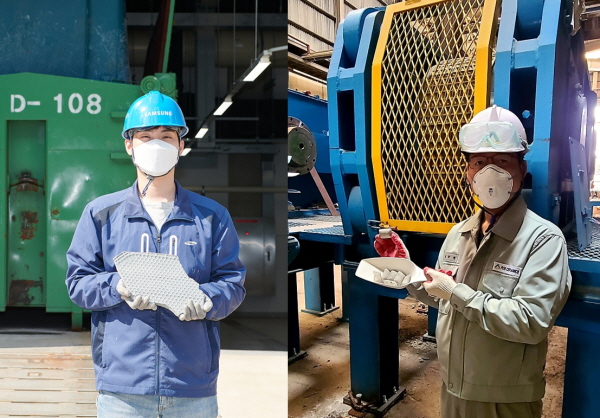
▲Officials from both companies are taking commemorative photos while holding fluorite replacement material.
Cost Reduction in Steel Production Process Expected Through Sludge Recycling
Technology has been developed to recycle wastewater sludge generated in semiconductor manufacturing processes and reuse it as a secondary raw material in steelmaking processes, with expectations for reduction of semiconductor waste, cost reduction in steel production, and substitution of imported minerals.
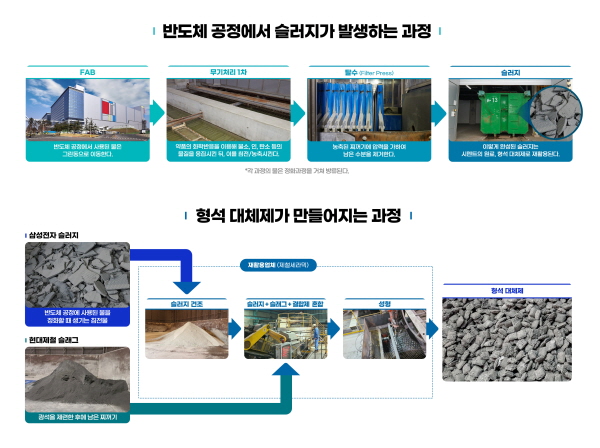
Samsung Electronics and Hyundai Steel announced on the 27th that they have jointly developed a new technology that enables the reuse of wastewater sludge (precipitate) generated in semiconductor manufacturing processes as a secondary raw material in steel production.
In the steelmaking process at steel mills, fluorite is used to more easily remove impurities (sulfur, phosphorus) from molten iron. This research result was inspired by the fact that the main component contained in semiconductor wastewater sludge (calcium fluoride, CaF2 50-60%) has a composition similar to fluorite.
Samsung Electronics, Hyundai Steel, and Steel Ceramics (a recycling company) signed a technology cooperation agreement in August 2020 related to wastewater sludge recycling, and through joint research and development, successfully produced steel materials using 30 tons of fluorite replacement material at Hyundai Steel's Dangjin Steel Mill in April.
The new technology underwent primary evaluation by the Korea Environment Institute in June 2021 and final evaluation by the National Institute of Environmental Research in August, and received final approval on August 31.
The National Institute of Environmental Research evaluated it as the most exemplary case since the Recycling Environmental Assessment system was established in July 2016. Additionally, the institute plans to provide active technical and administrative support so that waste that has not been recycled due to technical and institutional limitations can be more actively recycled through recycling environmental assessment.
Fluorite is a mineral entirely dependent on overseas imports (South America, China, etc.). Hyundai Steel imports and uses approximately 20,000 tons of fluorite annually, with plans to replace approximately 10,000 tons with recycled wastewater sludge products as early as the end of October this year, and gradually increase usage in the future.
Through this technology development, Samsung Electronics will now be able to recycle wastewater sludge that was previously sent to cement plants into various applications, and it is expected to contribute to cost reduction in Hyundai Steel's fluorite procurement.
The development of "alternative materials using waste" is an exemplary case of "circular economy-type ESG" created through response to the government's resource circulation policy and collaboration between companies and relevant agencies.
Jang Sung-dae, Senior Executive of Samsung Electronics' DS Division Environmental Safety Center, stated, "Samsung Electronics will continue to strengthen ESG management by continuing to develop eco-friendly resource circulation technology with the goal of achieving 100% waste recycling rate."
Meanwhile, wastewater sludge is generated in large quantities, accounting for 60% of total semiconductor waste generation. Samsung Electronics has made efforts since the late 1990s to achieve zero direct landfill of semiconductor wastewater sludge.
From 2018 onwards, the company set the goal of "zero waste emission" and has conducted research and facility investments.
Regarding semiconductor wastewater sludge, through research to improve dewatering pump and filter efficiency, the company has reduced approximately 75,000 tons of wastewater sludge annually.
Through recycling of this wastewater sludge, it is expected to contribute to reducing waste emissions and serve as a fluorite replacement material, achieving a dual benefit.

Comments
Related news
Samsung Electronics and KEPCO Join Forces for Energy-Saving Solutions
Samsung Electronics has joined hands with Korea Electric Power Corporation to develop energy-saving solutions.
2021.06.28by 배종인 기자
Samsung Electronics and Korea University Join Forces on Eco-Friendly Energy
Samsung Electronics and Korea University have signed a Memorandum of Understanding (MOU) for the establishment of an 'Eco-Friendly Energy Research Center,' entering into industry-academia collaboration for the development of eco-friendly home appliance solutions.
2021.09.01by 배종인 기자
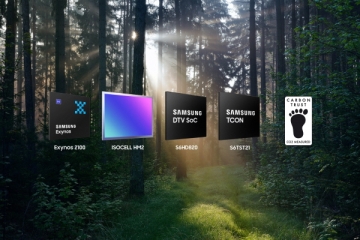
Samsung Electronics Obtains 'Carbon Footprint' Certification for System Semiconductors
Samsung Electronics has received international environmental certification for system semiconductor products following its memory products.
2021.09.09by 배종인 기자
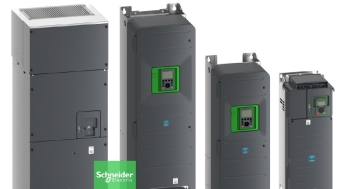
Schneider Aims for Building Energy Savings and Operational Stability with Next-Generation HVAC Drives
Schneider Electric has unveiled its next-generation HVAC drive product line 'Altivar HVAC'. The new product line's key features center on enhanced energy savings, system operational stability, and building management system integration. The products are divided into 'ATH200' for OEM and small equipment applications, and 'ATH600' for environments requiring continuous operation and advanced control. The company plans to expand the application scope from commercial buildings to facilities where HVAC system stability is critical, such as hospitals, airports, and data centers. The announcement includes over 30% energy savings, operation from -10°C to +60°C, Modbus and BACnet support, and compatibility with low global warming potential refrigerants.
2026.03.26by 명세환 기자
Ecolab Expands AI Data Center Cooling Business Through Acquisition of CoolIT
Ecolab has agreed to acquire CoolIT Systems, a liquid cooling company for AI data centers, for approximately $4.75 billion. The transaction is expected to close by Q3 2026, subject to regulatory approvals. CoolIT has been supplying direct-to-chip cooling-based coolant distribution units, cold plates, and manifolds, serving hyperscale data centers and colocation operators as customers. This acquisition is a measure to address the high-heat and high-density server environments created by AI proliferation. Ecolab plans to combine its water management and digital monitoring capabilities with CoolIT's hardware technology to expand its data center cooling business.
2026.03.26by 명세환 기자











