



KERI's 'Self-Charging Power Supply Device' Attracts Global Attention
 Published2021.10.07 09:17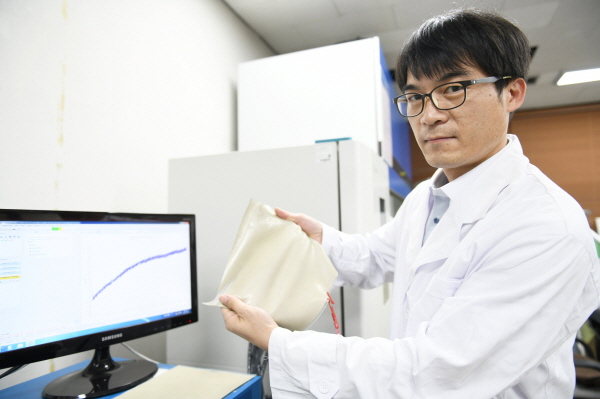
▲Researcher Jung Hee-jin demonstrates a self-charging power supply device for wearable electronic devices.
Research Results Published in Global Academic Journal 'Nano Energy'
The research results on 'self-charging power supply devices' from the Korea Electrotechnology Research Institute (KERI, President Myung Sung-ho), which will present a new paradigm in the future wearable devices field, are receiving significant attention as they have been published in internationally prestigious academic journals.
KERI announced on the 7th that the research results on 'self-charging power supply devices' by the Nano Convergence Research Center (Center Director Jung Hee-jin) research team (Principal Researcher Park Jong-hwan, Researcher Yang Hye-jin) have been published in 'Nano Energy (IF = 17.881)', an internationally prestigious academic journal ranked in the top 4.6% by Journal Citation Reports (JCR) in the materials field.
This research achievement involves the development of integrated technology combining a 'nanogenerator' (self-charging) that generates electricity by utilizing friction generated from clothing and other sources, and a 'micro supercapacitor' (power supply) that stores the generated electricity and supplies it to wearable electronic devices.
While previous research has seen cases where fully stretchable 'triboelectric nanogenerators' were developed, there has been no integrated stretchable device that also performs the function of a 'micro supercapacitor' that stably stores, transfers, and supplies electrical power.
Self-charging wearable devices must possess excellent tensile durability as a basic requirement, and also need several other conditions such as superior electrical properties, lightness, and biocompatibility. To address these challenges, many researchers have utilized wrinkled substrates or introduced partial stretchable electrodes; however, such approaches had limited stretching directions, poor durability, and high manufacturing costs.
Accordingly, the KERI research team, based on more than 10 years of accumulated nanoconvergence technology, utilized a method to effectively blend 'single-wall carbon nanotubes' with superior electrical conductivity and physical properties with stretchable 'polymers', thereby developing devices capable of simultaneously performing the role of 'current collectors' that transfer current as well as 'electrodes' that store energy. The device is stretchable in all directions, and according to the institute's own performance tests, it demonstrates excellent durability with the ability to withstand over 10,000 uses.
The developed technology is expected to be utilized as an important power supply source in fields such as defense and leisure. In particular, in future battlefields where the use of various electrical and electronic equipment is essential, there is a need for technology that can produce and utilize electricity on-site for power supply alongside military portable ultra-lightweight batteries and for survival in extreme environments. In this case, by applying KERI's technology, electricity can be generated from friction produced by military uniforms, military boots, military hats, and combat backpacks. In the leisure field, if the self-charging power supply device is applied to mountaineering clothing, it can be effectively utilized as a power source for flashlights or smartphone charging in emergency situations.
Dr. Park Jong-hwan of KERI stated, "This is the world's first achievement in fabricating a fully stretchable device capable of integrally performing electricity production, storage, and supply due to friction," and added, "We will continue to conduct research to further enhance the device's efficiency and performance, thereby greatly contributing to the lightness and improved portability of next-generation wearable electronic devices."
Meanwhile, KERI is a government-funded research institute specializing in electricity under the National Research Council of Science and Technology of the Ministry of Science and ICT. This research was conducted as part of the △Korea Research Foundation's Global Frontier Project (Project Director: Han Jung-taek), △Ministry of Industry's Technology Innovation Project (Project Director: Seo Seon-hee), and △KERI Basic Project (Project Director: Lee Kun-woong).

Comments
Related news
Electrotechnology Research Institute, Successful Development of SiC Power Semiconductor 'Trench MOSFET'
Korea Electrotechnology Research Institute (hereafter KERI, Acting President Yoo Dong-wook) has developed a 'trench structure MOSFET,' a cutting-edge technology for SiC power semiconductor devices, and concluded a technology transfer contract worth 2 billion won with a specialized manufacturer.
2021.04.21by 배종인 기자
Korea Electrotechnology Research Institute transfers battery cathode material technology worth 1.1 billion won.
The Korea Electrotechnology Research Institute (KERI), a government-funded research institute under the National Research Council of Science and Technology within the Ministry of Science and ICT, has achieved a major milestone by developing mass production technology for a battery anode material that compensates for silicon's limitations with graphene, and successfully transferring the technology for 1.1 billion won.
2021.08.30by 배종인 기자
KERI develops high-efficiency lithium storage technology for lithium metal batteries
Dr. Kim Byung-gon (Senior Researcher) of the Next-Generation Battery Research Center at the Korea Electrotechnology Research Institute (KERI, President Myung Sung-ho) has successfully improved safety and performance by effectively storing lithium metal for anode applications.
2021.09.09by 배종인 기자
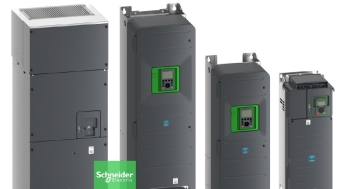
Schneider Aims for Building Energy Savings and Operational Stability with Next-Generation HVAC Drives
Schneider Electric has unveiled its next-generation HVAC drive product line 'Altivar HVAC'. The new product line's key features center on enhanced energy savings, system operational stability, and building management system integration. The products are divided into 'ATH200' for OEM and small equipment applications, and 'ATH600' for environments requiring continuous operation and advanced control. The company plans to expand the application scope from commercial buildings to facilities where HVAC system stability is critical, such as hospitals, airports, and data centers. The announcement includes over 30% energy savings, operation from -10°C to +60°C, Modbus and BACnet support, and compatibility with low global warming potential refrigerants.
2026.03.26by 명세환 기자
Ecolab Expands AI Data Center Cooling Business Through Acquisition of CoolIT
Ecolab has agreed to acquire CoolIT Systems, a liquid cooling company for AI data centers, for approximately $4.75 billion. The transaction is expected to close by Q3 2026, subject to regulatory approvals. CoolIT has been supplying direct-to-chip cooling-based coolant distribution units, cold plates, and manifolds, serving hyperscale data centers and colocation operators as customers. This acquisition is a measure to address the high-heat and high-density server environments created by AI proliferation. Ecolab plans to combine its water management and digital monitoring capabilities with CoolIT's hardware technology to expand its data center cooling business.
2026.03.26by 명세환 기자











