


Korea Electric Power Corporation (KEPCO) has achieved long-term storage of liquid hydrogen.
 Published2021.10.13 08:52
.jpg)
▲Dr. Ha Dong-woo and Dr. Go Rak-gil of the Korea Electrotechnology Research Institute, who developed liquid hydrogen production and long-term storage technology.
Contributing to long-distance transportation and carbon neutrality policies
A technology has been developed that can store liquefied hydrogen produced by cooling gaseous hydrogen to -253 degrees Celsius for long periods of time without loss, raising expectations that it will make a decisive contribution to long-distance transportation and the government's carbon neutrality policy.
The Korea Electrotechnology Research Institute (KERI, President Myeong-ho Myung), Korea's only specialized electrical research institute, has developed 'liquid hydrogen production and long-term storage technology' that will play a crucial role in realizing the future hydrogen economy.
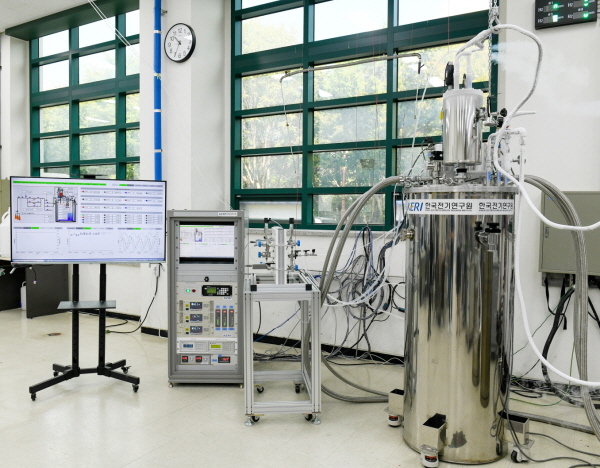
Zero Boil-off, developed by the team of Dr. Ha Dong-woo and Dr. Go Rak-gil of the Electric Power Equipment Research Center (Director Lee Jae-bok), automatically re-liquidates vaporized hydrogen within a liquid hydrogen storage container. Even if the hydrogen vaporizes due to temperature fluctuations, it is 100% re-condensed through cryogenic cooling, creating liquid hydrogen for storage. The research team recently demonstrated the effectiveness of this technology by successfully producing approximately 40 liters of liquid hydrogen and storing it for over two months without loss.
Because liquid hydrogen is produced at an extremely low temperature of -253 degrees Celsius, even the slightest change in the environment, such as a temperature rise, causes it to vaporize and fly away again. In other words, while production is important, storage is even more challenging. This situation is particularly acute during long-term storage or transport of liquid hydrogen, resulting in significant difficulties.
To this end, the team of Dr. Ha Dong-woo and Dr. Go Rak-gil applied the cryogenic cooling technology they have accumulated through research on superconductivity for over 20 years to this study.
This achievement, which opens the possibility of commercializing liquid hydrogen, has enormous economic significance.
Because liquid hydrogen has a smaller volume than gas and does not pose the risk of high pressure, the space required for hydrogen storage at charging stations and other locations can be significantly reduced and the amount of hydrogen stored can be increased.
Furthermore, the high stability of hydrogen storage facilitates securing public acceptance. From a transportation perspective, liquid hydrogen can be safely transported in much larger quantities than conventional gas transport, significantly expanding hydrogen availability nationwide.
Currently, the approximately 60 hydrogen charging stations nationwide store and supply hydrogen in gaseous form. Because hydrogen gas is bulky, it is compressed to high pressure and stored in sturdy tanks or trailers. However, the compression level, reaching up to 700 times its initial pressure, has always raised concerns about the risk of explosion, and long-term storage and transport of hydrogen have also been challenging.
Liquid hydrogen, an alternative solution, is hydrogen gas cooled to extremely low temperatures, liquefying it. Its volume is 800 times smaller than its gaseous form, making it highly safe to store and more than seven times more efficient to transport. However, creating liquid hydrogen requires technology that cools the gas to extremely low temperatures (-253 degrees Celsius) and, above all, allows for long-term storage while minimizing loss to prevent evaporation. This is a very technically difficult task because many factors, including stability, effectiveness, and economy, must be taken into consideration.
Senior Researcher Go Rak-gil said, “The advantages of liquid hydrogen are well known, but the key was the technology to effectively produce it and store it for a long period of time. KERI has solved this challenge very simply and effectively by utilizing the highest level of cryogenic freezing technology.” He added, “This technology will enable not only the safe and efficient production and storage of liquid hydrogen, but also its long-distance transport and wide-ranging use, and will greatly contribute to the government’s efforts to revitalize the hydrogen economy and realize its carbon neutrality policy.”
The KERI research team believes these findings will be applied to a variety of fields, including hydrogen mobility (ships, cars) and fuel cell power plants for buildings. They plan to strengthen cooperation with local governments like Gyeongnam Province and Changwon City and expand the technology through technology transfer to related companies. Ultimately, their goal is to lead the future-oriented hydrogen energy industry through the continued development of hydrogen-electric fusion technology.

Comments
Related news
Korea Electrotechnology Research Institute transfers battery cathode material technology worth 1.1 billion won.
The Korea Electrotechnology Research Institute (KERI), a government-funded research institute under the National Research Council of Science and Technology within the Ministry of Science and ICT, has achieved a major milestone by developing mass production technology for a battery anode material that compensates for silicon's limitations with graphene, and successfully transferring the technology for 1.1 billion won.
2021.08.30by 배종인 기자
KERI develops high-efficiency lithium storage technology for lithium metal batteries
Dr. Kim Byung-gon (Senior Researcher) of the Next-Generation Battery Research Center at the Korea Electrotechnology Research Institute (KERI, President Myung Sung-ho) has successfully improved safety and performance by effectively storing lithium metal for anode applications.
2021.09.09by 배종인 기자
KERI's 'Self-Charging Power Supply Device' Attracts Global Attention
The research results on 'self-charging power supply devices' from the Korea Electrotechnology Research Institute (KERI, President Myung Sung-ho), which will present a new paradigm in the future wearable devices field, are receiving significant attention as they have been published in internationally prestigious academic journals.
2021.10.07by 배종인 기자
Materials Research Institute Develops Ultra-thin Coating Water Electrolysis Catalyst Technology
The Korea Institute of Materials Science has simultaneously resolved the performance and durability trade-off problem in water electrolysis catalysts by applying ultra-thin surface coating technology. Achieving 1.9 times higher performance compared to conventional catalysts while demonstrating 1,000-hour long-term stability, the institute has developed technology scalable to industrial water electrolysis systems through a simple process.
2026.10.07by 배종인 기자
Gigaphoton Develops Neon Gas Recycling System for ArF Excimer Lasers...Achieves 50% Recycling Rate
Gigaphoton announced that it has developed a gas recycling system for ArF excimer lasers and achieved a 50% neon gas recycling rate.
2026.10.02by 배종인 기자











