



KERI Successfully Transfers Core Solid-State Battery Technology
 Published2021.10.26 10:32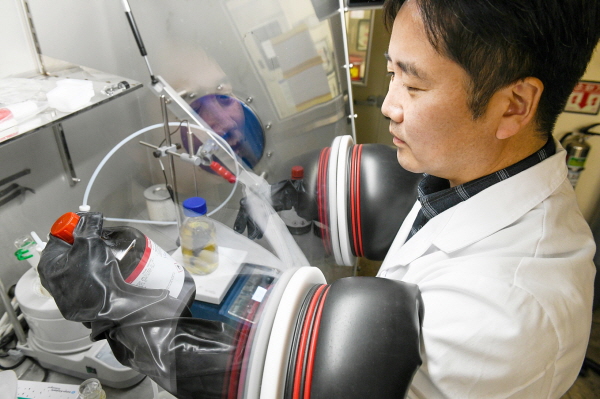
Dr. Ha Yun-cheol of the Korea Electrotechnology Research Institute is examining the solid electrolyte developed for the first time in the world using the coprecipitation method.
World's first achievement attracting significant attention with cost level 1/15 of existing standards
The Korea Electrotechnology Research Institute (KERI, President Myung Sung-ho) has succeeded in transferring core technology for all-solid-state batteries, which is attracting significant attention as a world-first achievement, and full-scale mass production is anticipated.
The Korea Electrotechnology Research Institute announced on the 26th that the 'co-precipitation technology for solid electrolytes for sulfide-based all-solid-state batteries,' developed by Dr. Ha Yun-cheol's team at the Next-Generation Battery Research Center, has been transferred to Daejoo Electronic Materials (CEO Im Il-ji), a leading specialized company in the domestic electrical and electronic materials field.
Sulfide-based solid electrolytes have the advantage of being easy to manufacture for electrodes and separators due to their high ionic conductivity and ductility; however, they have the disadvantages of high cost of lithium sulfide (Li2S), the main raw material, and the use of the 'ball milling method,' which requires high energy for the mixing process with other materials. For this reason, production of the product has been limited to small quantities, and the price per 100 grams has reached millions of won.
KERI’s technology for solving this problem is the world’s first achievement in mass-producing sulfide-based solid electrolytes at a low cost using only a simple solution synthesis (one-pot) process called the ‘co-precopitation method’ without using expensive lithium sulfide.
Co-precipitation is a method of simultaneously precipitating various different ions in aqueous or non-aqueous solutions, and it is the most widely utilized method in the industrial sector for the mass production of cathode materials for lithium-ion batteries. Through persistent efforts, the research team developed a process for co-precipitating lithium with sulfur, phosphorus, and halogen elements, and succeeded in manufacturing solid electrolytes of the same quality as those produced using the conventional method that utilized expensive lithium sulfide.
In terms of pure raw material costs, KERI's manufacturing method is about one-fifteenth the level of existing methods, and considering that it does not require high-cost, high-energy processes such as the ball mill method, the cost reduction effect is even greater.
Recognized for its high technological capabilities, this achievement has been transferred to Daejoo Electronic Materials Co., Ltd., a leading domestic company specializing in electrical and electronic materials and silicon anode materials for lithium-ion batteries. Daeju Electronic Materials Co., Ltd. plans to expand investment in mass production facilities for solid electrolytes, including establishing a pilot production facility on the site of its second factory by 2022 using this transferred technology. In addition, through the '100 Small but Strong Companies in Materials, Parts, and Equipment' project awarded last September, the company aims to develop various silicon materials capable of replacing lithium metal (Li metal) anodes for solid-state batteries and lead the solid-state battery market expected to blossom after 2025.
Dr. Ha Yun-cheol of KERI stated, “This is an achievement that can simultaneously resolve the issues of ‘low cost’ and ‘mass production’ of solid electrolytes, which are key to the commercialization of all-solid-state batteries.” He added, “Through this technology transfer to a company, mass production of solid electrolytes will be achieved, and it will play a leading role in the commercialization of all-solid-state batteries, which are called the ‘dream battery.’”

Comments
Related news
KERI named Best Institution at '2021 Korea SNS Awards'
The Korea Electrotechnology Research Institute (KERI, Director Myung Sung-ho), the country's sole specialized research institution dedicated to electrical technology, has received the Grand Prize in the Research Institute category at the '2021 Korea SNS Awards' in recognition of its outstanding achievements and contributions in online promotion.
2021.10.01by 배종인 기자
KERI's 'Self-Charging Power Supply Device' Attracts Global Attention
The research results on 'self-charging power supply devices' from the Korea Electrotechnology Research Institute (KERI, President Myung Sung-ho), which will present a new paradigm in the future wearable devices field, are receiving significant attention as they have been published in internationally prestigious academic journals.
2021.10.07by 배종인 기자
.jpg)
Korea Electric Power Corporation (KEPCO) has achieved long-term storage of liquid hydrogen.
A technology has been developed that can store liquefied hydrogen, produced by cooling gaseous hydrogen to -253 degrees, over an extended period without loss. This technology is garnering expectations that it will make a decisive contribution to long-distance transportation and the government's carbon neutrality policy.
2021.10.13by 배종인 기자
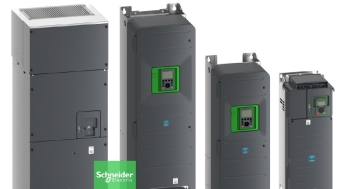
Schneider Aims for Building Energy Savings and Operational Stability with Next-Generation HVAC Drives
Schneider Electric has unveiled its next-generation HVAC drive product line 'Altivar HVAC'. The new product line's key features center on enhanced energy savings, system operational stability, and building management system integration. The products are divided into 'ATH200' for OEM and small equipment applications, and 'ATH600' for environments requiring continuous operation and advanced control. The company plans to expand the application scope from commercial buildings to facilities where HVAC system stability is critical, such as hospitals, airports, and data centers. The announcement includes over 30% energy savings, operation from -10°C to +60°C, Modbus and BACnet support, and compatibility with low global warming potential refrigerants.
2026.03.26by 명세환 기자
Ecolab Expands AI Data Center Cooling Business Through Acquisition of CoolIT
Ecolab has agreed to acquire CoolIT Systems, a liquid cooling company for AI data centers, for approximately $4.75 billion. The transaction is expected to close by Q3 2026, subject to regulatory approvals. CoolIT has been supplying direct-to-chip cooling-based coolant distribution units, cold plates, and manifolds, serving hyperscale data centers and colocation operators as customers. This acquisition is a measure to address the high-heat and high-density server environments created by AI proliferation. Ecolab plans to combine its water management and digital monitoring capabilities with CoolIT's hardware technology to expand its data center cooling business.
2026.03.26by 명세환 기자











