


ETRI Achieves 90% Accuracy in AI Telemedicine
 Published2021.10.27 08:59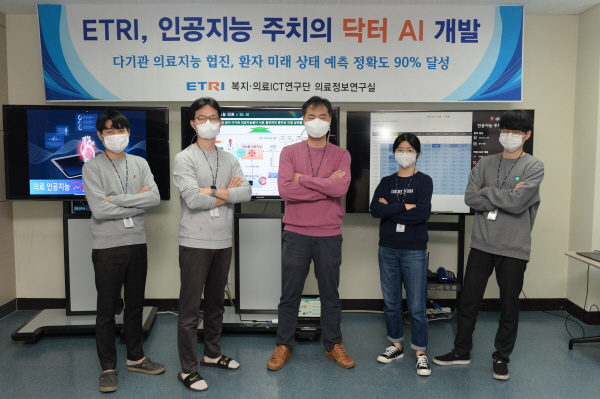
ETRI researchers who developed 'Doctor AI'
The Electronics and Telecommunications Research Institute (ETRI) has developed a non-face-to-face medical technology that uses artificial intelligence (AI) to aggregate medical intelligence from various institutions and predict a patient's health status with 90% accuracy, raising expectations for the establishment of a non-face-to-face collaborative medical system utilizing medical AI in the post-COVID era.
The Electronics and Telecommunications Research Institute (ETRI) has developed 'Dr. AI,' an artificial intelligence attending physician that integrates medical intelligence systems built across various hospitals to precisely analyze a patient's current condition and rationally predict their future health. It was announced on the 27th that it had developed 'AI'.
Doctor AI, developed by ETRI, assists in medical care by utilizing the EMR-based medical intelligence of each hospital simultaneously (ensemble) instead of integrating EMRs.
In other words, it has the effect of jointly utilizing medical data from other institutions without directly accessing sensitive information.
It amounts to indirectly turning medical information by institution into big data.
When a patient's current information is entered into Doctor AI, the medical intelligence of each institution analyzes it individually, integrates the results, adjusts for errors, and selects the optimal prediction.
It showed about 10% higher accuracy compared to using only medical intelligence from a single institution, which is because the predictions differ slightly depending on the patient group data according to hospital characteristics for each medical intelligence.
The research team improved accuracy by collaborating with medical intelligence trained on different data from each institution.
ETRI, together with Seoul Asan Medical Center, Ulsan National University Hospital, and Chungnam National University Hospital, utilized the EMRs of approximately 740,000 cardiovascular disease patients to secure a prediction accuracy of over 90%.
The core technologies of Doctor AI include ensemble medical intelligence (analysis of prediction trends and errors by institution), time-series EMR medical intelligence (analysis of prediction basis and health status), and multimodal medical intelligence (learning medical data).
So-called Ensemble Medical Intelligence identifies a patient's future health condition based on the most suitable medical data from hospitals nationwide equipped with Doctor AI, regardless of which hospital is visited.
For example, if chronic respiratory diseases diagnosed at local screening centers are analyzed and predicted using Doctor AI by leveraging the medical intelligence of large hospitals with sufficient accumulated cardiovascular data, more comprehensive and detailed analysis and prediction become possible.
It is even possible to predict that it is a disease that could cause serious heart damage in about two years..
The research team utilized time-series EMR medical intelligence to design different analysis weights and concentrations for factors such as hospital visit frequency and examination items, enabling more precise predictions.
Medical data used in time-series analysis requires a prediction method that considers the unique characteristics of EMRs, such as patients' irregular visit intervals and various types of tests, and this technology enabled us to improve accuracy.
Multimodal medical intelligence learns and utilizes not only EMR data but also cardiac CT image data, thereby improving the accuracy of cardiovascular disease prediction and assisting in personalized patient treatment.
ETRI plans to build medical intelligence in every hospital and improve accuracy by training deep learning on a vast number of cases that humans cannot handle.
It was stated that the purpose of the research is to ensure a healthy life for the public by actively utilizing even similar cases for prediction and diagnosing major diseases early.
Choi Jae-hoon, a principal researcher at ETRI and head of Doctor AI technology development, said, “Not only primary and secondary hospitals, where patient data is relatively scarce, but also large hospitals can achieve effects similar to collaborative treatment by simultaneously utilizing medical intelligence from hospitals with different patient populations. We expect that this will enable the standardization of medical standards to be raised.”
This study was conducted as part of the Ministry of Science and ICT's 'Development of AI Doctor Technology for Cardiovascular Diseases' project.
Dr. Seung-Hwan Kim of the Medical Information Research Division at ETRI served as the overall project manager, and Asan Medical Center and Daia Information Systems participated as joint research institutions, while Ajou University Hospital, Ulsan University Hospital, and Chungnam National University Hospital provided assistance through commissioned research.

Comments
Related news
Korea Institute of Machinery and Materials (KIMM) improves medical equipment accuracy with machine learning.
The research team led by Park Jong-won, Director of the Reliability Assessment Research Laboratory at the Korea Machine Research Institute, applied big data deep learning technology that has been utilized for reliability diagnosis of mechanical components and equipment to ultrasonic imaging diagnostic equipment. They developed 'image diagnostic technology utilizing machine learning' and achieved successful diagnosis with approximately 80% accuracy using GPU (graphics processing unit).
2021.06.09by 배종인 기자

'Digitalization, Miniaturization, and Connectivity', the Foundation for Medical Innovation
Robots simplify invasive procedures in surgical operations, helping patients recover quickly, and wearable devices monitor patient medication intake and daily activities. The collected data is transmitted to physicians, who use this information to understand patient status in real time. This is a vision of the future based on advances in medical technology. With progress in wireless data transmission and component miniaturization technologies, minimally invasive surgery and telemedicine are expected to become reality soon.
2021.09.15by 이수민 기자
.jpg)
Smart Care Works' AI analysis of medical CT images delivers outstanding results.
Professor Lee Seung-soo's team at the Department of Radiology at Asan Medical Center Seoul and SmartCareWorks jointly conducted automatic image analysis using AI, achieving a dramatic reduction in analysis time and enabling fast and accurate liver volume assessment. This development is drawing expectations for clinical application across various fields.
2021.10.12by 배종인 기자
[e4ds Tech Day 2026 ⑨] Sim Sang-gyu, Autocrypt CTO: "In the Physical AI Era, Automotive Security Must Extend Beyond the Vehicle"
At e4ds Tech Day 2026, Sim Sang-gyu, CTO of Autocrypt, explained automotive cybersecurity strategies in the era of Physical AI and SDV (Software-Defined Vehicle). Automobiles are evolving as part of an ecosystem connected to AI, cloud, chargers, IoT, and robots, and he emphasized that the scope of security must expand beyond the vehicle interior to the entire connected environment. In particular, AI model tampering, adversarial attacks, OTA updates, and EV charger hacking were identified as major threats. He explained that response measures require zero trust, AI model integrity protection, intrusion detection, Security by Design and Default, and full lifecycle security management, and that proactive security system establishment beyond regulatory compliance is critical for securing future mobility competitiveness.
2026.10.12by 배종인 기자
NVIDIA to Invest $1 Billion in U.S. Science Over Next Five Years
NVIDIA has announced plans to invest $1 billion over the next five years to strengthen U.S. scientific and technological competitiveness. The company will enhance cutting-edge artificial intelligence research and development capabilities in key areas including quantum computing, healthcare, and energy security, while expanding support for higher education research institutions and cloud service providers. NVIDIA is participating as a major industry partner in the White House Office of Science and Technology Policy's Genesis Mission, and is promoting supercomputer construction in collaboration with national laboratories including Argonne and Los Alamos.
2026.10.12by 배종인 기자











