



ETRI Commercializes World's First Low-Temperature OLED Photoresist
 Published2021.11.09 12:26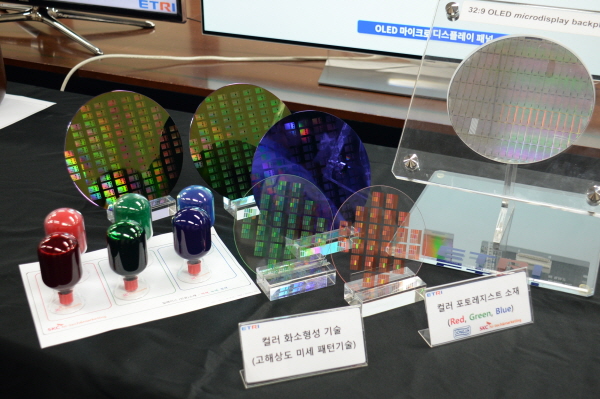
Achieved innovative results that even Japanese companies failed to achieve
The Electronics and Telecommunications Research Institute (ETRI) is garnering attention for its contribution to domestic material self-reliance, having developed material technology capable of producing high resolution without requiring high temperatures in the process and successfully commercialized it into actual products by applying it to displays.
ETRI announced on the 9th that it has developed material technology capable of making pixel sizes of 3μm or less even at process temperatures below 100℃ and has succeeded in applying it to an OLED microdisplay for the first time in Korea.
Until now, photoresist materials have been processed at high temperatures. Conventional LCD displays, due to their structure containing a glass film, did not pose a problem even when processed at high temperatures.
On the other hand, OLEDs, which have emerged as next-generation displays, may experience problems with light-emitting diodes that emit light at high temperatures. For this reason, the key was to develop material technology that enables processing even at low temperatures.
First, in this project, SKC High-Tech & Marketing and Dongjin Semichem localized the pigment, a core raw material for photoresist, and by appropriately blending it, developed a photoresist material capable of uniform color application even at low temperatures.
The developed material is being evaluated as an innovative achievement that neither domestic competitors nor Japanese companies have been able to develop.
ETRI applied the developed photoresist material to OLEDs for the first time in Korea.
The prototype created by the research team is a 0.7-inch microdisplay suitable for wearable devices.
It is possible to produce ultra-high resolution panels with 2,300 pixels per inch, with a pixel size of 3μm or less.
The research team has been conducting research on OLED microdisplays for augmented reality (AR) implementation since 2016 and was able to serve as a platform for creating this prototype.
In addition to this, ETRI evaluated the performance of the developed materials and supported participation in global academic conferences and exhibitions.
After completing verification, the developed material succeeded in securing an exclusive supply contract with domestic company S.
In particular, the application of this material to the mobile OLED display panels of the smartphones released by the company this year has resulted in the world's first commercialization.
Thanks to this, an economic ripple effect of over 60 billion won is expected in 2021 alone, and it was evaluated that substantial localization and self-reliance of materials had been achieved.
Cho Nam-sung, a principal researcher at ETRI who led the study, said, “The government, companies, and national research institutes have succeeded in localizing source materials through a national project.” "I hope this achievement will help not only achieve self-reliance in materials, parts, and equipment, but also help Korea maintain its status as the leading nation in the display industry," he stated.

Comments
Related news
.jpg)
ETRI Develops Stretchable Light-Blocking Transparent Film
Domestic researchers have developed a source material that can be freely stretched like a transparent vinyl film to completely block light by 100%. With the ability to easily control light transmittance while maintaining excellent elasticity, it is expected to be applicable to various fields including wearable devices, flexible displays, and smart windows.
2021.08.11by 배종인 기자
ETRI surpasses 141 technology startups, with three companies listed on KOSDAQ.
Domestic government-funded research institutions are attracting attention by achieving high commercialization results, including spinning out numerous startups based on information and communications technology (ICT) and listing on KOSDAQ.
2021.09.17by 배종인 기자
ETRI Ranks 1st in World at International Autonomous Driving Competition
Domestic researchers and researchers from the University of Washington jointly developed object segmentation and tracking technology for autonomous driving, which ranked first place in an international competition for tracking objects in the autonomous driving field.
2021.10.26by 배종인 기자

Intel Unveils Next-Generation 'Core Ultra Series 3' and vPro Platform for Enterprise PCs
Intel has officially unveiled the "Intel Core Ultra Series 3" for next-generation enterprise PCs and the latest vPro platform, addressing a wide range of demands from enterprise notebooks to high-performance workstations.
2026.03.26by 배종인 기자

ROHM Launches ESD Protection Diode Compatible with High-Speed Interfaces of 10Gbps or Higher
Semiconductor specialist ROHM has developed the 'RESDxVx series' of ESD (electrostatic discharge) protection diodes capable of responding to next-generation high-speed data communication environments exceeding 10Gbps, simultaneously enhancing both signal quality maintenance required in high-speed interfaces and IC protection performance.
2026.03.26by 배종인 기자











