



Jensen Huang “Contributing to the development of industry and science with new accelerated computing and AI technologies”
 Published2021.11.10 15:36
.jpg)
▲Nvidia CEO Jensen Huang is giving a keynote speech.
Jetson AGX Orin Up to 6x More Processing Power
Omniverse Avatar AI·Simulation Technology Connection
Nvidia is expected to make contributions in various fields ranging from quantum physics, digital biology, and climate science as it introduces new technologies for accelerated computing, AI, supercomputing centers, and cloud computing.
NVIDIA CEO Jensen Huang gave a keynote speech at the GPU Technology Conference (GTC) on the 9th, introducing various technologies ranging from AI, accelerated computing, computer graphics, robotics, and even the metaverse.
In this keynote, NVIDIA CEO Jensen Huang unveiled NVIDIA Quantum 2, the company’s next-generation InfiniBand networking platform that delivers the ultimate performance, broad accessibility, and robust security required by cloud computing providers and supercomputing centers.
NVIDIA Quantum 2 is the most advanced end-to-end networking platform ever built. It is a 400Gbps InfiniBand networking platform comprised of NVIDIA Quantum 2 switches, ConnectX-7 network adapters, BlueField-3 data processing units (DPUs), and all the software to support the new architecture.
NVIDIA Quantum 2 is a supercomputing sensorThe release comes as the world's cloud service providers increasingly open up their supercomputing services to millions of customers.
Along with this, NVIDIA unveiled the 'Jetson AGX Orin', which implements edge AI and autonomous machines. The world's smallest AI supercomputer, NVIDIA Jetson AGX Orin maximizes energy efficiency along with powerful performance.
Built on the NVIDIA Ampere architecture, Jetson AGX Orin delivers up to 6x the processing power while maintaining the form factor and pin compatibility of the previous-generation Jetson AGX Xavier. The model is similar to a GPU-enabled server, but is as small as the palm of your hand and performs about 200 TOPS (tera operations per second) per second.
The new Jetson AGX Orin accelerates the full stack of NVIDIA AI software, enabling developers to deploy the largest and most complex models essential to solving edge AI and robotics problems involving natural language understanding, 3D perception, multi-sensor fusion, and more.
Along with this, Jensen Huang announced that he will support global companies to build and develop large-scale language models (LLMs).
To this end, we are unveiling the NVIDIA NeMo Megatron for training language models with trillions of parameters, the Megatron 530B, a custom large-scale language model that can train new domains and languages, and the Triton Inference Server with multi-GPU, multi-node distributed inference capabilities.
When combined with NVIDIA DGX systems, these tools provide a production-ready, enterprise-grade solution that simplifies the development and deployment of large-scale language models.
The keynote also announced NVIDIA Omniverse Replicator, a powerful synthetic data generation engine that generates physically simulated synthetic data for training deep neural networks.
NVIDIA introduced two synthetic data generation applications with its first implementation of the engine. These are NVIDIA DRIVE Sim, a virtual world that hosts digital twins of autonomous vehicles, and NVIDIA Isaac Sim, a virtual world for digital twins of manipulation robots.
The two replicators allow developers to bootstrap AI models, fill in gaps in real-world data, and label ground truth in ways that humans cannot. The data generated in these virtual worlds covers a wide range of scenarios, including rare or dangerous conditions that are not regularly or safely experienced in the real world.
Additionally, NVIDIA announced the latest update to the Triton Inference Server, an AI inference platform used by more than 25,000 customers worldwide.
Triton Inference Server is used by many customers, including Capital One, Microsoft, Siemens Energy, and Snap. This update supports open source NVIDIA Triton Inference Server software, which provides cross-platform inference for any AI model and framework, and TensorRT, which optimizes AI models and provides a runtime for high-performance inference on NVIDIA GPUs.
NVIDIA also introduced the NVIDIA A2 Tensor Core GPU, a small, low-power accelerator for AI inference that delivers up to 20x higher inference performance than CPUs.
A platform for creating AI avatars was also announced.
NVIDIA Omniverse Avatar connects NVIDIA’s voice AI, computer vision, natural language understanding, recommendation engines, and simulation technologies. Avatars created on the Omniverse platform are interactive characters with ray-traced 3D graphics that can see, speak, converse, and naturally understand the intent of language on a variety of topics.
Omniverse Avatar enables the creation of easily customizable AI assistants for most industries, helping to expand business opportunities and increase customer satisfaction through billions of daily customer service interactions, including restaurant orders, banking transactions, and personal appointments and reservations.
“The era of intelligent virtual assistants has arrived,” said Jensen Huang, founder and CEO of NVIDIA. “Omniverse Avatar combines NVIDIA’s foundational graphics, simulation and AI technologies to create the most complex real-time applications ever created. The use cases for collaborative robots and virtual assistants are astonishing and far-reaching.”
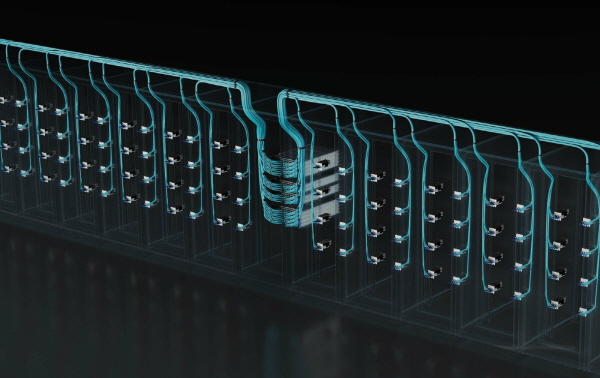
▲Quantum-2 networking platform
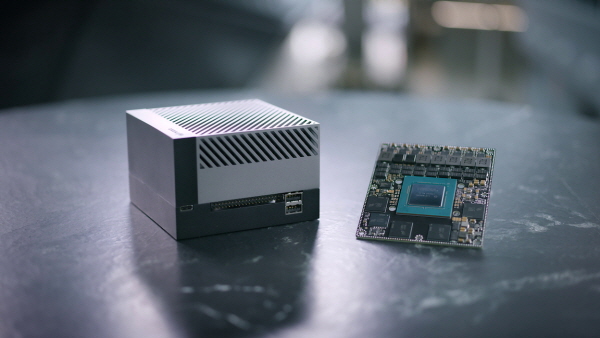
▲NVIDIA Jetson AGX Orin module and developer kit

Comments
Related news
NVIDIA AI Startup Program Grows 17% in First Half of Year
Nvidia announced that its AI startup accelerator program, Inception, has surpassed 8,500 member companies. This figure represents approximately two-thirds of all AI startups globally, according to PitchBook's estimates. Inception is one of the world's largest AI startup ecosystems, with accumulated funding exceeding $60 billion and participation from startups across more than 90 countries.
2021.08.04by 이수민 기자

NVIDIA, 'GTC' Opportunity to Learn the Latest AI Trends
Nvidia (CEO Jensen Huang), a leading company in artificial intelligence (AI) computing technology, has created an opportunity to learn the latest artificial intelligence trends.
2021.10.20by 강정규 기자
NVIDIA Announces New ROS Product to Accelerate Robot Development
Nvidia, a leader in artificial intelligence (AI) computing technology headed by CEO Jensen Huang, has announced a new robot operating system (ROS) and is moving forward with optimizing the performance of robot applications.
2021.11.03by 강정규 기자

Intel Unveils Next-Generation 'Core Ultra Series 3' and vPro Platform for Enterprise PCs
Intel has officially unveiled the "Intel Core Ultra Series 3" for next-generation enterprise PCs and the latest vPro platform, addressing a wide range of demands from enterprise notebooks to high-performance workstations.
2026.03.26by 배종인 기자

ROHM Launches ESD Protection Diode Compatible with High-Speed Interfaces of 10Gbps or Higher
Semiconductor specialist ROHM has developed the 'RESDxVx series' of ESD (electrostatic discharge) protection diodes capable of responding to next-generation high-speed data communication environments exceeding 10Gbps, simultaneously enhancing both signal quality maintenance required in high-speed interfaces and IC protection performance.
2026.03.26by 배종인 기자











