



[Interview] Matteo Maravita, Director of ST's AI Competence Center: "ST Solutions Solve the Deep Edge AI Data Explosion"
 Published2021.11.19 15:33
NanoEdgeAI: Create Edge AI Projects Without AI Knowledge
STM32Cube.AI: Customizing NN Models to Fit Hardware Characteristics
[Editor's Note] AI technology is opening up new opportunities in diverse fields, including autonomous driving, smart homes, and smart buildings. While the application of AI is endless across all data-gathering sectors, centralized AI—providing data from sensors to the cloud without intermediate analysis—has limitations in security, responsiveness, and efficiency. Deep-edge technology is gaining attention as a solution to overcome these limitations. Deep-edge technology decentralizes computing and services from the cloud to the edge of the network, enabling nodes to make decisions directly and improving responsiveness. Consequently, the demand and supply of deep-edge AI devices are expected to steadily increase, necessitating a broad range of solutions and expertise, from smart sensors to key tools and ecosystems. Accordingly, this magazine arranged an interview with Matteo Maravita, Director of the AI Competence Center at STMicroelectronics, to learn about machine learning and AI processes.
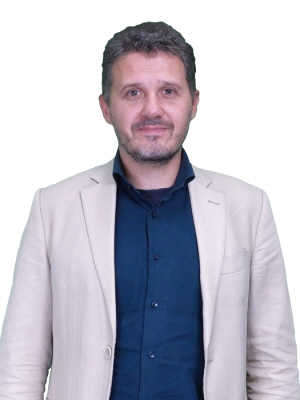 ■ Please introduce the ST AI Competency Center.
The Asia Pacific Competence Center is an application team of AI engineers working on system-level AI projects in locations including Tokyo, Taipei, Hong Kong, and Shenzhen.
We support customers in AI projects that encompass a large portfolio of ST products (MCUs, MPUs, sensors, etc.) and an ecosystem of AI tools.
We are also developing new and exciting proof-of-concept (PoC) demos based on machine learning or deep learning.
The center director stated that machine learning can solve problems that humans cannot. Machine learning requires a large amount of data. Do you think it's possible to collect enough data to solve human problems and use this data to find new, creative solutions?
Yes, that's right. Typically, a key step in a machine learning project is what is called data collection.
Traditional machine learning models (decision trees, SVMs, random forests, etc.) do not require that much data.
On the other hand, deep learning may require collecting thousands or even hundreds of thousands of samples depending on the complexity of the problem and the NN model used.
New machine learning and deep learning approaches now make it possible to solve a range of problems that were previously intractable with traditional algorithms.
I've heard that AI can use sensors to collect data that humans don't provide. Do you think AI can recognize unprocessed data as accurate data needed to solve problems and generate reliable results based on it?
Yes, that's right. In particular, there is a new library and tool solution called NanoEdgeAI that performs self-learning directly on STM32 microcontrollers.
Early in the design process, limited human intervention can be used to implement initial learning functions under standard driving conditions.
After that, the system continuously monitors the data derived from the sensors and automatically adjusts the initially generated machine learning model.
This is extremely useful in use cases involving motors or machines where parameters are affected by aging.
Several industrial customers around the world have already successfully deployed NanoEdgeAI solutions and are using them in their fields.
■ What is a deep edge AI device and what is the future market outlook?
Deep edge AI refers to autonomously executing AI algorithms based on machine learning or deep learning without the need to connect microcontrollers, MPUs, and sensors to the cloud or a central system.
According to numerous market reports, this type of solution will grow exponentially over the next three to five years, reaching an annual market size of several billion dollars.
STMicroelectronics is confident that this market trend will continue, and plans to gradually launch products and solutions focused on deep edge AI.
■ I want to know about STMicroelectronics' various AI implementation solutions.
Over the past two years, ST's AI solutions portfolio has expanded at a rate that defies description.
First, let's look at the sensor. It is a new MEMS inertial sensor that integrates a so-called machine learning core that implements a decision tree model in hardware. There is a product line of sensors.
Moving on to STM32, there is the Cube.AI library, designed for engineers with minimal knowledge of AI.
This library supports pre-trained traditional machine learning and deep learning models.
STM32 also has the NanoEdgeAI library and associated tools (NanoEdgeAI Studio) aimed at machine learning models for anomaly detection, predictive maintenance, and simple classification, including self-learning on the device itself.
This tool empowers embedded engineers with no prior AI knowledge to create engaging and robust edge AI projects.
For STM32MP1, popular TensorflowLite and OpenCV libraries are also supported natively in Linux environments.
In addition to the aforementioned products, libraries, and tools, we have an extensive portfolio of reference demos and IP, enabling customers to create complex proof-of-concept projects within hours or days, including motor anomaly detection, human activity recognition, person detection, people counting, image classification, object detection, 3D gesture recognition, acoustic scene classification, and face identification.
■ I heard that STM32Cube.AI can be used to port AI models trained using deep learning frameworks or less complex machine learning models. Could you please explain in detail about STM32Cube.AI?
To design, train, and validate NN models in the design process, major deep learning frameworks (Keras, Tensorflow Lite, etc.) must be used from the beginning.
This task is typically performed on a PC (eventually equipped with a GPU for more complex NN models) due to its significant computational workload.
Once the NN model is trained, you can translate it into a C-language AI library developed specifically by ST for the STM32 using STM32Cube.AI, achieving the best performance in memory allocation and inference calculations while maintaining the same accuracy as the original Python-based model.
Recently, STM32Cube.AI also supports machine learning models developed using scikit-learn and exported in ONNX format.
■ I heard that using STM32 MCU, you can implement inexpensive yet powerful computer vision applications. Could you elaborate on how STM32 MCUs support cost-effective edge AI development?
STM32Cube.AI, in particular its quantized 8-bit models, makes it possible to run several computer vision NN models on the STM32.
The simplest NN models are image classifiers, and the most complex models are object detection and face recognition models.
For the most complex models, ST AI engineers ‘customized’ popular NN models to fit the hardware characteristics of STM32 devices.
■ Finally, please say a word to the readers.
It's been a pleasure to explore new use cases and scenarios for deep edge AI projects based on ST solutions with customers across various markets. Please feel free to contact us with any questions.
thank you

Comments
Related news
.jpg)
ST Announces ML-Enhanced 'STM32Cube.AI 7.0' Development Environment
ST Microelectronics has announced an expansion of machine learning techniques available in the STM32Cube.AI development environment. The new STM32Cube.AI 7.0 version enables development of neural networks for edge inference on STM32 MCUs, and supports new supervised and semi-supervised methods that operate with smaller datasets and fewer CPU cycles.
2021.07.29by 강정규 기자
ST recognizes the security excellence of its STM32U5.
STMicroelectronics (hereinafter ST), a global semiconductor company supporting diverse electronic applications and customers, has been recognized for security excellence with its universal secure microcontroller.
2021.08.18by 배종인 기자
ST Launches STM32Cube Software and Evaluation Board
STMicroelectronics (ST), a global semiconductor company supporting diverse electronic applications and customers, is moving forward to support rapid development of the STM32U5 ultra-low-power microcontroller through expansion of the STM32 ecosystem.
2021.10.06by 명세환 기자
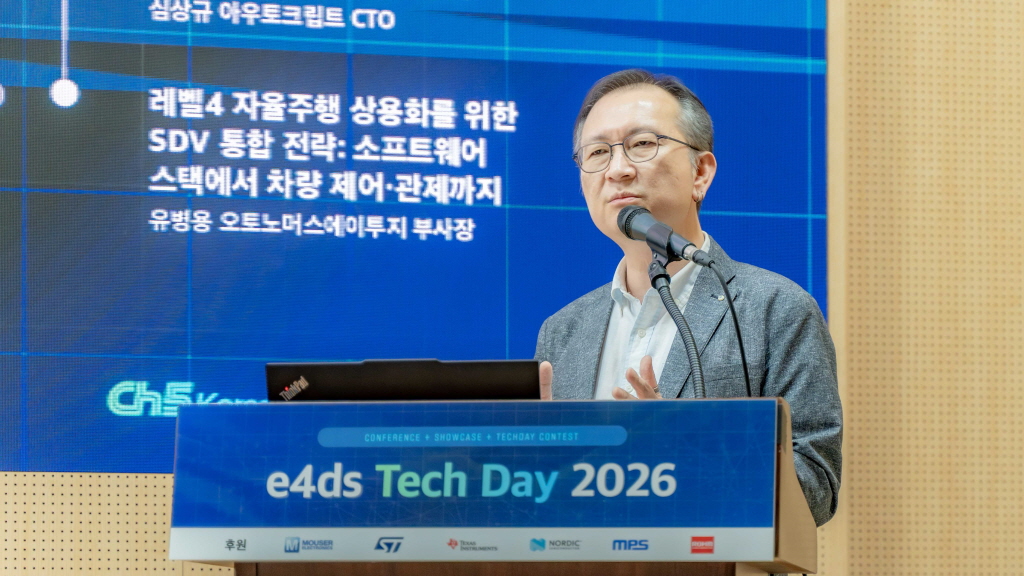
[e4ds Tech Day 2026 ⑨] Sim Sang-gyu, Autocrypt CTO: "In the Physical AI Era, Automotive Security Must Extend Beyond the Vehicle"
At e4ds Tech Day 2026, Sim Sang-gyu, CTO of Autocrypt, explained automotive cybersecurity strategies in the era of Physical AI and SDV (Software-Defined Vehicle). Automobiles are evolving as part of an ecosystem connected to AI, cloud, chargers, IoT, and robots, and he emphasized that the scope of security must expand beyond the vehicle interior to the entire connected environment. In particular, AI model tampering, adversarial attacks, OTA updates, and EV charger hacking were identified as major threats. He explained that response measures require zero trust, AI model integrity protection, intrusion detection, Security by Design and Default, and full lifecycle security management, and that proactive security system establishment beyond regulatory compliance is critical for securing future mobility competitiveness.
2026.10.12by 배종인 기자
NVIDIA to Invest $1 Billion in U.S. Science Over Next Five Years
NVIDIA has announced plans to invest $1 billion over the next five years to strengthen U.S. scientific and technological competitiveness. The company will enhance cutting-edge artificial intelligence research and development capabilities in key areas including quantum computing, healthcare, and energy security, while expanding support for higher education research institutions and cloud service providers. NVIDIA is participating as a major industry partner in the White House Office of Science and Technology Policy's Genesis Mission, and is promoting supercomputer construction in collaboration with national laboratories including Argonne and Los Alamos.
2026.10.12by 배종인 기자











