



Korea Electric Power Corporation (KEPCO) invests KRW 18.5 billion in large-scale HVDC testing infrastructure.
 Published2021.11.24 11:38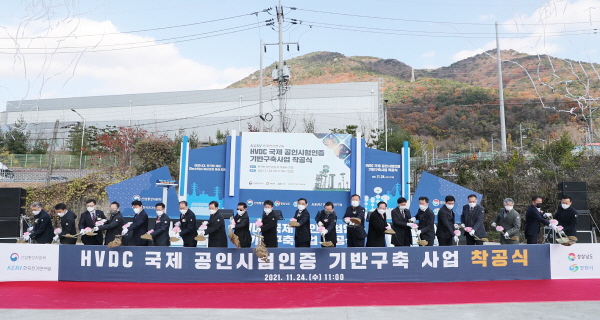
▲Dignitaries are performing tests at the groundbreaking ceremony for the Korea Electrotechnology Research Institute's 'HVDC International Accredited Testing Infrastructure.'
A large-scale power equipment testing infrastructure worth 18.5 billion won, which will lead the era of 'high voltage direct current (HVDC)', the next-generation power transmission technology, will be built in the Gyeongnam and Changwon regions.
The Korea Electrotechnology Research Institute (KERI), an internationally accredited testing and certification body for power equipment, held a groundbreaking ceremony for the 'HVDC International Accredited Testing and Certification Infrastructure Construction Project' at its Changwon headquarters on the 24th.
The event was attended by approximately 50 people including KERI Director Myeong-ho Myeong, Gyeongsangnam-do Deputy Governor for Economic Affairs Jong-won Park, Changwon City Mayor Seong-mu Heo, and Ministry of Trade, Industry and Energy Electronics Division Director Shin Yong-min, along with local government officials, key related organizations, and corporate representatives leading the project.
The event, which was held in compliance with quarantine guidelines to prevent the spread of COVID-19, consisted of welcoming remarks and congratulatory remarks from key figures, a project progress report, a groundbreaking ceremony, and commemorative photos.
HVDC is a high-voltage direct current system that transmits large amounts of electricity produced at power plants. This technology converts and transmits direct current (DC) over long distances. DC transmission maximizes energy efficiency by reducing line losses, both underground and overhead, compared to alternating current (AC) during long-distance power supply. Furthermore, because it eliminates the need for phase and frequency considerations, it facilitates power transmission across countries or between different power systems.
Furthermore, HVDC is a technology specialized for transmitting power generated by renewable energy sources, such as offshore wind power. For this reason, the government plans to expand the HVDC power grid in the 8th and 9th Basic Plans for Electricity Supply and Demand, and is planning to invest approximately 17 trillion won in 11 projects by 2025.
HVDC, which requires transmitting very high voltages over long distances, places extreme importance on the reliability and safety of related power equipment.
On the other hand, because Korea has not had a specialized testing infrastructure to verify the performance of HVDC power equipment, domestic companies have had to visit overseas testing labs, which has resulted in many problems such as financial burden, delivery delays, and overseas leakage of core design technology.
Accordingly, the Ministry of Trade, Industry and Energy, Gyeongnam Province, Changwon City, and KERI joined forces to invest a total of 18.5 billion won to build an 'Internationally Accredited Testing Infrastructure for HVDC Power Equipment' at the research institute's Changwon headquarters.
The project scale is 5,643 pyeong (18,622 m2) of land area and 467 pyeong (1,540 m2) of building area, and is targeted for completion in the second half of 2022.
KERI anticipates that once this testing infrastructure is completed, it will significantly contribute to enhancing technological capabilities and strengthening export competitiveness by quickly supporting product development for domestic power equipment companies. Referring to the case of the power equipment testing infrastructure construction project that the researcher has carried out so far, it is expected that the product development period of companies will be shortened by an average of 3.9 months, overseas testing costs will be reduced by 1.5 billion won per year, incidental costs (transportation costs, living expenses, etc.) will be reduced by 100 million won, and work efficiency will increase by a whopping 45.3%.
Furthermore, approximately 2,400 domestic and international engineers visit Gyeongnam and Changwon each year to take the exam, and the resulting boost to the local economy is expected to exceed 1 billion won annually. The total impact of infrastructure operation over the next 30 years is estimated to be an economic ripple effect of approximately 157.9 billion won and create approximately 1,000 jobs.
KERI President Myeong-ho Myeong said, “For nearly half a century, KERI has contributed greatly to domestic companies’ development of overseas markets by ensuring that the institute’s test reports are accepted in the global market based on its world-class facilities and professional manpower.” He added, “We will do our best to ensure the successful completion of the HVDC test infrastructure construction project, which will play a pivotal role in the development of the electric power industry in the southeastern region of the country.”
Meanwhile, along with the groundbreaking ceremony on this day, KERI also held a science and culture event titled “Artificial Intelligence, Direct Current, and Lightning Stories” for approximately 100 university students in the Changwon area to expand the base of AI. This event, designed to provide students who will lead the future electrified world with precious memories and experiences, consists of a special lecture on 'Understanding AI in Films', an introduction to KERI's AI technology for Changwon's development, and a tour of KERI's high-power and high-voltage testing facilities.
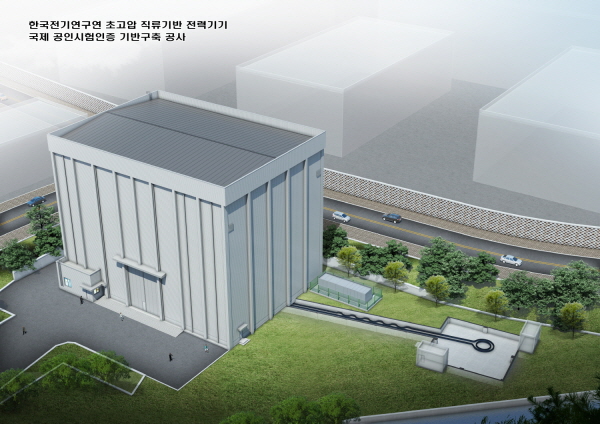
▲A bird's-eye view of the Korea Electrotechnology Research Institute's 'HVDC Internationally Accredited Testing Infrastructure'

Comments
Related news
The Korea Electrotechnology Research Institute (KERI) is building an internationally accredited testing infrastructure for HVDC power equipment, worth 18.5 billion won.
The Korea Electrotechnology Research Institute (KERI, Acting Director Yoo Dong-wook), a government-funded research institution under the National Research Council of Science and Technology (NST) under the Ministry of Science and ICT, is establishing the nation's first large-scale infrastructure in the Changwon area of South Gyeongnam Province for testing and certification of power equipment in the field of Ultra-High Voltage Direct Current (HVDC) transmission, which is recognized as a next-generation power transmission technology, thereby contributing to strengthening the export competitiveness of domestic power equipment manufacturers through the provision of fast and highly reliable testing and certification services.
2021.07.27by 배종인 기자
KERI Globally Recognized for Solving EV-Charger Compatibility Issues
The Korea Electrotechnology Research Institute (herein KERI, Acting Director Yoo Dong-wook), a government-funded research institute under the National Research Council of Science and Technology within the Ministry of Science and ICT, has been designated as the world's first electric vehicle global interoperability conformity assessment body. This is expected to resolve user inconveniences through compatibility error verification between electric vehicles and chargers.
2021.07.29by 배종인 기자
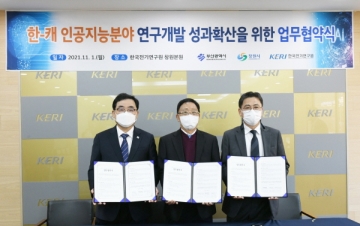
Korea Electric Power Corporation, Busan City, and Changwon City Join Forces to Expand AI Technology Achievements
The Korea Electrotechnology Research Institute (KERI, President Myung Sung-ho), Korea's only specialized research institution dedicated to electrical engineering, has joined hands with Busan Metropolitan City and Changwon City, representative cities in the southeastern region, to revitalize the regional economy through artificial intelligence (AI) technology.
2021.11.01by 배종인 기자
ESP32 Development Environment Selection and GPS Application Implementation
The ESP32 is a microcontroller that integrates Wi-Fi, Bluetooth, 12-bit ADC, capacitive touch, PWM, DAC, and UART in a single SoC. However, the abundance of features does not by itself solve the designer's problems. The real challenges lie in selecting the appropriate development environment, determining which pins can be used and which must be avoided, and converting raw data from modules into usable information. This document addresses ESP32 peripheral constraints (ADC2 and Wi-Fi coexistence limitation, UART1 occupancy, ADC non-linear regions), the trade-offs between Arduino IDE and ESP-IDF, and the process from connecting NEO-6M/NEO-M8N GPS modules to UART2, parsing NMEA sentences, and visualizing routes in Google Earth, all organized based on documented references.
2026.10.12by 편집부
MIPI CSI-2, DSI-2, C-PHY, D-PHY Test Solution Technical White Paper
The MIPI interface adopts a burst mode that transitions between low-power (LP) and high-speed (HS) states for low-power consumption, and in return, strict timing rules are imposed on state transitions. Additionally, the high-speed section operates as a packet-based protocol with headers, ECC, and CRC, so verification engineers must handle waveforms and protocols simultaneously. Traditional configurations combining general-purpose oscilloscopes and AWGs reveal limitations in setup complexity, measurement uncertainty, and lack of reproducibility when faced with these requirements. This white paper, based on webinar materials, organizes the structure of this problem and describes how the SV5C-DPTXCPTX generator for receiver testing and SV5C-DPRXCPRX analyzer for transmitter testing integrate state transition testing, stressed eye testing, and protocol analysis into a single bench, along with their application boundaries.
2026.10.12by 편집부











