



KIMM Develops Small Hydrogen Engine for Unmanned Vehicles
 Published2021.11.25 15:17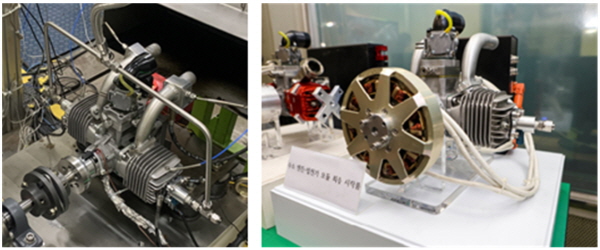
▲ Small hydrogen engine prototype
The Korea Institute of Machinery and Materials (KIMM), under the Ministry of Science and ICT (President Park Sang-jin), has created an opportunity to accelerate the future hydrogen-based mobility society through the development of core hydrogen engine technologies.
The research team led by Choi Young, head of the Green Power Research Laboratory at the Environmental Systems Research Division of the Korea Institute of Machinery and Materials, announced on the 25th that they have developed a 5 kW small hydrogen engine for driving drones.
This is the first time a small hydrogen engine capable of being used as a power source for unmanned vehicles has been developed in Korea.
Currently, most unmanned vehicles such as drones use batteries as their power source, but recently, various attempts are being made to achieve long flight endurance, including gasoline engine hybrid systems and hydrogen fuel cell systems.
The research team applied a direct injection method for supplying hydrogen fuel within a small engine and optimized engine parameters such as ignition and injection.
The small hydrogen engine developed this time achieved a maximum output of over 7 kW, and the generator and rectifier manufactured for the development of the power pack module secured an output of over 5 kW. This is enough power to launch commercially available 20-30 kg industrial drones.
Hydrogen fuel has an energy density 2.8 times higher than gasoline, allowing for longer flight times compared to drones equipped with gasoline engines. It is also noteworthy as an eco-friendly, carbon-free technology that emits no carbon.
In the future, along with research to ensure the reliability of small hydrogen engines, additional research on the development of power pack modules combining engines with generators is expected to be applied to increasing flight time and expanding the mission range of industrial drones.
It is also expected to be widely used as a power source for unmanned vehicles such as delivery robots.
Director Choi Young said, “It is significant that we have preemptively secured technology to respond to the upcoming carbon-neutral society based on the development of small hydrogen engines,” adding, “We expect to be able to accelerate the arrival of a hydrogen society by expanding the fields where hydrogen engine technology can be applied.”
Meanwhile, this research was conducted with support from the KIMM basic project 'Development of Liquid Hydrogen Engines for Drone and Robot Drives'.

Comments
Related news
.jpg)
Korea Institute of Machinery and Materials (KIMM) looks at hydrogen machine technology
The Korea Institute of Machinery and Materials will hold the "2021 Global Forum on Mechanical Engineering" online on September 8th with the theme of "Hydrogen Mechanical Engineering as the Foundation for Carbon Neutrality."
2021.08.09by 배종인 기자
Korea Institute of Machinery and Materials: Future Outlook for Hydrogen Technology
The Korea Institute of Machinery and Materials (hereinafter referred to as KIMM, Director Park Sang-jin) invited global hydrogen experts to discuss the future of hydrogen technology and share insights.
2021.09.09by 배종인 기자
Korea Mechanical Engineering & Research Institute, “Smart DP solves mid-term mechanical design difficulties”
The Korea Institute of Machinery and Materials (KIMM) under the Ministry of Science and ICT, headed by President Park Sang-jin, is moving to resolve mechanical design challenges faced by small and medium-sized enterprises through 'SmartDP,' which incorporates 40 years of mechanical design expertise.
2021.11.11by 배종인 기자
Schneider Aims for Building Energy Savings and Operational Stability with Next-Generation HVAC Drives
Schneider Electric has unveiled its next-generation HVAC drive product line 'Altivar HVAC'. The new product line's key features center on enhanced energy savings, system operational stability, and building management system integration. The products are divided into 'ATH200' for OEM and small equipment applications, and 'ATH600' for environments requiring continuous operation and advanced control. The company plans to expand the application scope from commercial buildings to facilities where HVAC system stability is critical, such as hospitals, airports, and data centers. The announcement includes over 30% energy savings, operation from -10°C to +60°C, Modbus and BACnet support, and compatibility with low global warming potential refrigerants.
2026.03.26by 명세환 기자
Ecolab Expands AI Data Center Cooling Business Through Acquisition of CoolIT
Ecolab has agreed to acquire CoolIT Systems, a liquid cooling company for AI data centers, for approximately $4.75 billion. The transaction is expected to close by Q3 2026, subject to regulatory approvals. CoolIT has been supplying direct-to-chip cooling-based coolant distribution units, cold plates, and manifolds, serving hyperscale data centers and colocation operators as customers. This acquisition is a measure to address the high-heat and high-density server environments created by AI proliferation. Ecolab plans to combine its water management and digital monitoring capabilities with CoolIT's hardware technology to expand its data center cooling business.
2026.03.26by 명세환 기자











