


Fabless Growth Depends on Talent and Investment
 Published2021.11.30 09:01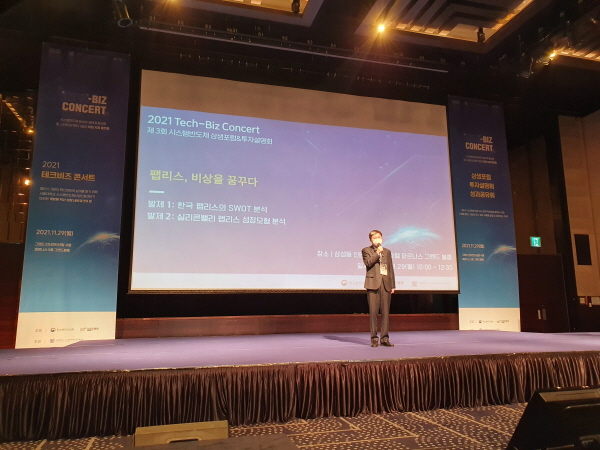
▲Lee Hyuk-jae, director of the Seoul National University System Semiconductor Industry Promotion Center, is giving an opening address.
Expanding GPs with semiconductor-specific support capabilities is essential.
It was suggested that for the growth of domestic system semiconductor fabless companies, there must be active investment from specialized fund managers (GPs) equipped with the capacity to train and secure professional human resources and support portfolios specialized in semiconductors.
The '2021 3rd System Semiconductor Symbiosis Forum & Investment Briefing', hosted by the Ministry of SMEs and Startups and the Korea Institute of Startups and Entrepreneurship Development and organized by the Seoul National University System Semiconductor Industry Promotion Center, was held at the Grand InterContinental Seoul Parnas on November 29.
In addition to the Symbiosis Forum & Investment Briefing, this event also included a job fair, performance sharing session, and networking.
At the Symbiosis Forum & Investment Briefing, a panel discussion followed the presentation of the topic.
The first presentation was by Dr. Kim Yang-paeng of the Korea Institute for Industrial Economics and Trade, titled ‘SWOT Analysis of Domestic System Semiconductors.’
Dr. Kim Yang-paeng said that the number of fabless companies in Korea peaked at about 200 in 2009 and decreased to about 150 in 2020, and that except for leading companies such as Silicon Works and AD Technology, growth is sluggish.all.
In particular, looking at the growth of the top 10 global fabless companies in terms of sales, it is diagnosed that although they are oligopolistic, many companies are showing even growth, but with the exception of a few Korean fabless companies, sales growth is not showing a particularly high level overall.
In relation to SWOT analysis, Dr. Kim Yang-paeng cited the undiscovered potential of fabless companies as a strength. Dr. Kim Yang-paeng stated that although Korea's fabless companies have not yet received much attention in the market, there are many companies that are developing semiconductors for use in new industries leading the Fourth Industrial Revolution based on their excellent technological capabilities.
Weaknesses cited include a lack of specialized personnel, a decline in new startups, a lack of scale compared to overseas competitors, the absence of demand industries, the financial strength of start-up fabless companies, and a lack of collaboration with overseas companies.
Regarding opportunities, he cited the increased possibility of small-scale fabless entry due to the development of semiconductor demand industries, increased government support, and the expansion of the domestic foundry industry. Regarding crises, he cited the prolonged US-China semiconductor hegemony competition, the growth of Taiwanese fabless, and the advancement of Chinese fabless.
Dr. Kim Yang-paeng analyzed that the domestic and international fabless markets are forming a winner-take-all structure through expansion of business areas and scale through M&A, and that in Korea, the semiconductor industry developed centered on memory semiconductors, so investment in system semiconductors has been relatively poor from the beginning.
In addition, it was revealed that domestic fabless companies are currently inferior to competitors such as the United States, China, and Taiwan in terms of the number of companies, professional manpower, and financing capacity.
However, the government has been actively supporting the industry recently, and it has great potential in terms of technology, so it is expected to have great potential for future growth.
Next, Eunse Lee, CEO of 541 Ventures, gave a presentation titled, “A Look at Silicon Valley’s Success Model Through NVIDIA’s Success Story and Actionable Insights for Korea’s Fabless Ecosystem.”
CEO Lee Eun-se analyzed that the success model of Silicon Valley in the US mostly has three elements: △mobility of talent △aggregation of talent △venture capital for high-growth high-tech companies, and that through these, technological development increases, competition among peer companies intensifies, and companies that are performing well grow through M&A.
/> He also introduced examples of growth in the US, such as Nvidia, saying that startups are actively being created in the US despite the disadvantages of low job security and career uncertainty, and that challenges and support for startups are frequently being provided, such as active training for becoming CEOs at universities.
He continued by saying that for domestic fabless companies to grow, universities play an important role in attracting talent to the ecosystem, and that domestic universities need to provide education that allows students to gain practical experience with startups and, furthermore, to help them quickly transform from entrepreneurs to managers.
Additionally, it was analyzed that the fabless ecosystem should be revitalized by encouraging the concentration of high-growth companies based in universities.
In addition, he argued that Korea's semiconductor-specialized venture capital is still lacking in terms of number and scale, and that it is necessary to foster full-fledged fabless and semiconductor-specialized venture capital, and through this, expand investment resources, expand GPs with excellent portfolio support capabilities, and expand the establishment of CVCs for Korea's fabless companies that are still in the early stages.
In the panel discussion that followed, it was discussed that domestic fabless companies are experiencing many difficulties due to the recent shortage of parts, making it difficult to reserve foundries, and that a certain portion of government support for semiconductors needs to be allocated to fabless companies.
Additionally, securing specialized talent is crucial for the growth of domestic fabless companies, and to this end, proposals have been made to operate a semiconductor design academy to attract non-major students.
In addition, they agreed that product development by fabless companies requires investments ranging from tens to hundreds of billions of won, and that an environment should be created where semiconductor investment companies can understand the reality of the semiconductor fabless industry and make full-scale investments throughout the entire cycle.
▲ Industry experts attending the '2021 3rd System Semiconductor Symbiosis Forum & Investment Briefing' are holding a panel discussion.

Comments
Related news
Minister Sung Yun-mo: "We will produce 4,800 semiconductor workers over the next two years."
Minister Sung Yun-mo of the Ministry of Trade, Industry and Energy visited Seoul National University's Semiconductor Joint Research Institute to inspect the current status of semiconductor workforce development and discuss solutions to address the chronic labor shortage in the semiconductor industry.
2021.04.16by 배종인 기자
The Semiconductor Association is taking the lead in addressing the semiconductor talent shortage.
In response to chronic semiconductor workforce shortages, the Semiconductor Industry Association and seven universities, including Seoul National University, have joined forces.
2021.09.15by 배종인 기자
Seoul National University System Semiconductor Industry Promotion Center Actively Promotes System Semiconductor Support
Seoul National University's System Semiconductor Industry Promotion Center actively promoted support policies for fostering the system semiconductor industry.
2021.10.28by 배종인 기자

Intel Unveils Next-Generation 'Core Ultra Series 3' and vPro Platform for Enterprise PCs
Intel has officially unveiled the "Intel Core Ultra Series 3" for next-generation enterprise PCs and the latest vPro platform, addressing a wide range of demands from enterprise notebooks to high-performance workstations.
2026.03.26by 배종인 기자

ROHM Launches ESD Protection Diode Compatible with High-Speed Interfaces of 10Gbps or Higher
Semiconductor specialist ROHM has developed the 'RESDxVx series' of ESD (electrostatic discharge) protection diodes capable of responding to next-generation high-speed data communication environments exceeding 10Gbps, simultaneously enhancing both signal quality maintenance required in high-speed interfaces and IC protection performance.
2026.03.26by 배종인 기자











