


Korea Electric Power Corporation (KEPCO) "Korea's leading technology in four mobility sectors"
 Published2021.11.30 16:58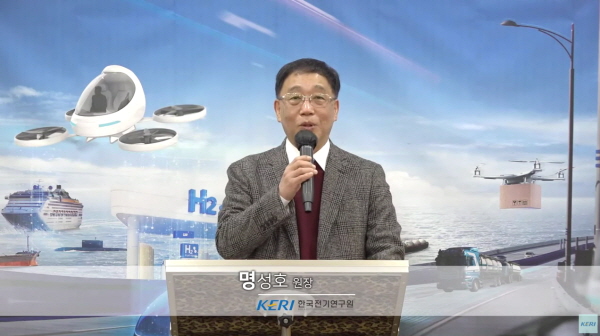
▲Myung Seong-ho, director of the Korea Electric Power Research Institute, is giving a speech at the 'Research Site Online Briefing' event.
SiC power semiconductors, onshore electric ship testing labs, electric engines for drones, and liquid hydrogen
President Myung-Ho Myeong: "We will do everything we can to achieve tangible results in the field of mobility 'electrification'."
The Korea Electrotechnology Research Institute (KERI, President Myeong-ho Myung), a government-funded research institute specializing in electricity under the National Research Council of Science and Technology of the Ministry of Science and ICT, showcased four major future mobility technologies by revealing core technologies in the fields of electric vehicles, electric ships, drones/flying cars, and hydrogen, including SiC power semiconductors, onshore testing labs for electric ships, localization of electric engines for drones/flying cars, and liquid hydrogen production and long-term storage technology.
On the 30th, the Korea Electrotechnology Research Institute presented the 'Four Key Mobility Technologies Based on Electricity Technology' through the 'Research Site Online Briefing' event.
The four core technologies introduced at this event are: △SiC (silicon carbide) power semiconductors for electric vehicles, △LBTS (Land-Based Testing Laboratory for Electric Ships), △Domestic production of electric engines for drones/flying cars, and △Liquid hydrogen production and long-term storage technology.
SiC power semiconductors play a role similar to human muscles, such as controlling the direction of current and controlling power conversion, and are essential for high-performance inverters that connect batteries and electric motors in electric vehicles.It is a key component that improves power efficiency by 10% based on its excellent material properties.
The technological barriers were high, so only a few companies in advanced countries had a monopoly, and with the recent global supply and demand shortage, technological independence was urgently needed.
In the midst of this, KERI has received much attention for developing the ultra-high-difficulty 'Trench MOSFET' technology, which can solve the supply shortage problem beyond realizing localization, becoming the third company in the world (after Germany, Japan, and Korea).
The Electric Ship Land Testing Laboratory, as its name suggests, is a facility for testing electric ships on land. It is a key facility that was completed in 2015 as the first of its kind in Korea and the third in the world (after the US, UK, and Korea).
Electric ships are a difficult field to maintain if a breakdown or problem occurs after the propulsion system is installed at the bottom, and the ship must be dismantled and repaired.
On the other hand, by conducting a preliminary performance verification process through KERI's onshore testing laboratory, it has brought about significant effects such as shortening the ship construction period and reducing losses caused by delays in electrification. Including other benefits such as technology import substitution and development of related industries, the total ripple effect is over 500 billion won.
The localization of electric engines for drones and flying cars is the first domestic achievement of independently developing 'electric motors' and 'generators' that propel manned and unmanned aircraft with electric power rather than the existing fossil fuel-based aircraft engines.
The most important conditions in the field, such as 'low noise', 'stability', and 'high output', were all successfully achieved, and safety and security issues that had previously arisen from the use of foreign parts were resolved through domestic production.
Through continuous research in the future, we will develop a 10kW electric motor and a 100kW generator with stability sufficient for a person to ride within 3 years.The goal is to make the country a leader in the flying car industry.
Liquid hydrogen production and long-term storage technology is expected to significantly contribute to eliminating the explosion risk of existing gaseous hydrogen and to the revitalization of the future hydrogen economy and the realization of carbon-neutral policies.
KERI's achievement is the 'Zero Boil-off' technology, which cools hydrogen gas to an extremely low temperature (-253 degrees Celsius) to create liquid hydrogen and allows long-term storage of this hydrogen without loss.
This technology, which enhances the safety of hydrogen storage, is expected to secure public acceptance and enable long-distance transport and widespread use of hydrogen.
In an online briefing held that day, KERI President Myeong-ho Myung said, “Mobility is a field that has a huge impact on the lives of our people and the Korean industry, and it is a field where ‘electrification’ is progressing faster than anywhere else.” He added, “We will do our best to create tangible results that the people and businesses can feel.”
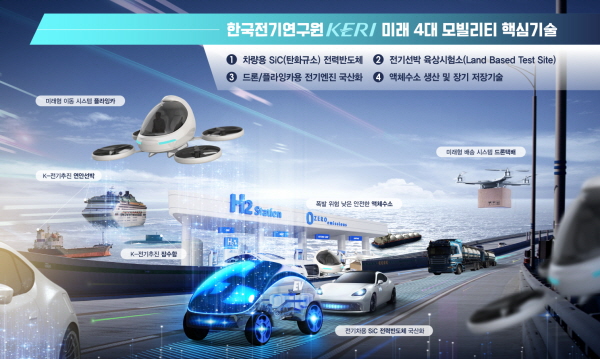
▲Korea Electrotechnology Research Institute's four key future mobility technologies

Comments
Related news
.jpg)
Korea Electric Power Corporation (KEPCO) has achieved long-term storage of liquid hydrogen.
A technology has been developed that can store liquefied hydrogen, produced by cooling gaseous hydrogen to -253 degrees, over an extended period without loss. This technology is garnering expectations that it will make a decisive contribution to long-distance transportation and the government's carbon neutrality policy.
2021.10.13by 배종인 기자
KERI Solves Challenges in All-Solid State Battery Commercialization
The Korea Electrotechnology Research Institute (KERI, President Myung Sung-ho) has developed a technology capable of resolving various issues including lithium loss, interfacial side reactions, and internal short circuits—key challenges in commercializing solid-state batteries—thereby further enhancing the prospects for future commercialization of solid-state batteries.
2021.11.08by 배종인 기자
Korea Electric Power Corporation (KEPCO) invests KRW 18.5 billion in large-scale HVDC testing infrastructure.
A massive power equipment testing infrastructure worth 18.5 billion won, which will lead the era of next-generation power transmission technology known as High Voltage Direct Current (HVDC), is being constructed in the Gyeongnam and Changwon regions.
2021.11.24by 배종인 기자

[e4ds Tech Day 2026 ⑨] Sim Sang-gyu, Autocrypt CTO: "In the Physical AI Era, Automotive Security Must Extend Beyond the Vehicle"
At e4ds Tech Day 2026, Sim Sang-gyu, CTO of Autocrypt, explained automotive cybersecurity strategies in the era of Physical AI and SDV (Software-Defined Vehicle). Automobiles are evolving as part of an ecosystem connected to AI, cloud, chargers, IoT, and robots, and he emphasized that the scope of security must expand beyond the vehicle interior to the entire connected environment. In particular, AI model tampering, adversarial attacks, OTA updates, and EV charger hacking were identified as major threats. He explained that response measures require zero trust, AI model integrity protection, intrusion detection, Security by Design and Default, and full lifecycle security management, and that proactive security system establishment beyond regulatory compliance is critical for securing future mobility competitiveness.
2026.10.12by 배종인 기자

Practical HIL Construction Strategy for Automotive and Off-Highway Controller Validation
As vehicle E/E architecture transitions to zonal structures and shifts to software-defined vehicles (SDV), the number of controllers (ECUs) requiring validation and software complexity are surging dramatically. Meanwhile, real vehicle testing cannot provide repeated verification under identical conditions and entails lead time and safety concerns. This white paper explains the principles of HIL (Hardware-in-the-Loop) validation and the structure of the NI platform composed of PXI, SLSC, and VeriStand, and through two actual implementation cases—Camera Record & Replay HIL for In-Cabin Monitoring Controller (ICMU) and Forklift Controller (VCU) HILS—describes how controller-level regression testing becomes possible. Additionally, it explicitly states application boundaries and limitations, such as lack of A2B support.
2026.10.12by 편집부











