



ETRI Develops Large-Scale Drone Simulator
 Published2021.12.13 15:13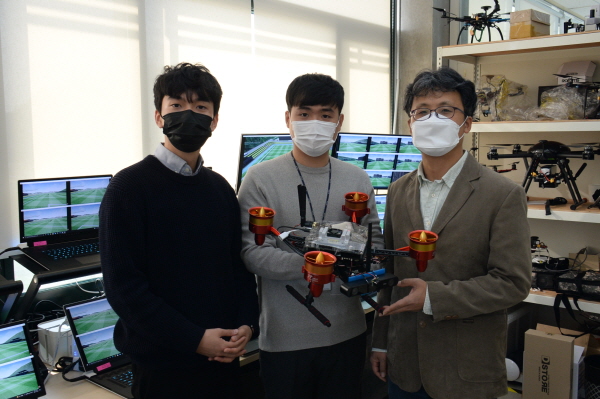
▲ (From left) Researcher Yang Jeong-gi, Researcher Choi Eui-hwan, Principal Researcher Lee Su-jeon, and other researchers who participated in the development of distributed multi-drone simulation technology
Domestic researchers have developed the world's first technology that allows multiple drones to interact and perform various missions in a virtual space.
The Electronics and Telecommunications Research Institute (ETRI) announced that it has developed 'high-precision distributed drone simulation' technology that enables safe and rapid research on various drones in a virtual space.
The technology developed by ETRI is the world's first simulator capable of testing the process of performing various missions with large-scale drones, and software that allows for easy control and monitoring of drones from the ground.
By utilizing this technology, you can make drones smarter by testing various situations that are difficult to implement in actual experimental environments.
The simulator can display an avatar drone that precisely reflects the characteristics of a real drone.
In addition, by setting up environments such as virtual drones and obstacles in the simulator, you can test situations where a real drone avoids or interacts with them even if there is nothing in reality.
Even functions requiring high performance are not includedIt made it possible to test quickly while conveying it.
Previously, complex tasks could not be assigned because only limited computing power could be utilized, but the research team overcame this limitation with a technology that enables iterative and reinforcement learning using multiple distributed computers.
ETRI conducted a demonstration to verify the technology by connecting various types of devices, such as server-class computers and laptops, and simultaneously operating 100 virtual drones.
In addition, they succeeded in precisely reproducing the physical phenomena that occur in situations where multiple virtual drones collaborate to transport heavy objects connected by ropes.
Furthermore, we have completed the verification of a technology in which a deep neural network for autonomous flight, trained through hundreds of thousands of iterations in a simulation space, is installed on an actual drone to fly to its destination while avoiding obstacles.
ETRI stated that the core technologies are drone simulation technology and its application technologies, including distributed multi-drone simulation technology, high-precision object modeling technology, drone physics engine technology, simulation reinforcement learning-based drone autonomous flight technology, multi-drone ground control technology, and synchronization technology between actual drones and avatar drones.
Lee Su-jeon, a principal researcher at ETRI’s Unmanned Vehicle Research Lab, said, “I hope this technology will help accelerate the development of multi-drone missions and services, making economies of scale—which were considered impossible in the drone industry—a reality.”

Comments
Related news
ETRI Successfully Develops 5G Standalone Mode Small Cell Software
Domestic researchers have developed technology that enables 5G implementation without LTE assistance in small base stations, which is expected to be widely utilized in providing users with high-capacity, high-quality data or delivering 5G specialized network services.
2021.11.25by 배종인 기자
ETRI develops AI capable of 5 quadrillion calculations per second
Domestic researchers have developed a system capable of accelerating artificial intelligence (AI) learning and inference with approximately 5,000 trillion operations per second, and it is expected to be utilized in large-scale AI services such as autonomous driving, cloud computing, and data centers.
2021.12.03by 배종인 기자
.jpg)
ETRI establishes international standards for real-time streaming technology.
The real-time streaming technology proposed by the Electronics and Telecommunications Research Institute (ETRI) has been established as an international standard, and it is garnering expectations that internet live broadcasting services can be supported worldwide without traffic loss of real-time data.
2021.12.10by 배종인 기자
Korea Instrument, KOLAS Accredited Calibration Agency First to Simultaneously Acquire ISO/IEC 27,001·27,701
Korea Instrument has become the first among KOLAS accredited calibration agencies to simultaneously acquire ISO/IEC 27,001 and ISO/IEC 27,701 certifications. Through its proprietary platforms CWIZ Enterprise and CWIZ Partners, the company has embedded information security and personal data protection requirements across all business processes including customer information, equipment data, and calibration reports, with plans to continuously advance its management system through regular audits and security inspections.
2026.10.12by 배종인 기자
TeamViewer One, IT Incident Automation Workflow and Resolution Center Enhanced
TeamViewer has added IT incident automation capabilities and an advanced Resolution Center to its integrated digital workplace management platform 'TeamViewer ONE'. Recurrent service disruptions, configuration errors, and capacity shortages are automatically handled according to preset policies, and device status verification through script deployment can be managed in a unified interface, significantly reducing repetitive tasks for IT teams.
2026.10.12by 배종인 기자











