



Samsung Electronics to Supply Automotive Memory, Accelerating its Targeting of the Automotive Market
 Published2021.12.16 12:25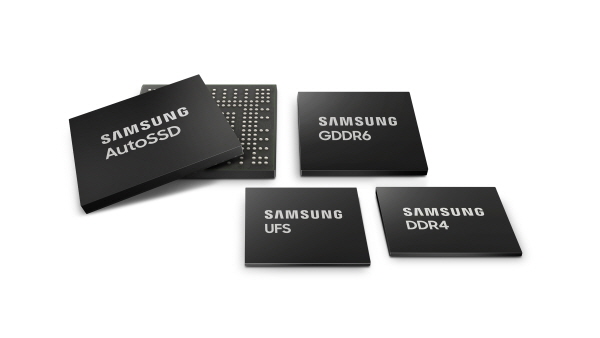
Samsung Electronics has begun supplying next-generation vehicle memory solutions to global automakers, marking the start of its full-scale attack on the automotive semiconductor market.
Samsung Electronics announced on the 16th that it will begin full-scale market expansion by supplying advanced automotive memory solutions with enhanced performance and reliability, such as high-performance SSDs and graphic DRAM, to global automakers.
The vehicle memory solutions being supplied this time include three types of △PCIe Gen3 NVMe 256GB (gigabyte) SSD △2GB DDR4 DRAM △2GB GDDR6 graphic DRAM optimized for high-performance infotainment systems, and two types of △2GB GDDR6 graphic DRAM △128GB UFS for autonomous driving systems.
With the recent expansion of autonomous driving systems and the advancement of in-vehicle infotainment systems, including high-resolution maps, video streaming, and high-spec games, demand for high-capacity, high-performance memory semiconductors, such as high-capacity NVMe SSDs and high-performance graphic DRAM, is also continuously increasing.
Samsung Electronics, which introduced the industry's first automotive UFS in 2017, plans to lead market growth by expanding the supply of high-performance server-grade SSDs and graphic DRAM for automotive use.
The industry's highest-performance 256GB (gigabyte) SSD being supplied this time has a sequential read speed of 2,100MB/s and a sequential write speed of 300MB/s, which are 7 times and 2 times faster, respectively, than the eMMC installed in existing vehicles.
2GB GDDR6 per pin It is expected to support data processing speeds of up to 14 Gbps, allowing drivers to enjoy a variety of high-spec multimedia content and quickly process large amounts of autonomous driving data, providing a safer driving environment.
Additionally, all of these products meet AEC-Q100, the automotive semiconductor quality standard.
It operates stably in extreme environments from -40℃ to 105℃, ensuring the high level of safety required in the automotive semiconductor market.
“Due to the recent spread of electric vehicles and the rapid development of infotainment and autonomous driving systems, the semiconductor replacement cycle in the automotive industry is shortening from 7-8 years to 3-4 years, and a paradigm shift is underway in which future performance and capacity are evolving to server-level levels,” said Han Jin-man, Executive Vice President and Head of Strategic Marketing at Samsung Electronics’ Memory Business Division. “Samsung Electronics will contribute to accelerating the era of autonomous driving by providing cutting-edge total memory solutions for vehicles in a timely manner.”

Comments
Related news
Samsung Electronics Strengthens Foundry's Cutting-Edge Process-Based Chip Implementation Solutions
Samsung Electronics is strengthening its foundry cutting-edge solutions with △3-nanometer design infrastructure △AI EDA technology △2.5D/3D packaging.
2021.11.19by 배종인 기자

Samsung Electronics to Invest $17 Billion in New Foundry in Taylor, Massachusetts
Samsung Electronics has decided on Taylor, Texas as the location for its new foundry investment in the United States. Samsung Electronics will invest $17 billion in Taylor with the goal of beginning operations in 2024.
2021.11.24by 배종인 기자
Samsung Electronics Strengthens Automotive Semiconductors
Samsung Electronics has unveiled three next-generation automotive system semiconductors, including communication chips, processors, and power management chips, thereby strengthening its automotive semiconductor portfolio.
2021.12.01by 배종인 기자

Intel Unveils Next-Generation 'Core Ultra Series 3' and vPro Platform for Enterprise PCs
Intel has officially unveiled the "Intel Core Ultra Series 3" for next-generation enterprise PCs and the latest vPro platform, addressing a wide range of demands from enterprise notebooks to high-performance workstations.
2026.03.26by 배종인 기자
ROHM Launches ESD Protection Diode Compatible with High-Speed Interfaces of 10Gbps or Higher
Semiconductor specialist ROHM has developed the 'RESDxVx series' of ESD (electrostatic discharge) protection diodes capable of responding to next-generation high-speed data communication environments exceeding 10Gbps, simultaneously enhancing both signal quality maintenance required in high-speed interfaces and IC protection performance.
2026.03.26by 배종인 기자











