


UNIST Challenges Development of 35% Efficiency Super Solar Cells
 Published2021.12.22 09:36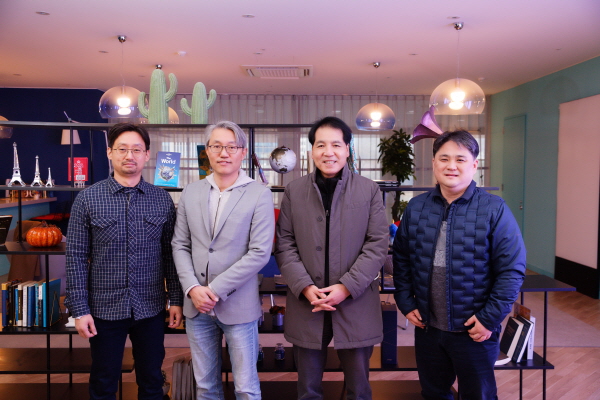
▲(From left) Professor Yang Chang-deok of the Department of Energy and Chemical Engineering, Professor Choi Kyung-jin of the Department of Materials Science and Engineering, Professor Seok Sang-il of the Department of Energy and Chemical Engineering, and Professor Song Myeong-hun of the Department of Materials Science and Engineering who will conduct this research
UNIST is challenging itself to develop a super solar cell with an efficiency of 35% over the next five years, contributing to carbon neutrality and the advancement of the domestic solar power industry.
On the 8th, UNIST was confirmed as the final implementing agency for the Alchemist Project, hosted by the Ministry of Trade, Industry and Energy. UNIST beat out Seoul National University and other institutions to be selected as the final project implementer for the renewable energy Alchemist Project, and will receive 10 billion won in support over the next five years.
The research team is challenging the development of a super solar cell with an efficiency of 35%. Tandem technology will be used to develop this cell, which will significantly exceed the theoretical efficiency limit of 30% for commercial silicon solar cells.
Tandem technology is a 1+1 technology that combines perovskite thin-film solar cells on top of silicon solar cells.
For this purpose, researchers from UNIST's Department of Materials Science and Engineering (Professor Song Myung-hoon) and Department of Energy and Chemical Engineering (Professor Yang Chang-deok) gathered together, including Professor Kyung-jin Choi, an expert in silicon solar cells, and Professor Sang-il Seok, a world-renowned scholar in the field of perovskite solar cells.
In addition to developing ultra-high-efficiency super solar cells, the research team will also conduct research to improve long-term stability and price competitiveness, known as the Golden Triangle, the three conditions for commercializing solar cells.
Research includes materials technology, large-area processes, modular component technology, and integrated equipment development. Leading research institutes and companies such as KETI, KIST, Juseong Engineering Co., Ltd., and ENF Technology Co., Ltd. are expected to contribute their efforts.
Professor Kyung-Jin Choi of the Department of Materials Science and Engineering at UNIST, who is in charge of the project, said, “Ultra-high-efficiency super solar cells will be an effective strategy to respond to climate change and bring forward the era of carbon neutrality,” and added, “It will also be of great help to the domestic solar power industry, which has lost its leadership due to China’s low-price offensive.”
Professor Seok Sang-il of the Department of Energy and Chemical Engineering at UNIST said, “UNIST researchers have established themselves as a global leader in the field of perovskite solar cells over the past decade,” adding, “If we make good use of the knowledge we have accumulated so far, developing a super solar cell with an efficiency of 35% is very difficult, but it is worth the challenge.”
Meanwhile, the Alchemist Project, launched in 2019, is a tournament-style technology development project. The final project implementer is selected through a comprehensive evaluation of the performance of the preliminary project implementers selected in the first round. Among the 10 research teams that applied for the renewable energy sector, UNIST, Seoul National University, and Korea University were selected as preliminary implementation organizations for the project and have been conducting preliminary research for the past two years.

Comments
Related news
UNIST Knocks on the Door to the World Finals of the Avatar Robot Competition
UNIST (President Lee Yong-hoon) has advanced to the finals on the world stage of "avatar robots" where robots move following the user's movements with a control device, competing for the position of top performer.
2021.10.26by 배종인 기자
UNIST Semiconductor Circuit Design Technology 3, Unveiled at ISSCC
Three semiconductor circuit design technologies from UNIST (President Lee Yong-hoon) will be presented at the 2022 International Solid-State Circuits Conference (ISSCC), known as the "Semiconductor Olympics."
2021.11.23by 배종인 기자
UNIST, AI World Stage ‘Top’ Recognition
A graduate student Yun Tae-hyun from UNIST's Graduate School of Artificial Intelligence (advisor: Prof. Lim Sung-bin) achieved the top position in the student category at a prestigious global artificial intelligence conference competition. The achievement was recognized for delivering the highest program performance in an emerging field that has recently attracted significant academic attention.
2021.12.06by 배종인 기자
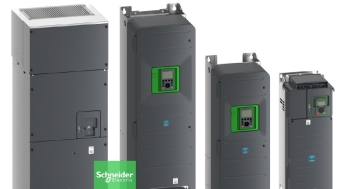
Schneider Aims for Building Energy Savings and Operational Stability with Next-Generation HVAC Drives
Schneider Electric has unveiled its next-generation HVAC drive product line 'Altivar HVAC'. The new product line's key features center on enhanced energy savings, system operational stability, and building management system integration. The products are divided into 'ATH200' for OEM and small equipment applications, and 'ATH600' for environments requiring continuous operation and advanced control. The company plans to expand the application scope from commercial buildings to facilities where HVAC system stability is critical, such as hospitals, airports, and data centers. The announcement includes over 30% energy savings, operation from -10°C to +60°C, Modbus and BACnet support, and compatibility with low global warming potential refrigerants.
2026.03.26by 명세환 기자
Ecolab Expands AI Data Center Cooling Business Through Acquisition of CoolIT
Ecolab has agreed to acquire CoolIT Systems, a liquid cooling company for AI data centers, for approximately $4.75 billion. The transaction is expected to close by Q3 2026, subject to regulatory approvals. CoolIT has been supplying direct-to-chip cooling-based coolant distribution units, cold plates, and manifolds, serving hyperscale data centers and colocation operators as customers. This acquisition is a measure to address the high-heat and high-density server environments created by AI proliferation. Ecolab plans to combine its water management and digital monitoring capabilities with CoolIT's hardware technology to expand its data center cooling business.
2026.03.26by 명세환 기자











