



NXP to provide autonomous driving L2 and above radar chips
 Published2022.01.14 10:13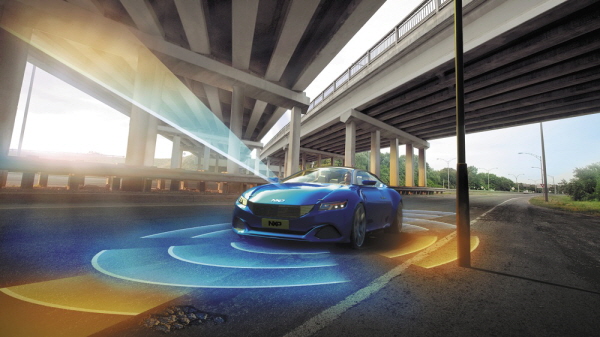
NXP Semiconductors is providing a 16nm radar processor tailored for autonomous driving L2 and higher applications, providing momentum for securing the rapidly growing autonomous driving radar market.
NXP Semiconductors N.V. today announced updates to its industry-leading automotive radar portfolio, the S32R45 and S32R41, which are currently being designed into by the top 20 global OEMs.
NXP has begun volume production of the NXP S32R45, the industry’s first dedicated 16nm imaging radar processor, with initial customer adoption beginning in the first half of 2022.
Additionally, the new product NXP S32R41 has been introduced to apply the advantages of 4D imaging radar to more vehicles.
Both processors provide 4D imaging radar for 360-degree surround sensing, meeting autonomous driving requirements from L2 to L5.
Imaging radar extends radar's ability to see the environment around a vehicle beyond detecting large objects by providing high-resolution point clouds that enhance environmental mapping and scene understanding.
Images can be used to distinguish between objects such as vehicles and vulnerable road users in complex urban environments, such as a motorcycle driving close to a large delivery truck or a child weaving between parked cars.
In addition, imaging radar can detect objects at distances of up to 300 meters, beyond the range of human vision. We need to measure speed and classify objects.
They also need to distinguish between fast-moving vehicles on the road and stationary obstacles, such as slow-moving vehicles or a missing tire on the road. NXP addresses these challenges with its latest imaging radar processor update.
NXP’s 4D imaging radar is the first to provide simultaneous 3-in-1 multi-mode radar detection for short-, medium-, and long-range operation, enabling simultaneous detection of a very wide area around a vehicle.
To achieve this, NXP leverages an innovative architecture that leverages 192 virtual antenna channels to reduce complexity in sensor configurations, boosting performance beyond the capabilities of raw sensor hardware.
This is achieved through a combination of proprietary radar hardware acceleration that can deliver up to 64x the compute performance of standard processors, super-resolution radar software algorithms that achieve sub-angular resolution, and advanced MIMO waveforms that allow simultaneous operation of antenna channels. This architecture helps overcome the limitations of other high-resolution sensors, such as LIDAR and massive MIMO radar with large antenna counts, which have limited their use due to cost and complexity.
“NXP’s new imaging radar processors enable vehicles to perceive their surroundings by producing high-resolution images that enhance object detection and classification – a key step toward improving road safety and saving lives,” said Torsten Lehmann, general manager and executive vice president of radio frequency processing at NXP. “Our expanded S32R family lineup leverages NXP’s leadership in radar processing, super-resolution algorithms and advanced MIMO waveforms to bring the benefits of imaging radar to the rapidly growing fleet of autonomous L2 and beyond vehicles.”

Comments
Related news
.jpg)
NXP Reduces Wi-Fi 6/6E Loss Tracking with QFN Packages
NXP Semiconductors has launched a QFN solution supporting Wi-Fi 6/6E for smartphones and computing devices. OnePlus has become the first to adopt NXP's Wi-Fi 6 QFN RF front-end solution in its latest flagship smartphone model, the OnePlus 9, which supports Wi-Fi 6.
2021.04.29by 강정규 기자
.jpg)
NXP Implements CAN SIC Transceiver for China's Changan Automobile
NXP Semiconductor has achieved improved CAN FD performance through its CAN signal enhancement technology.
2021.10.20by 강정규 기자
IAR Supports NXP's Latest Automotive MCU, the S32K3
IAR Systems®, a global embedded development software tools and services provider, supports NXP's latest automotive MCUs.
2021.12.03by 배종인 기자

[e4ds Tech Day 2026 ⑨] Sim Sang-gyu, Autocrypt CTO: "In the Physical AI Era, Automotive Security Must Extend Beyond the Vehicle"
At e4ds Tech Day 2026, Sim Sang-gyu, CTO of Autocrypt, explained automotive cybersecurity strategies in the era of Physical AI and SDV (Software-Defined Vehicle). Automobiles are evolving as part of an ecosystem connected to AI, cloud, chargers, IoT, and robots, and he emphasized that the scope of security must expand beyond the vehicle interior to the entire connected environment. In particular, AI model tampering, adversarial attacks, OTA updates, and EV charger hacking were identified as major threats. He explained that response measures require zero trust, AI model integrity protection, intrusion detection, Security by Design and Default, and full lifecycle security management, and that proactive security system establishment beyond regulatory compliance is critical for securing future mobility competitiveness.
2026.10.12by 배종인 기자

Practical HIL Construction Strategy for Automotive and Off-Highway Controller Validation
As vehicle E/E architecture transitions to zonal structures and shifts to software-defined vehicles (SDV), the number of controllers (ECUs) requiring validation and software complexity are surging dramatically. Meanwhile, real vehicle testing cannot provide repeated verification under identical conditions and entails lead time and safety concerns. This white paper explains the principles of HIL (Hardware-in-the-Loop) validation and the structure of the NI platform composed of PXI, SLSC, and VeriStand, and through two actual implementation cases—Camera Record & Replay HIL for In-Cabin Monitoring Controller (ICMU) and Forklift Controller (VCU) HILS—describes how controller-level regression testing becomes possible. Additionally, it explicitly states application boundaries and limitations, such as lack of A2B support.
2026.10.12by 편집부











