



KT and Nokia Apply 30km Fronthaul Technology to Commercial Networks
 Published2022.01.24 10:21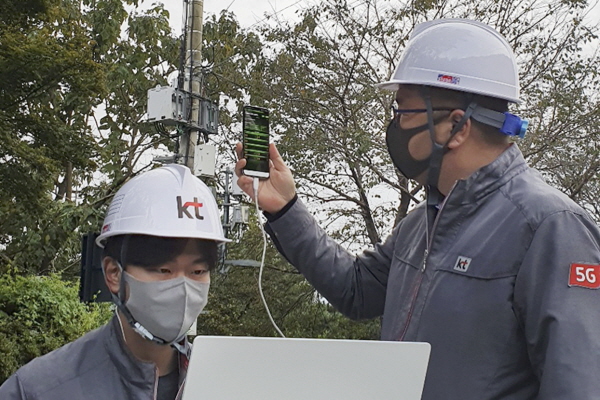
▲ KT employees are conducting a long-distance fronthaul test in Damyang, South Jeolla Province.
Increased network investment and operational efficiency
Rapid failure cause analysis and action possible
KT announced on the 24th that, in cooperation with Nokia, it has successfully verified a 30km long-distance fronthaul for both 5G and LTE for the first time in Korea and applied it to a commercial network.
With this technology, it is expected that network investment and operational efficiency will be improved by increasing the centralization of DUs that process digital signals in wireless networks, and rapid fault recovery measures will be possible by eliminating travel time in the event of a failure.
Fronthall refers to the section between the RU (Radio Unit) installed at the wireless base station and the DU (Distributed Unit) installed at the local office.
RU is a unit that processes RF signals at a wireless base station, and DU is a unit that processes digital data at a local office.
Generally, data collected at the RU antenna for wireless communication is transmitted to the DU through the optical cable of the front hall.
Since the existing fronthaul supported up to 20km, it was impossible to operate the wireless base station where the RU was installed if it went beyond this distance.
For this reason, LTE and 5G coverage was provided through local offices equipped with DUs to meet the 20km front-haul distance.
In addition, when a wireless network failure occurred, there was the burden of having to dispatch personnel from the central office to the regional office to analyze the cause, and the delay in travel time made it difficult to take prompt measures to restore the network.
KT is expected to be able to resolve difficulties, such as rapid disaster recovery measures, through this technical verification.
Lee Jong-sik, Head of the Infrastructure DX Research Institute at KT's Convergence Technology Institute, stated, "This successful verification is the result of KT's dedication to differentiated research and development." He added, "Going forward, we will continue to build networks that simultaneously satisfy 5G coverage and quality, and we will also make sustained efforts in R&D for network architectures to facilitate future 6G evolution."
Comments
Related news
Nvidia invests $5 billion in Intel
NVIDIA and Intel, leaders in global AI computing technology, are now forging ahead in providing cutting-edge solutions through NVLink-based architecture integration. NVIDIA and Intel have officially announced a strategic partnership and stated that they will jointly develop customized data center and personal computing products to accelerate diverse applications and workloads ranging from hyperscale to enterprise and consumer markets, thereby laying the foundation for the next generation computing era.
2025.09.22by 배종인 기자
.jpg)
Applied Materials Launches Environmental Protection Campaign to Mark World Cleanup Day
Applied Materials Korea (CEO Park Kwang-seon) is carrying out environmental cleanup activities with employees and their families around the Dongtan Sinricheon area on the occasion of World Cleanup Day, evolving into a company that engages with the local community beyond technological innovation.
2025.09.22by 명세환 기자
.jpg)
The combination of electrical and electronic technologies like AI, semiconductors, and electric vehicles with renewable energy will determine industrial competitiveness.
Professor Lim Chun-taek from Gwangju Institute of Science and Technology (GIST) stated in his keynote speech at the '2025 e4ds Tech Day' on the 9th, "Global energy investment is already shifting from fossil fuels to renewable energy, and the trend of electrification combined with electrical and electronic technologies is changing the industrial landscape."
2025.09.12by 배종인 기자
.jpg)
"Data Center Power Demand Surges: Distributed Energy is the Solution"
The power demand of data centers is surging rapidly alongside the accelerating growth of artificial intelligence (AI), cloud, and electric vehicle industries. In particular, the global power supply and demand structure centered on the United States is undertaking a massive infrastructure reorganization to adapt to this change, and Korea is no exception in this trend. As an alternative to overcome the limitations of the existing centralized power system, distributed energy systems and smart grid technologies are gaining attention.
2025.09.02by 배종인 기자
Huawei Begins Full-Scale Training of Young Korean Global ICT Leaders
Global ICT company Huawei Korea has signed a Memorandum of Understanding (MOU) with Dongguk University, Ewha Womans University, and Hanyang University, and will jointly implement a global education program to nurture next-generation ICT leaders.
2025.08.29by 배종인 기자











