



“Protecting against car firmware vulnerabilities with chips”
 Published2022.01.25 14:30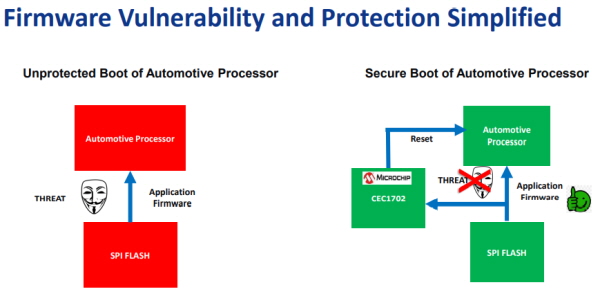
Firmware integrity verification through digital signatures is required
With fully autonomous vehicles equipped with advanced sensors and computers expected to generate up to 20TB of data per day, a session was held to share ways to protect against hacking threats that may occur during the booting process and firmware updates.
On the 25th, E4ds Webinar hosted a webinar by Microchip Senior Engineer Sangshin Kwak titled 'Platform Firmware Resilience for Automotive Applications'.
In this webinar, Senior Engineer Kwak Sang-shin presented on vulnerabilities and protection methods that occur during the booting process and firmware updates in rapidly evolving automotive systems.
He then proposed verifying the integrity of the firmware through an unmanipulable ROM area and a digital signature using asymmetric encryption, stating that Microchip's CEC1702 could be a method.
Currently, the automotive market is rapidly developing not only infotainment but also driver assistance systems and autonomous driving capabilities.
Lane keeping assist, front and rear collision avoidance and warning systems, etc., help drivers drive safely and easily and also help prevent accidents.
The widespread adoption of electric vehicles cannot be overlooked either.
Hybrid and electric vehicles recommended for environmental protectionThis is a growing trend, and many companies are signaling a shift from internal combustion engines to electric vehicles.
Companies are preparing various wired and wireless interfaces to connect automobiles and smart devices.
It has been raised that the rapid development of the infotainment market could lead to cybersecurity issues.
As user interfaces increase, security vulnerabilities arise, leading to various hacking attempts, and consequently, various cases of damage and research are being reported.
Automotive systems generate such a massive amount of data that they are called 'data centers on wheels'.
The amount of data produced by the final autonomous vehicle per day is expected to be 5TB to 20TB.
Since this information may contain personal information, care must be taken in its handling and processing.
Chief Kwak stated, “There may be vulnerabilities in firmware when processing vast amounts of information,” adding, “We are already being attacked by hackers for various reasons.”
Automotive systems do not have good countermeasures for hacking defense compared to other applications.
Unlike other IT applications, CPUs, MCUs, and SoCs used in automobiles do not restrict access to internal or external memory for automotive-type processes, nor do they perform secure boot for authentication or load mutual authentication across networks.
As the latest automotive electronic systems evolve in functionality and complexity, security vulnerabilities within vehicles are increasing significantly and can have a serious impact.
Interfaces such as USB, Bluetooth, and Wi-Fi provide convenience to users, but from the system's perspective, they increase the vulnerable areas susceptible to attack.
OEMIt requires system program update functions for various reasons, and this can also be a vulnerability.
Failure to prepare for this poses a significant threat to end users, can damage the company's image, and carries the risk of intellectual property exposure.
Chief Kwak proposed using a method to verify the integrity of the firmware through an unmanipulable ROM area implemented in internal hardware and a digital signature using asymmetric encryption.
Microchip's CEC1702 product boots from an immutable area, and after power is turned on, the processor maintains a reset state until firmware verification is complete. Once verification is complete, the reset state is released to allow the processor to operate from an external flash, which can serve as a measure to protect the firmware.
The 'CEC1 Family' product line is AEC-Q100 certified, making it suitable for automotive applications, and is evaluated as suitable for automotive use because it supports various symmetric and asymmetric algorithms.
When updating the firmware, you must also go through the same process as Secure Boot.
In addition, you must update to the new firmware after undergoing verification processes such as digital signatures.
In response to a question during the Q&A about what needs to be reviewed to ensure smooth protection from risks during the automotive firmware update process, Senior Manager Kwak stated that in order to update firmware for various products, including not only automobiles but also IoT, it is necessary to verify who sent the update and whether the source is safe.
They added that this verification process is a basic requirement and that additional verification may be necessary depending on the application.
Comments
Related news
Microchip Launches maXTouch® Touchscreen Controller
A versatile touchscreen controller offering various display flexibility including ISO 26262 functional safety support and flexible RF emission control has been released, and it is attracting expectations that it will save time and resources required for additional development and certification.
2021.12.01by 강정규 기자

Microchip Expands GaN RF Power Portfolio
Microchip Technology, a global leader in microcontrollers, mixed-signal, analog semiconductors, and flash-IP solutions (Asia General Manager and Korea Representative Ban Byung-don), has expanded its radio frequency power device portfolio by launching new MMIC and discrete devices that meet the performance requirements of 5G, satellite communications, and defense applications.
2021.12.06by 강정규 기자
Microchip Launches ICE for MCUs and MPUs
In-circuit emulators featuring wireless connectivity, power debugging, and real-time code profiling through tracing are expected to provide a flexible development experience.
2022.01.06by 강정규 기자
.png)
Databricks Unveils Open AI Security Monitoring 'Lakewatch'
Databricks entered the security market on March 24 by unveiling LakeWatch, an open-source agentic SIEM. The core functionality of this product is to integrate and analyze security, IT, and business data in a single environment to support AI-based threat detection and investigation. The company explained that it reduces the limitations of existing security operations centers, which have had to forgo some data due to high cost structures, and enables large-scale data analysis and automation based on open formats and ecosystems. LakeWatch is currently offered as a private preview, with Adobe and Dropbox mentioned as early customers. Databricks also announced an expanded partnership with Anthropic as well as the acquisition of Antimatter and SiftD.ai.
2026.03.26by 배종인 기자

Kaspersky Unveils Revamped 'NEXT' Combining SOC Integrated Management and AI Analytics
As enterprises increase demand for integrated management and automation in the construction and operation of Security Operations Centers (SOC), Kaspersky has disclosed updates to its B2B security product suite 'Kaspersky Next'. This update expands EPP, EDR, XDR, and SIEM integration through a single console based on OSMP, incorporates AI capabilities such as DLL hijacking detection and suspicious account takeover behavior identification, and includes integration with generative AI assistant tool KIRA. The company stated that in large-scale deployment environments, EDR Expert can reduce resource requirements by up to 30%, and XDR Expert by up to 60%.
2026.03.25by 배종인 기자











