


"Level 5 autonomous driving is not possible if EMC is not met."
 Published2022.01.26 11:22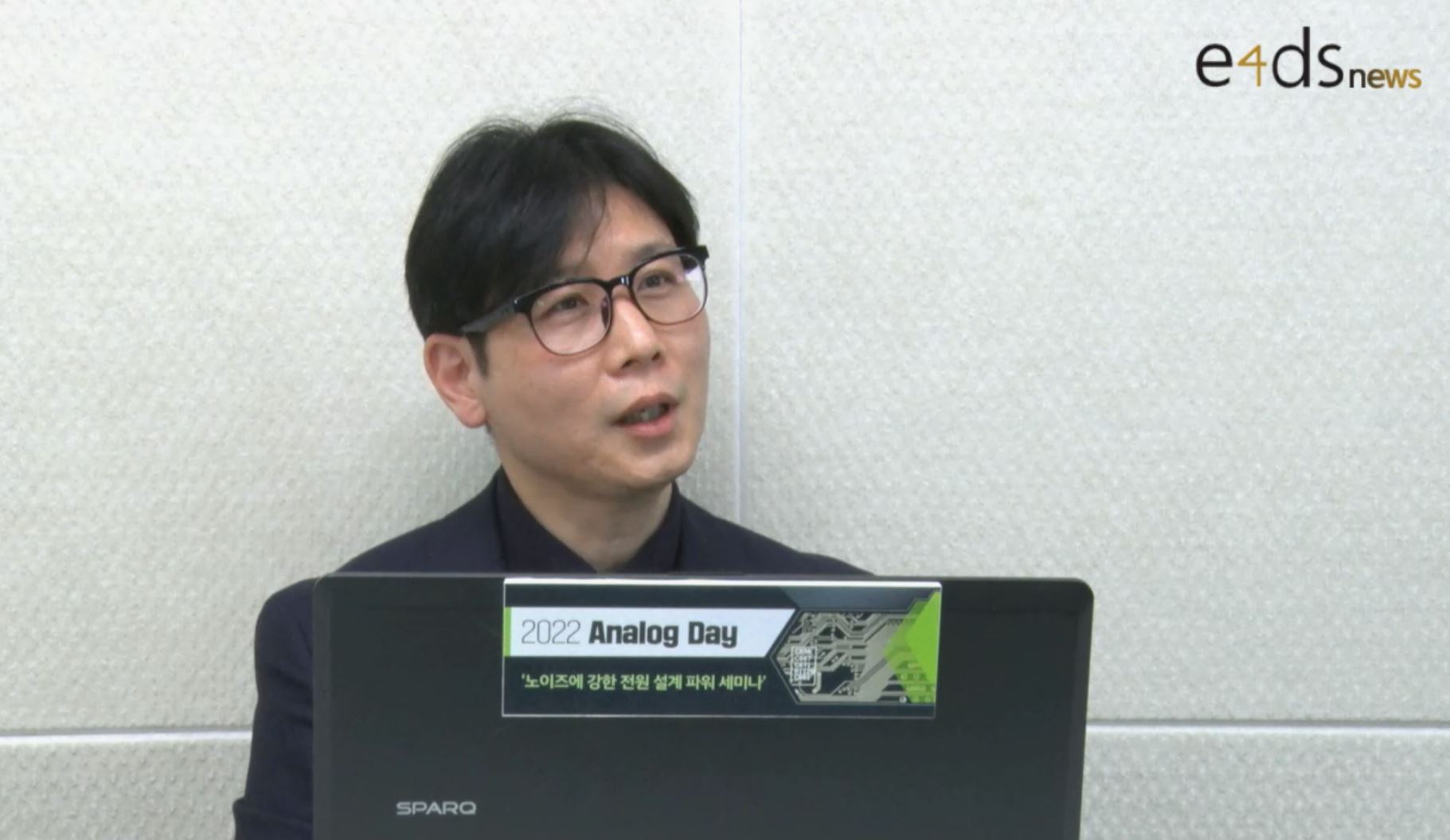
▲Yeon Gyu-bong, a senior researcher at the Korea Automobile Research Institute, is giving a presentation at the 2022 Analog Day event.
Senior Vice President Yeon Gyu-bong emphasizes the importance of achieving EMC.
Strengthening industry cooperation is necessary to achieve EMC.
Experts have suggested that meeting EMC standards is essential for achieving Level 5 autonomous driving.
At the 2022 Analog Day held by e4ds news on the 20th and 21st, Yeon Gyu-bong, head of the AI Semiconductor Research Center at the Korea Automotive Research Institute, presented on the topic of electromagnetic interference and EMI shielding issues in electrical components.
Senior Yeon addressed the following issues: △Electromagnetic wave issues in electric/autonomous vehicle electronic systems, △Automobile EMC standards, △EMC issues in in-vehicle networks, and △Application EMC issues.
Modern automobiles are rapidly transitioning from internal combustion engines to electric vehicles, including hybrids, battery electric vehicles, and hydrogen electric vehicles. Demand for electric vehicles has surged, particularly following the COVID-19 pandemic, as people increasingly avoid public transportation.
Currently, hybrids are in the process of converting the existing power system to 48V, up to 800V within the main battery. In addition, hydrogen fuel cell electric vehicles have been delayed in their spread due to issues such as economic and material problems, but they will receive attention in the future when environmentally friendly factors are taken into consideration.
Accordingly, the risk of electromagnetic radiation from components is increasing. In particular, interfaces are connected to networks, and various electromagnetic issues arise during voltage boosting.
Senior Researcher Yeon presented a roadmap for autonomous vehicles (sensors), noting that the number of sensors used increases with increasing vehicle levels. He explained the sensors and semiconductors used in vehicles for Levels 1 to 5, emphasizing that sensors connected to and communicating through in-vehicle networks must meet EMC (electromagnetic compatibility) and radiation characteristics standards.
He also mentioned that the company has currently achieved autonomous driving level 3, is developing to meet levels 4 and 5, and is resuming work this year to meet specific challenges.
Level 5 must satisfy ASIL D, meaning it must be able to maintain functionality without issues under any conditions. In the future, it must satisfy all the following functions: fail silent (stop operation when a problem occurs), fail safe (enter safe mode when a problem occurs), and fail operation (perform other functions even when a problem occurs).
Senior Researcher Yeon ultimately emphasized that it would be difficult to achieve Level 5 without meeting EMC regulations.
In the latter half of the lecture, Senior Professor Yeon discussed automotive applications such as cars, sunroofs, LEDs, and lidar, and once again emphasized the importance of achieving EMC regulations in these autonomous vehicle communication issues.
Lastly, Senior Vice President Yeon emphasized that EMC issues are becoming more important with the transition to electric and autonomous vehicles, and that it is important to secure EMC integrity technology for automotive EMI shielding issues, and that it is important for companies to work together to ensure the safety of the public.
Comments
Related news
Automotive semiconductor shortages will likely persist for the foreseeable future.
An Ki-hyun, Executive Director of the Korea Semiconductor Industry Association, delivered a keynote presentation titled "Recent Issues and Responses in the Semiconductor Industry" at the 'e4ds Semiconductor Technology Conference 2021 Spring'. Executive Director An Ki-hyun projected that automotive semiconductor supply and demand imbalances will persist in the near term, as production capacity falls short relative to the year-over-year demand growth for automotive semiconductors.
2021.04.30by 배종인 기자
Memory: Technology Gap Reduction, Second Half Growth
Do Hyun-woo, research director at NH Investment & Securities, predicted at the 'e4ds Semiconductor Technology Conference 2021 spring' that the profit margin differences among memory semiconductor companies will decrease as the technology gap narrows, and that the upward price movement of memory in the second half of the year will expand due to favorable market conditions.
2021.04.30by 배종인 기자
.jpg)
[Interview] Yeon Gyu-bong, Head of the AI Semiconductor Research Center: "Electromagnetic safety in vehicle electronics must be integrated into the design phase."
Modern vehicles are experiencing rapid increases in electrical components, including advanced autonomous driving functions, large displays, sensors, and various assistance systems, which can create issues such as electromagnetic interference between electrical components. To address this, we have arranged an interview with Yeon Gyu-bong, Senior Researcher at the AI Semiconductor Research Center and automotive semiconductor expert, to discuss the electromagnetic effects on automotive electrical components and design considerations for electrical products.
2021.09.02by 배종인 기자

[e4ds Tech Day 2026 ⑨] Sim Sang-gyu, Autocrypt CTO: "In the Physical AI Era, Automotive Security Must Extend Beyond the Vehicle"
At e4ds Tech Day 2026, Sim Sang-gyu, CTO of Autocrypt, explained automotive cybersecurity strategies in the era of Physical AI and SDV (Software-Defined Vehicle). Automobiles are evolving as part of an ecosystem connected to AI, cloud, chargers, IoT, and robots, and he emphasized that the scope of security must expand beyond the vehicle interior to the entire connected environment. In particular, AI model tampering, adversarial attacks, OTA updates, and EV charger hacking were identified as major threats. He explained that response measures require zero trust, AI model integrity protection, intrusion detection, Security by Design and Default, and full lifecycle security management, and that proactive security system establishment beyond regulatory compliance is critical for securing future mobility competitiveness.
2026.10.12by 배종인 기자

Practical HIL Construction Strategy for Automotive and Off-Highway Controller Validation
As vehicle E/E architecture transitions to zonal structures and shifts to software-defined vehicles (SDV), the number of controllers (ECUs) requiring validation and software complexity are surging dramatically. Meanwhile, real vehicle testing cannot provide repeated verification under identical conditions and entails lead time and safety concerns. This white paper explains the principles of HIL (Hardware-in-the-Loop) validation and the structure of the NI platform composed of PXI, SLSC, and VeriStand, and through two actual implementation cases—Camera Record & Replay HIL for In-Cabin Monitoring Controller (ICMU) and Forklift Controller (VCU) HILS—describes how controller-level regression testing becomes possible. Additionally, it explicitly states application boundaries and limitations, such as lack of A2B support.
2026.10.12by 편집부











