


Korea Institute of Materials Science Develops Materials with Antibacterial and Antiviral Additives
 Published2022.02.03 12:10
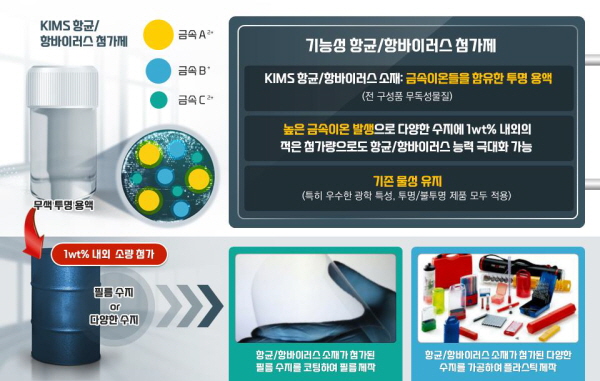
 A material has been developed that imparts antibacterial and antiviral functions to existing products simply by adding it, without any additional processing, raising expectations that it will enable a direct response to concerns regarding viral infections such as COVID-19.
A research team led by Dr. Chang-Su Kim of the Nano-Bio Convergence Research Laboratory at the Korea Institute of Materials Science (KIMS, President Jeong-Hwan Lee), a government-funded research institute under the Ministry of Science and ICT, has succeeded in developing a material that imparts antibacterial and antiviral functions to various products we commonly use without altering their physical properties.
The material developed by the research team is an antibacterial and anti-vibration additive that generates high levels of metal ions.
By adding only a small amount of about 1 to 2 weight percent (wt%) to various resins, the antibacterial properties were improved to 99.99% and the antiviral properties were improved by more than 10 times within 2 hours without causing changes in the optical, mechanical, or thermal properties of existing products.
Since the developed material is used as an additive, it can be subjected to UV and heat curing without additional processes for existing products, and its advantage is that it can maintain an antibacterial effect semi-permanently when mixed with resin.
In addition, the developed antibacterial and antiviral additive consists entirely of non-toxic materials that do not use any organic antimicrobial agents or nano-compounds.
Principal Researcher Kim Chang-soo, the research leader, said, “Display"It is a technology with wide-ranging applications, including films for lighting, functional textiles, films for home appliances and furniture, window films, automotive interior and exterior materials, kitchen, bathroom, and hygiene products, and medical supplies," he said. "We are currently conducting mass production tests with various companies that require the technology, and we will do our best to contribute to solving the problem of novel infectious diseases in preparation for the post-COVID era, where people's interest in personal hygiene is expected to increase significantly."
Lee Jeong-hwan, President of the Korea Institute of Materials Science, stated, “We will continue to discover excellent ideas with commercial potential within the institute and strive to materialize and commercialize them quickly from a market perspective.” He added, “We will spare no support or encouragement to accelerate the localization of functional antibacterial and antiviral materials, as well as the penetration of overseas markets.”
Meanwhile, this research achievement was made possible with support from the Korea Institute of Materials Science's major projects, and the research team is currently working to support its practical application by pursuing the establishment of a research institute spin-off company to facilitate the rapid commercialization of the technology.

Comments
Related news
KIMS Academic-Research Collaborative Growth Through Technology Cooperation
The Korea Institute of Materials Science (KIMS, Director Lee Jung-hwan), a government-funded research institute under the Ministry of Science and ICT, and Gyeongsang National University (President Kwon Sun-gi) are embarking on mutual growth between academia and research institutes through technological cooperation.
2021.12.15by 배종인 기자
Materials Research, commercialization of cerium permanent magnets begins in earnest
The Korea Institute of Materials Science (KIMS, Director Lee Jung-hwan), a government-funded research institute under the Ministry of Science and ICT, is transferring technology for developing high-performance rare-earth permanent magnets using cerium (Ce) instead of expensive neodymium (Nd) to companies, and commercialization of cerium permanent magnets is now expected to accelerate alongside improved price competitiveness.
2022.01.03by 배종인 기자
Materials Research Institute, Dr. Hyosun Jang, Receives 2021 Outstanding Paper Award from the International Magnesium Society
Dr. Jang Hyo-sun of the Computational Materials Research Division at the Korea Institute of Materials Science (KIMS, Director Lee Jung-hwan), a government-funded research institute under the Ministry of Science and ICT, has been recognized for his contributions to improving the room-temperature formability of magnesium alloys.
2022.01.05by 배종인 기자
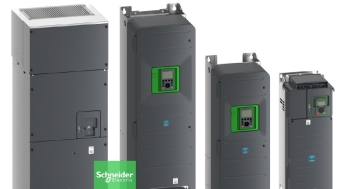
Schneider Aims for Building Energy Savings and Operational Stability with Next-Generation HVAC Drives
Schneider Electric has unveiled its next-generation HVAC drive product line 'Altivar HVAC'. The new product line's key features center on enhanced energy savings, system operational stability, and building management system integration. The products are divided into 'ATH200' for OEM and small equipment applications, and 'ATH600' for environments requiring continuous operation and advanced control. The company plans to expand the application scope from commercial buildings to facilities where HVAC system stability is critical, such as hospitals, airports, and data centers. The announcement includes over 30% energy savings, operation from -10°C to +60°C, Modbus and BACnet support, and compatibility with low global warming potential refrigerants.
2026.03.26by 명세환 기자
Ecolab Expands AI Data Center Cooling Business Through Acquisition of CoolIT
Ecolab has agreed to acquire CoolIT Systems, a liquid cooling company for AI data centers, for approximately $4.75 billion. The transaction is expected to close by Q3 2026, subject to regulatory approvals. CoolIT has been supplying direct-to-chip cooling-based coolant distribution units, cold plates, and manifolds, serving hyperscale data centers and colocation operators as customers. This acquisition is a measure to address the high-heat and high-density server environments created by AI proliferation. Ecolab plans to combine its water management and digital monitoring capabilities with CoolIT's hardware technology to expand its data center cooling business.
2026.03.26by 명세환 기자











