



Power Efficiency: A System-Wide Rethink is Necessary
 Published2022.02.15 16:01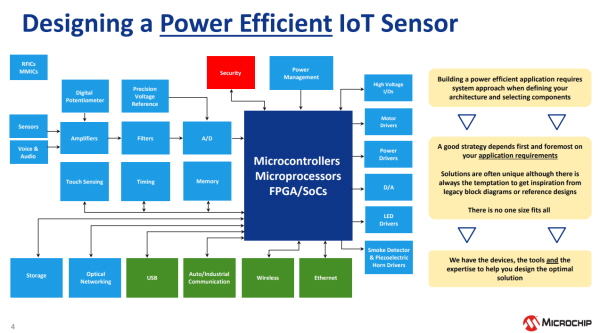
IoT sensor design is closely related to power efficiency.
Experts have suggested that in order to design power-efficient IoT applications, appropriate designs must be made according to the type of power source, and that power efficiency must be reconsidered from the perspective of the entire system rather than individual power-related components.
The E4ds webinar was held on the 15th with the topic of 'Designing Power-Efficient Solutions and Building Easy Connectivity for IoT Sensors' by Microchip Technology's Senior Vice President, Ki-Beom Kim.
“There is no one-size-fits-all solution for analog design,” said Senior Vice President Kim Ki-beom. “Compromise and choice are crucial.”
He continued, “Analog design should start early in the design process, taking a systems approach to defining the power budget and considering the cost and performance of the application.”
Power efficiency is a complex topic that involves all components, such as operating and sleep modes, Wi-Fi connectivity and communication, sensors, and power management.
Senior Kim said that in order to design IoT applications with high power efficiency, appropriate design must be made according to the type of power source, and that the power should be designed from the perspective of the entire system rather than individual power-related components.He said that the power efficiency should be reconsidered.
He also mentioned that in order to ensure the power efficiency of the system, it must be considered from the early stages of design.
Applying low-power wired/wireless communication solutions, using secure elements that reduce the controller's computational load, and using MCUs with built-in intelligent peripherals that minimize controller operation in operating mode are also important methods for securing power efficiency.
Today's IoT designs, especially sensor designs, are facing increasing demands for extended battery life, multi-sensor applications, performance enhancements, compliance with communication standards, and data and communication security.
This trend is related to reducing power consumption, which is most important for battery-operated applications.
Each component or solution within an IoT system must be carefully selected and evaluated through a systems approach to effectively manage power consumption.
■ Designed for maximum power efficiency in battery-powered solutions
Senior Kim explained that building power-efficient applications requires a systems approach that prioritizes defining the system architecture and selecting the optimal power-efficient components, regarding the best power-efficient design for battery-powered solutions.
This systems approach is a good strategy to meet the requirements of your application.
There is no single solution that fits all designs.
Without a systems approach, you may not find a suitable solution for your application.
Senior Kim also presented on the power design process.
A typical power design process begins with defining requirements.
movement After defining the sequence, power budget, etc., select the appropriate components or solutions.
Afterwards, performance is simulated using evaluation boards and the like, and the solution is verified.
■ Power Selection Procedure for Power-Efficient IoT Sensor Design
The power source selection process for designing power-efficient IoT sensors begins with ensuring that the environment has access to a power source capable of recharging batteries.
If you have power, you can charge the battery, so check to see what kind of rechargeable battery you need.
At this time, temperature range, capacity, charge/discharge speed, internal impedance, etc. must be considered.
Since charging is not possible without a power source nearby, you will need to check which standard batteries are required.
Likewise, temperature range, capacity, discharge rate, etc. must be considered.
These conditions have a significant impact on signal chain and power management design.
The second is to define the motion profile.
Typically, IoT sensors cycle between sleep and active modes, and the power consumption varies depending on the mode.
Additionally, in active mode, power consumption varies depending on the tasks being performed, such as wireless communication, sensor detection, and OTA.
Therefore, the most important thing is to calculate the power budget required by the application based on the previously defined operating profile.
The third is to estimate the life of the battery.
It is important to estimate the optimal to worst-case operating conditions for each battery, and to also calculate for each applicable wireless or security solution, if necessary.
Finally, along with what we reviewed earlier, the battery sizeYou can choose the right battery by considering the price of the tile.
Meanwhile, having team members who can strategize and develop power-efficient solutions that best fit each design need has many advantages and high value.
To deliver value, Microchip has invested for over 30 years in a unique portfolio of efficient and optimized IoT sensor designs.
We have low-power analog products for power supply and signal chains, ultra-low-power microcontrollers, communication solutions, and IoT security solutions.
To help you design efficient products, Microchip offers technical support including evaluation boards, design review services, technical training, software, and on-site support from subject matter experts.
Microchip has power-efficient analog products for IoT applications.
These products have the advantages of high accuracy, power efficiency, low power consumption and low voltage operation, and stability.
We provide Treelink, MPLAB Analog Designer, and MPLAB Mindy to help you identify the right analog products for your design, and to help you select and simulate analog solutions yourself.
ClockWorks Configurator is a simple online tool that lets you customize oscillators and clock generators to suit your application needs.
Program parts based on frequency, temperature, package size, and more with just a few clicks, and order custom samples within 48 hours.
Comments
Related news
.jpg)
“Protecting against car firmware vulnerabilities with chips”
E4ds held a webinar on the 25th featuring Microchip's Senior Director Kwak Sang-shin on "Platform Firmware Resilience for Automotive Applications." During this webinar, Kwak Sang-shin presented on vulnerabilities and protection methods that occur during the boot process and firmware updates in rapidly advancing automotive systems.
2022.01.25by 성유창 기자
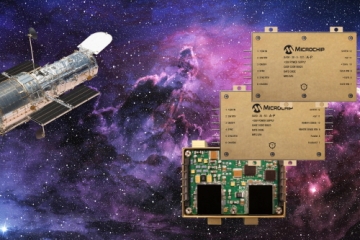
Microchip Launches Non-Hybrid Space-Grade Power Converter
Microchip Technology announced on the 26th that it has launched a space-grade DC-DC power converter product line with 28V input and 50W radiation-hardened options.
2022.01.27by 성유창 기자
.jpg)
Microchip Launches High-Precision Time Networking Ethernet Switch Family
Microchip Technology announced on the 28th the launch of the LAN9668 TSN switching device product family. This is the industry's first turnkey solution-providing precision time networking (TSN) Ethernet switch product family for industrial automation networks.
2022.01.28by 성유창 기자

Intel Unveils Next-Generation 'Core Ultra Series 3' and vPro Platform for Enterprise PCs
Intel has officially unveiled the "Intel Core Ultra Series 3" for next-generation enterprise PCs and the latest vPro platform, addressing a wide range of demands from enterprise notebooks to high-performance workstations.
2026.03.26by 배종인 기자

ROHM Launches ESD Protection Diode Compatible with High-Speed Interfaces of 10Gbps or Higher
Semiconductor specialist ROHM has developed the 'RESDxVx series' of ESD (electrostatic discharge) protection diodes capable of responding to next-generation high-speed data communication environments exceeding 10Gbps, simultaneously enhancing both signal quality maintenance required in high-speed interfaces and IC protection performance.
2026.03.26by 배종인 기자











