



Infineon Launches Future Security Solutions
 Published2022.02.17 08:24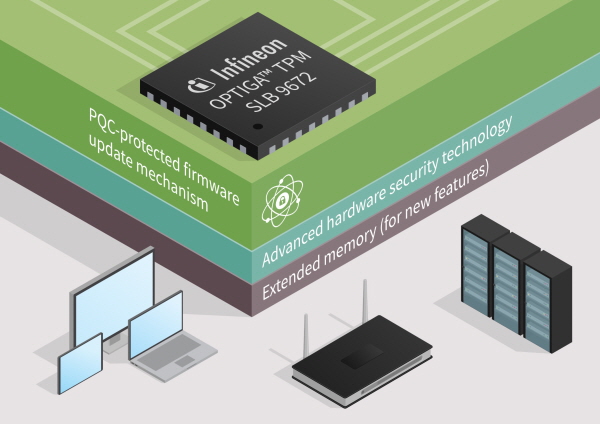
Provides PQC protection firmware update mechanism
Activate the quantum-resistant firmware upgrade path
Infineon Technologies AG announced today the launch of its new OPTIGA™ Trusted Platform Module (TPM) SLB 9672, which takes security to the next level.
The SLB 9672 provides a future-proof security solution with a post-quantum cryptography (PQC) protected firmware update mechanism using XMSS signatures.
This mechanism counters the threat of firmware corruption from attackers using quantum computers and enables a quantum-resistant firmware upgrade path, increasing the long-term usability of the device.
TPM provides a solid foundation for securely establishing the identity and software state of PCs, servers, and connected devices, and protecting the integrity and confidentiality of data stored or in transit.
The SLB 9672, a new addition to the Infineon OPTIGA TPM family, is the industry’s first TPM to offer additional PQC-based checking and a firmware update mechanism with 256-bit key length.
OPTIGA TPM uses a robust and reliable update mechanism to ensure that it is always up to date even when the standard algorithms are no longer reliable. The SLB 9672 can be updated and achieves improved computing performance with fail-safe functionality that blocks the impact of firmware corruption.
For example, the built-in fail-safe feature enables TPM firmware recovery according to the NIST SP 800-193 Platform Firmware Recovery Guidelines.
This TPM provides expanded non-volatile memory to store new capabilities such as additional certificates and encryption keys.
Security assessments and certifications are performed by external organizations according to Common Criteria and FIPS standards.
It also meets the TCG (Trusted Computing Group) standard (TPM 2.0 standard version 1.59) and is certified according to the latest TPM 2.0 standard.
TPM can be easily integrated into host software, providing a standardized trust base and various tools (software/demo boards) to assist design work.
It also supports the latest versions of Windows and Linux, and the chip operates over an extended temperature range of -40°C to 105°C.
Comments
Related news
Infineon Launches MOTIX™ Single Half-Bridge IC Family
Infineon has introduced the MOTIX™ single half-bridge IC product family with 47% lower on-resistance in a package that is 60% smaller than the previous generation, making it ideal for automotive applications.
2022.01.25by 성유창 기자
Infineon Offers SEMPER™ NOR Flash Solution Hub
Infineon Technologies announced on the 4th that it provides a SEMPER Solution Hub supporting the SEMPER™ NOR flash product family.
2022.02.04by 성유창 기자
Infineon Launches Automotive High-Side Gate Driver
Infineon announced on the 9th that it has launched an automotive dual-channel high-side gate driver for protecting 48V battery systems.
2022.02.09by 성유창 기자
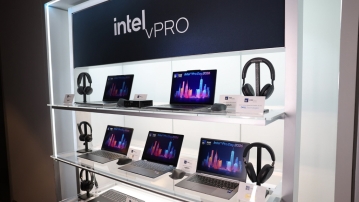
Intel Unveils Next-Generation 'Core Ultra Series 3' and vPro Platform for Enterprise PCs
Intel has officially unveiled the "Intel Core Ultra Series 3" for next-generation enterprise PCs and the latest vPro platform, addressing a wide range of demands from enterprise notebooks to high-performance workstations.
2026.03.26by 배종인 기자
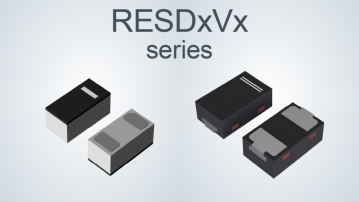
ROHM Launches ESD Protection Diode Compatible with High-Speed Interfaces of 10Gbps or Higher
Semiconductor specialist ROHM has developed the 'RESDxVx series' of ESD (electrostatic discharge) protection diodes capable of responding to next-generation high-speed data communication environments exceeding 10Gbps, simultaneously enhancing both signal quality maintenance required in high-speed interfaces and IC protection performance.
2026.03.26by 배종인 기자











