



KERI and University of Waterloo Lead Busan's Manufacturing Innovation with AI
 Published2022.02.21 14:28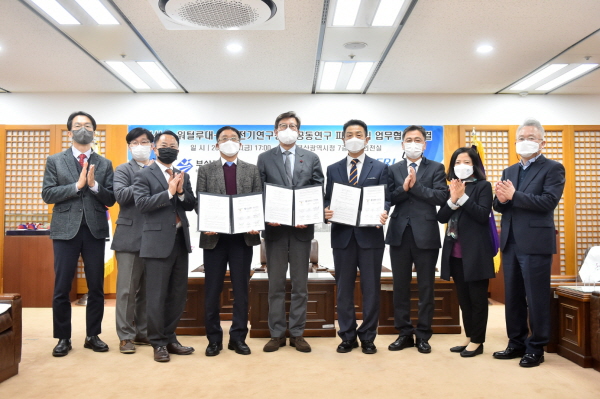
▲ The AI joint research partnership agreement signed last December between KERI, Busan Metropolitan City, and the University of Waterloo, Canada.
The Korea Electrotechnology Research Institute (KERI, President Myung Sung-ho), a state-run research institute, and the University of Waterloo in Canada, which possesses world-class AI technology, are embarking on manufacturing innovation in the Busan region through artificial intelligence (AI).
The Korea Electrotechnology Research Institute and the University of Waterloo announced on the 21st that they will begin full-scale implementation of a manufacturing innovation project in the Busan region utilizing artificial intelligence (AI) technology starting this year.
Since 2020, the two organizations, centered around the 'KERI-University of Waterloo Changwon Artificial Intelligence Research Center,' have effectively carried out tasks such as 'diagnosis of core component failure status,' 'assembly intelligence,' and 'effective tool management and optimal customized machining for each product' for companies located in Changwon, Gyeongnam, using big data-based AI technology.
Last November, KERI, Busan Metropolitan City, and Changwon City signed a business agreement with the aim of expanding the benefits of the manufacturing AI business to the entire southeastern region and injecting great vitality into the local economy. Following this, in December, KERI, Busan Metropolitan City, and the University of Waterloo in Canada signed a memorandum of understanding for a joint research partnership to expand the reach of AI in the region. As a follow-up measure, AI technology will begin to be introduced to the manufacturing sites of two companies in Busan (Daeyang Bolt Co., Ltd. and Taehwa Precision Industry Co., Ltd.) starting this year.
Daeyang Bolt Co., Ltd., a manufacturer specializing in the production of automotive parts and equipment, is applying and implementing 'AI technology for automated high-frequency heat treatment' based on big data. The existing high-frequency heat treatment process, which was performed by humans, presented many difficulties, including health problems caused by the generation of toxic gases, electric shock from high voltage and burns from high heat, uncertainty in ensuring heat treatment quality, and a lack of work data management.
On the other hand, starting this year, collaborative robots are being deployed to the field in place of humans, and AI trained on on-site heat treatment parameters performs optimized heat treatment for product hardness according to conditions such as temperature, frequency, voltage, and time. This plays a significant role not only in improving work efficiency but also in enhancing industrial safety and the working environment. In numerical terms, the expected annual benefits amount to approximately 170 million won, including a reduction in product defect rates and a shortening of inspection time.
In addition, at another company, Taehwa Precision Industry Co., Ltd., 'AI tool management technology' is being applied to the precision machining process line, which is the most critical step in producing automotive and heavy equipment parts. Previously, because operations relied on the operator's experience and senses, it was impossible to detect tool problems immediately; defects were only recognized after the work was completed, and tool issues were discovered through reverse tracing. This resulted in difficulties such as loss of materials and time, increased defect rates and manufacturing costs due to rework, and decreased productivity.
On the other hand, by establishing an AI-based system capable of diagnosing tool conditions in advance and detecting breakage, and applying it to the production line, quality innovation in the machining process can now be expected. Furthermore, by accumulating production data, it predicts tool lifespan and enables tools to be replaced proactively at the appropriate time. The expected benefits from this manufacturing AI amount to approximately 280 million won annually, including savings on tool costs, labor costs, and rework costs.
Kim Jong-mun, Head of the AI Research Center at KERI, stated, “Our project aims to apply AI to the manufacturing industry to improve corporate work efficiency, productivity, product quality, and on-site safety and environmental conditions. Through this, we intend to enhance regional industrial competitiveness and contribute to job creation.” He added, “Following the two companies that will become representative model factories for manufacturing AI in the Busan region this year, we will gradually expand the scope of AI application and the number of beneficiary companies.”
Meanwhile, KERI is a government-funded research institute specializing in electricity under the National Science and Technology Research Council of the Ministry of Science and ICT.

Comments
Related news
KERI, Technology Startup Center Expansion
The Korea Electrotechnology Research Institute (KERI, Director Myung Sung-ho) is launching a full-scale initiative to support early business establishment and corporate growth for companies residing in the Gangso Special Zone through the expansion of its Technology Startup Center.
2022.01.27by 배종인 기자
KERI Develops World's First Magnetic-based Counter-rotating Propeller
A counter-rotating propeller in which two propellers rotate in opposite directions using the power of magnets has been developed, and is expected to improve propulsion efficiency of ships and aircraft by more than 10% compared to conventional mechanical gear systems.
2022.02.07by 배종인 기자
Electric start-up company 'Medinetech' attracts 8 billion won in investment for 'soft endoscope'
MediIntech Co., Ltd., a startup company established based on the technology of the Korea Electrotechnology Research Institute (hereinafter KERI, President Myung Sung-ho), is launching a full-scale initiative to localize technology and capture the 5 trillion-won market in the flexible endoscope field for digestive systems, which is currently dominated by Japan, through sustained investment of 8 billion won.
2022.02.15by 배종인 기자
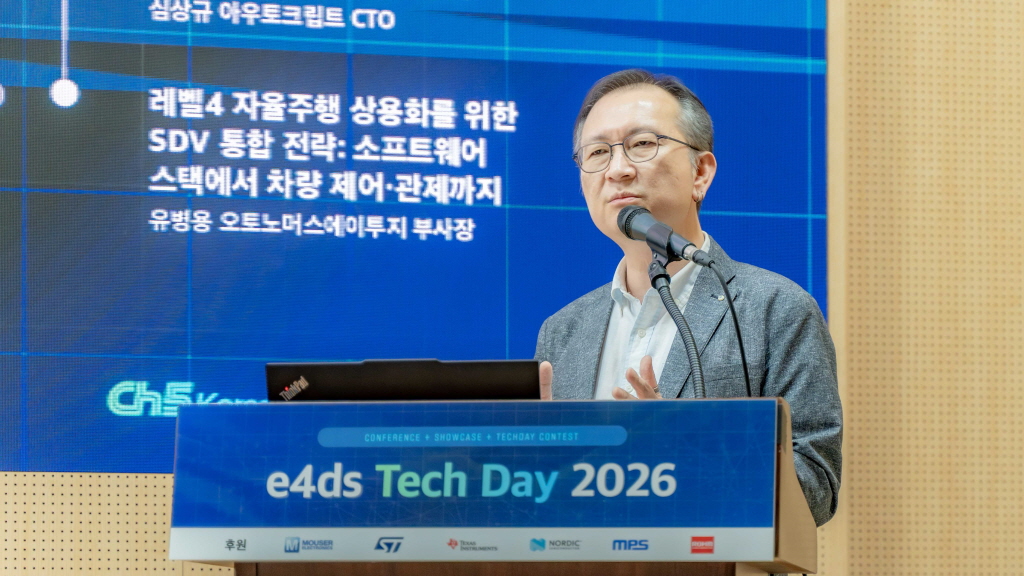
[e4ds Tech Day 2026 ⑨] Sim Sang-gyu, Autocrypt CTO: "In the Physical AI Era, Automotive Security Must Extend Beyond the Vehicle"
At e4ds Tech Day 2026, Sim Sang-gyu, CTO of Autocrypt, explained automotive cybersecurity strategies in the era of Physical AI and SDV (Software-Defined Vehicle). Automobiles are evolving as part of an ecosystem connected to AI, cloud, chargers, IoT, and robots, and he emphasized that the scope of security must expand beyond the vehicle interior to the entire connected environment. In particular, AI model tampering, adversarial attacks, OTA updates, and EV charger hacking were identified as major threats. He explained that response measures require zero trust, AI model integrity protection, intrusion detection, Security by Design and Default, and full lifecycle security management, and that proactive security system establishment beyond regulatory compliance is critical for securing future mobility competitiveness.
2026.10.12by 배종인 기자
NVIDIA to Invest $1 Billion in U.S. Science Over Next Five Years
NVIDIA has announced plans to invest $1 billion over the next five years to strengthen U.S. scientific and technological competitiveness. The company will enhance cutting-edge artificial intelligence research and development capabilities in key areas including quantum computing, healthcare, and energy security, while expanding support for higher education research institutions and cloud service providers. NVIDIA is participating as a major industry partner in the White House Office of Science and Technology Policy's Genesis Mission, and is promoting supercomputer construction in collaboration with national laboratories including Argonne and Los Alamos.
2026.10.12by 배종인 기자











