



Connected Cars Require Cybersecurity
 Published2022.02.24 14:14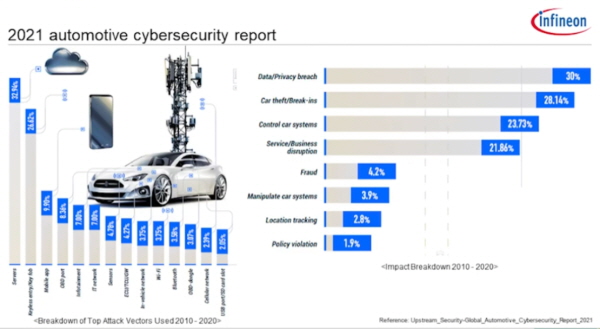
28% of cyberattacks in 2021 will involve vehicles.
Semiconductor and automobile manufacturers are collaborating with standards agencies.
On the 22nd, E4ds Webinar was held with Infineon's Manager Lee Kyung-soo on the topic of 'The Present and Future of Automotive Cybersecurity and Infineon's Response Plan.'
Connected cars are vulnerable to hacker attacks, including malware, data manipulation, and hardware-level physical attacks. These attacks can threaten the safety of vehicle drivers, lead to personal data loss, and even impact manufacturers' businesses.
Upstream's 2021 Automotive Cybersecurity Report outlines cybersecurity attacks that occurred in 2021.
Attacks targeting vehicle theft and internal control systems accounted for 28.4%, followed by data breaches (30%).
If the internal control system is hijacked, it can malfunction and cause injury to not only the driver but also other people, making it a very serious matter.
To prevent this, data is processed without external exposure.Safe data processing is required so that only data with a structure can be processed.
Additionally, as vehicle architecture evolves into △E/E architecture and △domain architecture, protection is also essential in areas that can be closely connected to the outside world and in gateways that lead communication.
Currently, many standards organizations and automobile and semiconductor manufacturers are collaborating to develop guidelines, standards, and regulations for automotive cybersecurity.
In 2009, the HIS working group included its work on how software should be implemented in the Secure Hardware Extension (SHE) Functional Specification.
The intention is to create a mechanism that can process security activities that were previously performed in software in the hardware domain quickly in real time, and the result includes the need to create a security domain within the MCU to take charge of security by performing the role previously performed by an external dedicated security IC.
SAE and ISO have collaborated to publish a single standard, ISO/SAE 21434: 2021 Road Vehicles – Cybersecurity engineering.
This standard is important because specific comments in various regulations refer to ISO/SAE 21434 for details.
When developing a vehicle system, it is important to consider the vehicle life cycle, including △how to design it △the pre- and post-development stages △the mass production stage △the disposal stage.
△Comprehensive content on how to manage security, △what functions to include, and △how to maintain and repair vulnerabilities when discovered has been compiled into a standard.
The reason this standard is important is that specific comments in various regulations are detailed in ISO/SAE 214Because I recommend you refer to 34.
△UNECE WP.29's UN R No.155 CSMS △No.156 SUMS are the first automotive cybersecurity regulations established in Europe.
CSMS is a regulation for the overall management system of the Cyber Security Management System, and vehicle manufacturers must obtain CSMS certification through an external certification agency.
Only certified vehicles can be sold in Europe, and the certification must be renewed every three years.
Vehicle Type Approval (TA) is an item that must be approved by vehicle type.
To sell a car in Europe, a manufacturer must obtain a type approval (TA) for each vehicle along with CSMS certification.
Adopted in June 2020 and effective in January 2021, all new types of vehicles developed from the effective date of July 2022 must be vehicles that have received TA.
The domestic cybersecurity guideline is the 'Automobile Cybersecurity Guideline' established by the Ministry of Land, Infrastructure and Transport in December 2020.
Based on the current UN Regulation No. 155, recommendations were first presented for matters likely to be established as domestic standards in the future.
It includes recommendations from manufacturers and the roles of security approval/testing agencies.
Infineon is actively engaged in various activities to address security issues, including various hacking threats, and provides cybersecurity solutions.
Infineon is a member of AUTO-ISAC and is actively sharing information about vehicle security incidents both online and offline.
The solution is to have an HSM hardware security module embedded within the MCU. There is a Aurix family of products.
Additionally, for applications requiring a higher level of security, an external security-only IC is provided to meet the requirements.
This product line includes OPTIGA TPM, SLI 97 V2X, etc.
When asked whether the country is adequately prepared for hacker threats, Manager Lee Kyung-soo stated, "I believe many automakers, standards organizations, and the national government are making significant efforts and preparing accordingly." He added, "There is no such thing as perfect security. New threats continually emerge, so analyzing, supplementing, maintaining, and managing them is crucial."
Comments
Related news
Infineon Launches New Automotive Security Controller
A new controller product has been launched that can alleviate concerns about automotive security threats through its extended lifespan and low failure rate.
2021.11.12by 배종인 기자

Infineon Expands AURIX™ MCU Family
Infineon Technologies (Korea CEO Lee Seung-soo) has expanded its AURIX™ MCU product family, continuing innovation for future mobility.
2022.01.07by 명세환 기자

[Interview] Lee Kyung-soo, Manager at Infineon: "AURIX™ Automotive Security: Safe and Rapid Implementation"
Infineon Korea, a global company supplying diverse security product lines for automotive and industrial IoT applications, shared insights on automotive cybersecurity solutions through Kyung-soo Lee, Section Manager.
2022.01.24by 배종인 기자

[e4ds Tech Day 2026 ⑨] Sim Sang-gyu, Autocrypt CTO: "In the Physical AI Era, Automotive Security Must Extend Beyond the Vehicle"
At e4ds Tech Day 2026, Sim Sang-gyu, CTO of Autocrypt, explained automotive cybersecurity strategies in the era of Physical AI and SDV (Software-Defined Vehicle). Automobiles are evolving as part of an ecosystem connected to AI, cloud, chargers, IoT, and robots, and he emphasized that the scope of security must expand beyond the vehicle interior to the entire connected environment. In particular, AI model tampering, adversarial attacks, OTA updates, and EV charger hacking were identified as major threats. He explained that response measures require zero trust, AI model integrity protection, intrusion detection, Security by Design and Default, and full lifecycle security management, and that proactive security system establishment beyond regulatory compliance is critical for securing future mobility competitiveness.
2026.10.12by 배종인 기자

Practical HIL Construction Strategy for Automotive and Off-Highway Controller Validation
As vehicle E/E architecture transitions to zonal structures and shifts to software-defined vehicles (SDV), the number of controllers (ECUs) requiring validation and software complexity are surging dramatically. Meanwhile, real vehicle testing cannot provide repeated verification under identical conditions and entails lead time and safety concerns. This white paper explains the principles of HIL (Hardware-in-the-Loop) validation and the structure of the NI platform composed of PXI, SLSC, and VeriStand, and through two actual implementation cases—Camera Record & Replay HIL for In-Cabin Monitoring Controller (ICMU) and Forklift Controller (VCU) HILS—describes how controller-level regression testing becomes possible. Additionally, it explicitly states application boundaries and limitations, such as lack of A2B support.
2026.10.12by 편집부











