



"Machinery Industry Growth Continues in 2022"
 Published2022.02.25 08:23
Machine tools and construction equipment continue to grow, but growth is limited.
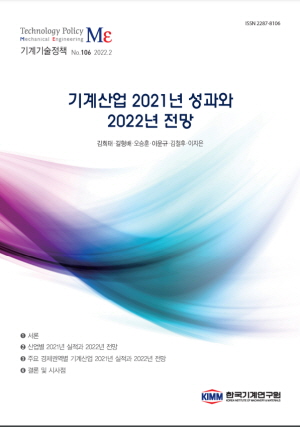 The Korea Institute of Machinery and Materials (President Park Sang-jin, hereinafter referred to as KIMM), under the Ministry of Science and ICT, predicted that the domestic machinery industry will continue its growth trend from 2021 in 2022.
The Korea Institute of Machinery and Materials recently announced Machinery Technology Policy No. 106, "Machine Industry Performance in 2021 and Outlook for 2022."
According to this, the domestic machinery industry's production volume in 2022 is projected to reach KRW 110 trillion, a 2% increase from the previous year's KRW 108 trillion. This forecast takes into account increased demand driven by the ongoing economic recovery, the gradual resolution of global supply chain issues, and the robust performance of downstream industries such as semiconductors.
The Korean machinery industry is expected to continue its growth in 2022, following the positive outlook for the 2022 market from the fourth quarter of last year's manufacturing PMI, and the continued economic recovery fueled by the widespread availability of COVID-19 vaccines and treatments.
However, growth is expected to be limited due to uncertainty stemming from the spread of COVID-19 virus variants and geopolitical risks.
In particular, attention is focused on whether the machinery industry will continue its growth this year as government policies such as digital transformation, carbon neutrality, and housing stability are applied to the industry. Semiconductor equipment has continued to show strong growth, and is expected to drive growth in the machinery industry this year as well.
By industry, semiconductor equipment is expected to maintain the previous year's growth, driven by the continued boom in upstream industries. Machine tools and construction equipment, which delivered notable performance in 2021, are also expected to continue their growth, but to a limited extent.
Major institutions projected that semiconductor equipment sales would grow 11.2-22% in 2022, fueled by steady investment from global chipmakers. The research team noted that while the effects of supply chain diversification in Middle Eastern countries, including Israel, are beginning to show, a strategic approach to technological security is necessary to address growing demand from upstream industries and semiconductor alliances among neighboring countries.
The display equipment sector is analyzed as needing policies to strengthen industrial competitiveness. The decline in exports and large-scale facility investment is attributed to the sluggish downstream industries caused by COVID-19 and the delay in the equipment industry restructuring to focus on OLED.
The plant and construction equipment sectors are expected to remain stable. While the plant sector faces a prolonged shortage of large-scale project orders, LNG demand and liquefaction plant orders are expected to increase. The construction equipment sector is expected to see modest growth, driven by exports, driven by increased infrastructure investment to stimulate the economy and the resumption of delayed projects.
The machine tool industry grew by at least 30% across all major demand sectors in 2021, with both domestic sales and exports rising by a significant margin of approximately 60%. Both production and exports are expected to increase thanks to the global economic recovery, but growth is expected to be limited due to uncertainties in the Chinese economy and the previous year's strong performance.
By region, the metropolitan area was the only region where the production index stagnated, but exports increased along with the Chungcheong region, centered on semiconductor equipment, while the southeastern region only saw a slight rebound due to a sluggish performance in the automobile industry, its main industry.
Kim Hee-tae, a senior researcher at the Korea Institute of Machinery and Materials' Machinery Technology Policy Center, said, "The machinery industry is expected to grow slightly in 2022, driven by increased demand from upstream industries and the resolution of supply chain issues." He added, "However, to avoid losing leadership in the display equipment industry, a swift industrial restructuring centered on OLED is necessary."
Meanwhile, the Korea Institute of Machinery and Materials (KIMM) aims to contribute to national policy and academic development by providing rational direction for machinery industry policies and consolidating policy capabilities. Starting this year, the journal will be published in conjunction with its policy journal. The inaugural issue of Machinery Technology Policy will feature policy research in the machinery industry and technology sectors, and manuscripts will be accepted until April 30th.

Comments
Related news
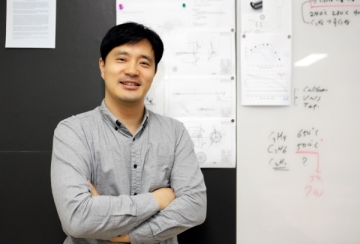
Korea Institute of Machinery and Materials (KIMM) 2021 Best Achievement Award: "Industrial Plasma Source Technology"
The industrial plasma foundational technology has been selected as the top research achievement of 2021 by the Korea Institute of Machinery and Materials (Director Park Sang-jin).
2021.12.22by 배종인 기자
.jpg)
Machinery and Materials Research Institute Reduces Pollutants by 80% by Optimizing Port Loading Equipment
The Korea Institute of Machinery and Materials (KIMM), under the Ministry of Science and ICT, has achieved an 80% reduction in pollutant emissions through port cargo handling equipment optimization technology, with expectations for future domestication of related products and market development.
2022.02.22by 배종인 기자
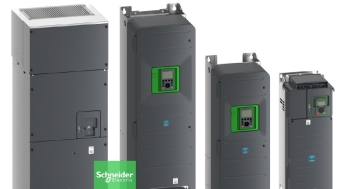
Schneider Aims for Building Energy Savings and Operational Stability with Next-Generation HVAC Drives
Schneider Electric has unveiled its next-generation HVAC drive product line 'Altivar HVAC'. The new product line's key features center on enhanced energy savings, system operational stability, and building management system integration. The products are divided into 'ATH200' for OEM and small equipment applications, and 'ATH600' for environments requiring continuous operation and advanced control. The company plans to expand the application scope from commercial buildings to facilities where HVAC system stability is critical, such as hospitals, airports, and data centers. The announcement includes over 30% energy savings, operation from -10°C to +60°C, Modbus and BACnet support, and compatibility with low global warming potential refrigerants.
2026.03.26by 명세환 기자
Ecolab Expands AI Data Center Cooling Business Through Acquisition of CoolIT
Ecolab has agreed to acquire CoolIT Systems, a liquid cooling company for AI data centers, for approximately $4.75 billion. The transaction is expected to close by Q3 2026, subject to regulatory approvals. CoolIT has been supplying direct-to-chip cooling-based coolant distribution units, cold plates, and manifolds, serving hyperscale data centers and colocation operators as customers. This acquisition is a measure to address the high-heat and high-density server environments created by AI proliferation. Ecolab plans to combine its water management and digital monitoring capabilities with CoolIT's hardware technology to expand its data center cooling business.
2026.03.26by 명세환 기자
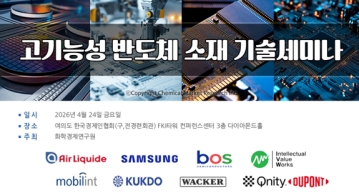
AI Semiconductor Era, Key is 'Materials Technology'… KIEC Holds Seminar on High-Performance Semiconductor Materials
With rapid growth in the global semiconductor market driven by expanded AI data center investments and increased demand for high-bandwidth memory (HBM), a specialized seminar examining next-generation semiconductor materials and packaging technologies will be held. The Korea Chemical Industry Institute will host a "High-Performance Semiconductor Materials Technology Seminar" on April 24 at the FKI Tower of the Korea Economic Association in Yeouido, Seoul. Applications to participate in the seminar are being accepted on a first-come, first-served basis through the Korea Chemical Industry Institute's official website, with early bird discounts available until March 27 and advance registration open until April 22.
2026.03.25by 배종인 기자











