


ETRI Prevents Building Collapses with AIoT Technology
 Published2022.02.25 09:04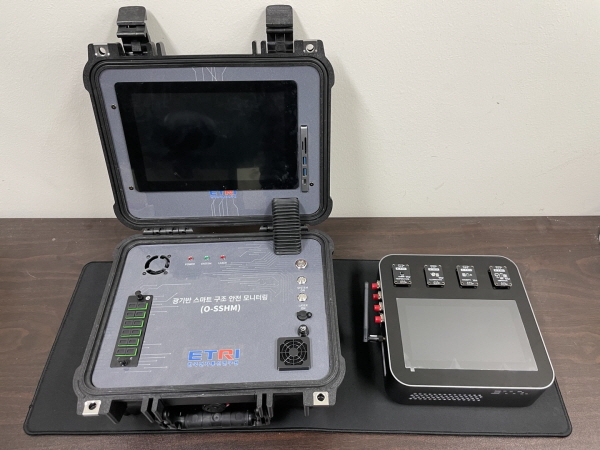
▲Smart safety building structure monitoring device (left) and optical sensor node terminal (right) developed by ETRI researchers.
Development of a concrete curing quality prediction monitoring system
The development of a technology that can predict concrete strength by combining optical fiber sensors and AIoT technology is expected to contribute to the prevention of future building collapse accidents.
The Electronics and Telecommunications Research Institute (ETRI) announced on the 24th that it is developing a system using fiber optic sensors capable of measuring tensile force, torsion, and vibration after a building is completed, and is currently manufacturing and testing prototypes for application on construction sites. Commercialization is scheduled for around October of this year.
The technology developed by ETRI is an ‘optical-based multi-array sensor system.’ It is a technology that can continuously monitor the concrete foundation of a building as well as temporary supports and measure the current condition of the building.
This technology can measure the heat of hydration generated during concrete curing.
Therefore, it is possible to predict long-term strength according to concrete curing by considering the concrete mixing ratio, internal temperature, and external environment.
Currently, the research team is building a prototype and test bed to evaluate the system's applicability to construction sites and is monitoring the hydration heat and accumulated temperature of concrete in winter.
Additionally, it was revealed that compressive strength experiments are being conducted to predict the strength of future buildings.
Through this, we plan to additionally implement concrete curing quality and long-term strength prediction algorithms and reflect them in the system.
The research team inserted 1mm-sized optical fibers per unit area of concrete (3m x 3m) and monitored building cracks through sensing.
Sensors in concrete can be used semi-permanently, and for a 31-pyeong apartment, about 20 sensors are required.
Additionally, the intelligent building safety monitoring system developed by the research team is laptop-sized and can easily access data such as temperature, material strain, and vibration measurements collected from optical fiber sensors.
ETRI explained that the core of this technology is ‘optical fiber-based sensing technology.’
Through this, it was explained that it can be expanded to various application technologies such as long-term strength prediction, crack trend monitoring, and external noise measurement.
In the future, the research team plans to further develop artificial intelligence deep learning technology to meet the customized needs of construction companies, such as concrete mixing ratios, thereby increasing the completeness of the technology.
In addition, it is planned to be applied to construction sites to predict the time of formwork removal and to predict concrete deterioration and building lifespan due to concrete aging.all.
ETRI Honam Research Center Director Gil-Haeng Lee said, “We will use ICT to reduce the number of serious accidents that occur every year at construction sites, such as concrete slab collapse when removing formwork, poorly placed concrete, and shortened construction periods, which result in human casualties.”

Comments
Related news
ETRI Shows Off Communication and Media Technology
ETRI will hold the '2021 ETRI Communications and Media Research Institute Achievement Presentation' to present major research results in communications and media, and will conduct live demonstrations of the deliverables.
2022.01.11by 김예지 기자
ETRI Distributes Core AI Semiconductor Software for Free
ETRI has developed and disclosed core technologies to shorten the development time and reduce costs for AI semiconductor design.
2022.02.03by 김예지 기자
ETRI Develops Sensor to Find People at Disaster Sites
A semiconductor sensor with high-precision radar capabilities that can detect vital signs of victims through walls has been developed, raising expectations for its support in rapid and safe rescue operations at disaster sites.
2022.02.03by 강정규 기자
ETRI and KAIST Join Hands to Secure Future Technologies
The Electronics and Telecommunications Research Institute of Korea and the Korea Advanced Institute of Science and Technology will jointly respond to collaborative research on 'New Frontier Technologies' as future new growth drivers, mutual personnel exchange, and securing global capabilities.
2022.02.22by 배종인 기자

[e4ds Tech Day 2026 ⑨] Sim Sang-gyu, Autocrypt CTO: "In the Physical AI Era, Automotive Security Must Extend Beyond the Vehicle"
At e4ds Tech Day 2026, Sim Sang-gyu, CTO of Autocrypt, explained automotive cybersecurity strategies in the era of Physical AI and SDV (Software-Defined Vehicle). Automobiles are evolving as part of an ecosystem connected to AI, cloud, chargers, IoT, and robots, and he emphasized that the scope of security must expand beyond the vehicle interior to the entire connected environment. In particular, AI model tampering, adversarial attacks, OTA updates, and EV charger hacking were identified as major threats. He explained that response measures require zero trust, AI model integrity protection, intrusion detection, Security by Design and Default, and full lifecycle security management, and that proactive security system establishment beyond regulatory compliance is critical for securing future mobility competitiveness.
2026.10.12by 배종인 기자











