



Six global automotive semiconductor companies achieved $70.8 billion in sales, up 29% year-over-year.
 Published2022.03.03 11:08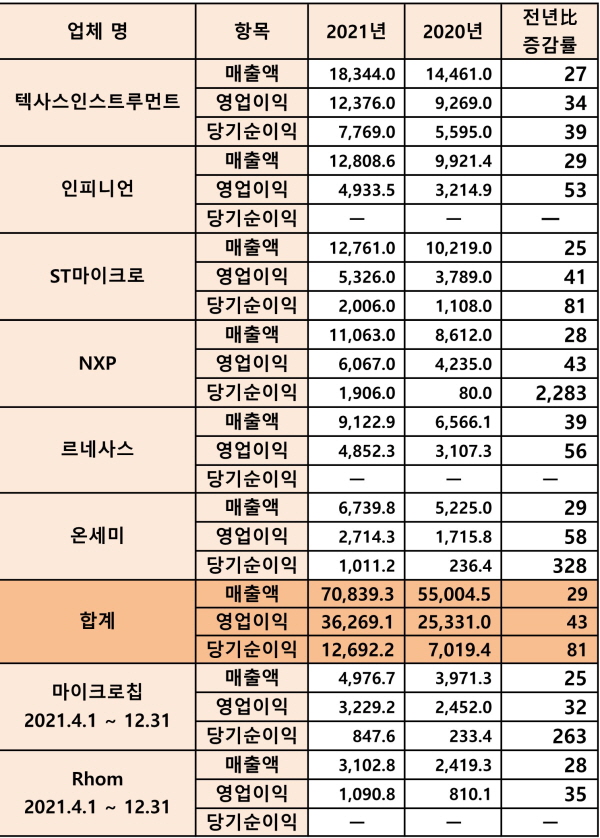
▲2021 Global Automotive Semiconductor Company Performance (Unit: Millions of Dollars, %, Source: Announcements from each company, e4ds News Survey)
Electric and autonomous vehicles contribute to increased semiconductor sales.
Automotive semiconductor sales accounted for 9% of total semiconductor sales last year.
According to an analysis of the 2021 business performance of six global automotive semiconductor companies surveyed by e4ds News, sales reached $70.839 billion, a 29% increase year-on-year, and operating profit reached $36.269 billion, a 43% increase year-on-year.
Excluding Infineon and Renesas' net income, the net income of the remaining four companies was $12.692 billion, an 81% increase year-on-year.
This performance increase was driven by record-breaking sales volume and unit price increases for automotive semiconductor companies in 2021, driven by increased global demand for automotive semiconductors and rising prices due to widespread component shortages.
Texas Instruments (TI) ranked first in sales. TI's 2021 sales reached $18.344 billion, a 27% increase year-over-year, and operating profit rose 34% to $12.376 billion. Net income was $7.77 billion, up 39% from the previous year.
TI said it is “turning to analog and embedded technologies to make end products smarter,” adding that “this trend will continue to increase chip content per application and drive rapid market growth.”
Infineon's 2021 revenue was approximately $12.8 billion, up 29% year-over-year, and operating profit was $4.93 billion, up 53%.
In its 2021 business report, Infineon forecasted a bright future for the automotive semiconductor sector, stating, “Sales in the automotive and connected secure systems sectors are expected to grow at a much higher rate than other sectors in 2022.”
STMicroelectronics reported revenue of $12.76 billion in 2021, up 25% from 2020, and operating profit of $5.326 billion, up 41%. Net income for the year reached $2 billion, up 81% from the previous year.
STMicroelectronics announced that “advancements in automotive technology mean an increase in the number of semiconductors installed,” and that “automotive semiconductors will be developed in line with safety, security, and eco-friendliness trends.”
NXP's revenue last year was $11.063 billion, up 28% from 2020, and operating profit was $6.067 billion, up 43% from the previous year.
In particular, NXP's automotive division sales recorded a 44% annual growth rate to $5.493 billion, accounting for 49.6% of total sales, or half.
Renesas reported revenue of $9.123 billion in 2021, up 39% year-over-year. Operating profit also increased 56% year-on-year to $4.852 billion.
Renesas said the recovery in automobile sales, which had declined due to the coronavirus pandemic, led to increased sales in 2021.
Onsemi also showed an upward trend. In 2021, sales increased 29% year-over-year to $6.739 billion, and operating profit increased 58% to $2.714 billion.
“Increased demand for automotive-related products and improved economic conditions across the automotive industry, including for auto parts manufacturers, led to increased sales,” Onsemi said in the report.
Microchip reported revenue of $4.976 billion for the period April 1, 2021, through December 31, 2021, up 25% from the same period in 2020, and operating profit of $3.229 billion, up 32%.
Japan's Rhom also showed growth. Rhom's revenue for the period April 1, 2021 to December 31, 2021, was $3.13 billion, up 28% year-over-year, and operating profit was $1.09 billion, up 35%.
With the rise of automotive electrification and display components, as well as the increasing adoption of autonomous driving, semiconductors are emerging as a key player in the automotive industry.
According to Omdia, automotive semiconductor sales already exceeded $50 billion in 2021 and are projected to continue growing at an annual rate of 12.3% through 2025.
The development and spread of electric and autonomous vehicles has also driven the growth of the automotive semiconductor market.
The International Energy Agency (IEA) predicted in its '2021 Global Electric Vehicle Outlook' report last year that the number of electric vehicles worldwide would increase from approximately 11 million in 2020 to 230 million in 2030.
Additionally, the global autonomous vehicle market is expected to reach $1.2 trillion by 2035, with an average annual growth rate of 21.9%.
While a typical vehicle is equipped with about 300 semiconductors, an electric vehicle is expected to be equipped with about 2,000, and a self-driving car is expected to be equipped with up to 30,000 semiconductors.
Accordingly, it is analyzed that companies with automotive semiconductor portfolios will seize growth opportunities in the future semiconductor market.
Automotive semiconductor sales accounted for 9% of total semiconductor sales last year, ranking fourth after smartphones, PCs, and data centers.
Driven by the growth of autonomous and electric vehicles, companies have also seen a notable increase in sales.
Competition in the automotive semiconductor market is expected to intensify.
Intel announced at its Investor Day last month that it would provide cutting-edge processes for the automotive industry. This decision comes as the automotive sector's share of the semiconductor industry grows.
Samsung Electronics has also strengthened its portfolio of automotive system semiconductors, including processors and power management chips, and has begun supplying automotive memory solutions to global automakers.
With companies like SK Hynix, Samsung Electronics, and Intel investing heavily in automotive semiconductors, established companies like Infineon and NXP are also jumping into the fray, leading to fierce competition.
Meanwhile, the automotive semiconductor crisis is still an unfinished business.
Last year, a semiconductor shortage caused production disruptions for approximately 10 million units.
The semiconductor supply shortage has been improving since December of last year, but shortages of some items are expected to persist until the first quarter of this year.
Some say the shortage will ease in the second half of 2022, but the timing of this easing remains uncertain, as Volkswagen CEO Herbert Diess recently predicted that this year will not be easy either.
Comments
Related news
.jpg)
Automotive semiconductors to grow at an average annual rate of 12.3% by 2025
The automotive semiconductor market is expected to continue growing at a compound annual growth rate of 12.3% through 2025, and it has been suggested that a portfolio centered on automotive semiconductors will provide growth opportunities for the semiconductor industry.
2022.02.17by 배종인 기자

Intel Enters Automotive Semiconductor Foundry
Intel Foundry Services has announced the launch of a dedicated automotive group and plans to enter the automotive foundry market, raising tensions across the industry including Samsung.
2022.02.18by 성유창 기자
.jpg)
The semiconductor industry is intensifying its competition in the automotive business.
The automotive semiconductor supply shortage, triggered by the expansion of electric vehicles and the automotive parts shortage caused by COVID-19, has prompted not only traditional automotive semiconductor companies but also integrated semiconductor enterprises, foundries, and consumer electronics manufacturers to enter the automotive semiconductor business, with competition for market leadership in the automotive semiconductor market now in full swing.
2022.02.21by 배종인 기자

[e4ds Tech Day 2026 ⑨] Sim Sang-gyu, Autocrypt CTO: "In the Physical AI Era, Automotive Security Must Extend Beyond the Vehicle"
At e4ds Tech Day 2026, Sim Sang-gyu, CTO of Autocrypt, explained automotive cybersecurity strategies in the era of Physical AI and SDV (Software-Defined Vehicle). Automobiles are evolving as part of an ecosystem connected to AI, cloud, chargers, IoT, and robots, and he emphasized that the scope of security must expand beyond the vehicle interior to the entire connected environment. In particular, AI model tampering, adversarial attacks, OTA updates, and EV charger hacking were identified as major threats. He explained that response measures require zero trust, AI model integrity protection, intrusion detection, Security by Design and Default, and full lifecycle security management, and that proactive security system establishment beyond regulatory compliance is critical for securing future mobility competitiveness.
2026.10.12by 배종인 기자

Practical HIL Construction Strategy for Automotive and Off-Highway Controller Validation
As vehicle E/E architecture transitions to zonal structures and shifts to software-defined vehicles (SDV), the number of controllers (ECUs) requiring validation and software complexity are surging dramatically. Meanwhile, real vehicle testing cannot provide repeated verification under identical conditions and entails lead time and safety concerns. This white paper explains the principles of HIL (Hardware-in-the-Loop) validation and the structure of the NI platform composed of PXI, SLSC, and VeriStand, and through two actual implementation cases—Camera Record & Replay HIL for In-Cabin Monitoring Controller (ICMU) and Forklift Controller (VCU) HILS—describes how controller-level regression testing becomes possible. Additionally, it explicitly states application boundaries and limitations, such as lack of A2B support.
2026.10.12by 편집부











