

ADI Launches BioZ AFE for Bioimpedance Monitoring
 Published2022.03.10 09:44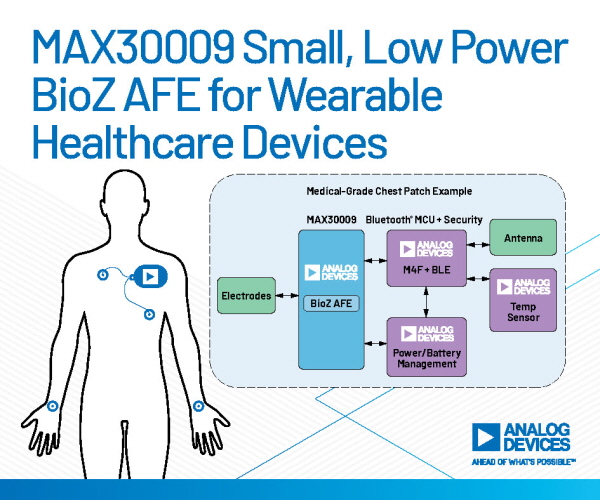
Analog Devices (ADI) has launched a low-power, high-performance analog front end (AFE) for small, wearable devices that is expected to help develop battery-powered devices that assess patient health.
Analog Devices (ADI) today announced the availability of the MAX30009 low-power, high-performance BioZ analog front end (AFE), which enables smaller size and longer life of bioimpedance (BioZ) remote patient monitoring (RPM) devices.
The MAX30009 BioZ AFE is highly integrated and is 30% smaller than competing products, enabling smaller measurement devices for improved patient comfort and consuming 62% less power than competing products.
It is also a high-performance device that supports simultaneous measurement of I and Q channels, 2-electrode and 4-electrode configurations, sample rates of 16sps to 4ksps, and a wide frequency range of 16Hz to 891KHz.
“For developers of small, battery-powered wearable devices that require continuous operation, this chip-on-AFE provides clinical-grade vital sign measurements required for bioimpedance analysis in wearables and medical-grade patches to assess patient health,” ADI said.

Comments
Related news

ADI Announces RadioVerse® SoC Series
Analog Devices (ADI) is advancing 5G wireless efficiency and performance through a new SoC.
2021.12.10by 강정규 기자
ADI Reduces Class-D Audio Amplifier Space by Up to 36%
Analog Devices (ADI) has introduced a high-efficiency multiphase synchronous automotive boost controller that reduces solution costs with programmable current-limit blanking time and can save up to 36 percent of Class D audio amplifier space.
2021.12.21by 강정규 기자
ADI Launches Buck Converter with Up to 94% Efficiency
A new step-down buck converter for multi-cell battery applications has been released, delivering maximum efficiency of 94% to extend battery life and providing a WLP that is 61% smaller compared to existing solutions.
2022.02.03by 강정규 기자

Intel Unveils Next-Generation 'Core Ultra Series 3' and vPro Platform for Enterprise PCs
Intel has officially unveiled the "Intel Core Ultra Series 3" for next-generation enterprise PCs and the latest vPro platform, addressing a wide range of demands from enterprise notebooks to high-performance workstations.
2026.03.26by 배종인 기자
ROHM Launches ESD Protection Diode Compatible with High-Speed Interfaces of 10Gbps or Higher
Semiconductor specialist ROHM has developed the 'RESDxVx series' of ESD (electrostatic discharge) protection diodes capable of responding to next-generation high-speed data communication environments exceeding 10Gbps, simultaneously enhancing both signal quality maintenance required in high-speed interfaces and IC protection performance.
2026.03.26by 배종인 기자