



[Technical contribution] Thomas Brand ADI FAE-“Ethernet PHY must have low loss and withstand external conditions well”
 Published2022.03.15 16:56
Acts as a bridge between digital and electrical signals on the PHY interface
Easy PHY robust certification work, no design changes required
As digitalization accelerates across all areas of our daily lives, the amount of data exchanged between devices and machines continues to grow rapidly.
In the industrial sector, Ethernet (Industrial Ethernet) is emerging as a new standard as existing communication technologies reach their limits.
Ethernet technology enables data transmission at gigabit speeds over distances of up to 100 meters, or up to several kilometers using optical fiber.
Ethernet is an interface standard defined in IEEE 802.3. One of the elements of IEEE 802.3 is the Ethernet physical layer (PHY).
This is a transceiver device for transmitting and receiving data or Ethernet frames. In the OSI model, Ethernet belongs to Layer 1 (physical layer) and Layer 2 (data link layer).
The physical layer defines electrical signals, signal transmission speeds, media and connector types, and network topologies. When the Ethernet PHY is substituted into the OSI model, it is as shown in Table 1.
.jpg)
▲Table 1: OSI model
PHY is a physical interface that is responsible for coding and decoding data between a purely digital system and the medium for transmitting signals. It thus acts as a bridge between digital and electrical signals on the interface.
The data link layer defines the frame structure for communicating and transmitting and receiving messages over the medium. In other words, it defines structuring bits from the wire and extracting data from the bit stream.
In Ethernet, this function is called MAC (media access control), and is performed at the data link layer, although it is close to the PHY. The MAC is typically integrated into a controller or switch.
The PHY can be configured externally using components or integrated into the Ethernet controller. The block diagram in Figure 1 shows the required Ethernet components and an externally configured PHY. If you want to use an externally configured PHY in a design, there are several considerations to consider when choosing a PHY.
In industrial applications, data transmission and networks must be extremely reliable and operate seamlessly over a wide temperature range. All components must meet these requirements.
Network cycle time is the time it takes for the controller to collect and update data from connected devices. A low-latency PHY reduces network cycle times and improves network update times. This is especially important for time-critical applications. Choosing a low-latency PHY can increase the amount of processing in the same amount of time, allowing more devices to be connected to the network.
Industrial applications must operate reliably even in harsh environments. Since the PHY is connected directly to the cable or through small passive components, interference (radiated or conducted) may occur in the cable, so it must be able to withstand external conditions.
EMC standards that must be adhered to in relation to the PHY specification include CISPR 32 and IEC 61000-4-2 through IEC 61000-4-6. A robust PHY makes certification easier and eliminates the need for cumbersome design changes.
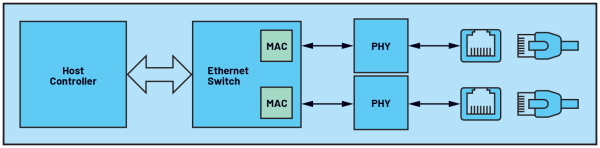
▲Figure 1: Simple block diagram of an Ethernet connection
Devices used in industrial applications must be protected against dust and moisture ingress to achieve IP65/IP66 ratings, which restricts airflow to cool the device.
Additionally, devices used in industrial applications are exposed to high temperature environments.
Here, a line or ring topology requires two Ethernet wires and therefore two PHYs, doubling the PHY loss for data input and output. Therefore, to minimize self-heating, a PHY with low loss must be selected.
Analog Devices offers ADI Chronous™, a family of industrial Ethernet products designed to meet the needs of industrial applications, including the robust PHYs ADIN1200 (10 Mbps/100 Mbps), ADIN1300 (10 Mbps/100 Mbps/1 Gbps), and ADIN1100 (10BASE-T1L).
※ About the author
Thomas Brand started his career at Analog Devices in Munich in 2015 while completing his Master’s thesis. After graduation, he joined the Analog Devices apprenticeship program and became a Field Application Engineer in 2017. He currently supports industrial customers in the Central European region and is responsible for the field of Industrial Ethernet. He studied electrical engineering at the University of Applied Sciences Mösbach in Germany and holds a Master’s degree in International Trade from the University of Applied Sciences Konstanz.

Comments
Related news
.jpg)
[Technical Contribution] ADI's Frederik Dostal: "Increasing Loop Bandwidth and Reducing the Number of Output Capacitors"
Analog Devices, Inc. FAE Frederik Dostal presents solutions on how to minimize the number and size of output capacitors in power supply design.
2021.10.18by 명세환 기자
.jpg)
[Technical contribution] ADI Frederik Dostal - “LT8330, positive feedback pin polarity required when using boost/SEPIC topology”
ADI's Frederick Dostal explains key considerations when designing buck regulator circuits using ADI's LT8330.
2022.01.21by 명세환 기자

[Technical contribution] ADI Frederik Dostal - “Burst mode and pulse skipping must be checked when designing power supply”
Analog Devices, Inc. FAE Frederik Dostal presents a solution to explain why pulses appear to be omitted in switch mode power supplies.
2022.02.15by 명세환 기자

Intel Unveils Next-Generation 'Core Ultra Series 3' and vPro Platform for Enterprise PCs
Intel has officially unveiled the "Intel Core Ultra Series 3" for next-generation enterprise PCs and the latest vPro platform, addressing a wide range of demands from enterprise notebooks to high-performance workstations.
2026.03.26by 배종인 기자

ROHM Launches ESD Protection Diode Compatible with High-Speed Interfaces of 10Gbps or Higher
Semiconductor specialist ROHM has developed the 'RESDxVx series' of ESD (electrostatic discharge) protection diodes capable of responding to next-generation high-speed data communication environments exceeding 10Gbps, simultaneously enhancing both signal quality maintenance required in high-speed interfaces and IC protection performance.
2026.03.26by 배종인 기자











