


Xenon, Neon, and Krypton 0% Tariff in April
 Published2022.03.18 14:11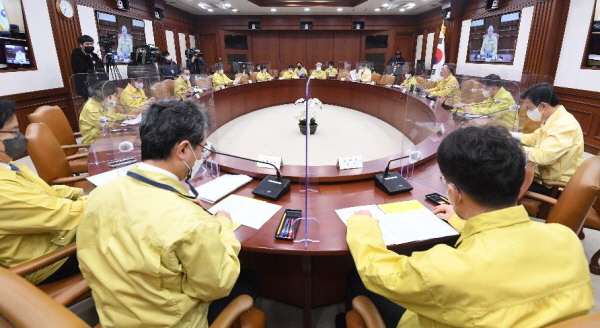
The government is taking steps to stabilize the supply of neon (Ne), xenon (Xe), and krypton (Kr), key materials in semiconductor manufacturing processes that have a high dependence on imports from Russia and Ukraine, by applying tariff quotas.
The government held the 19th meeting of the 'Ukraine Crisis Emergency Response Task Force' at the Government Complex Seoul on the 18th.
At today's meeting, as numerous cases of damage were reported on-site, including delays and non-collection of payments and logistics disruptions, mainly from companies dealing with Russia and Ukraine, and difficulties in remittances for international students and expatriates were also raised, the meeting focused on resolving payment and remittance difficulties, supporting affected companies, and managing the supply and demand of raw materials.
Among these, regarding raw materials, it was decided to apply a tariff quota of 0% from 5.5% to neon, xenon, and krypton, which have a high dependence on imports from Russia and Ukraine, in April, and to further increase inventory levels.
In addition, it was decided to implement stabilization measures, such as emergency supply and demand adjustments, in the event of market disruption.
Meanwhile, the import price of neon per kilogram rose by 111% to about $256 in February based on customs clearance, compared to about $121 in January, and the import volume in February was 3,096 kg, a 72% decrease compared to 11,244 kg in January.
Based on customs clearance data, the price of krypton recorded $744 per kilogram in February, a 15% increase compared to $465 per kilogram in January, and the import volume in February was 7It fell by 40% to 666 kg compared to 12,868 kg in January.
As for the price of xenon, based on customs clearance, it fell 21% to $4,150 per kg in February compared to $5,283 in January, and the import volume in February was 2,550 kg, a 16% decrease compared to 3,038 kg in January.

Comments
Related news
Ukrainian military conflict, Korean semiconductor 'crisis'
As the possibility of Russia's invasion of Ukraine increases, concerns about supply instability of specialty gases essential to semiconductor processes—such as neon, xenon, krypton, and helium—are rising, and South Korea's semiconductor industry is closely monitoring the situation.
2021.12.22by 배종인 기자
.jpg)
POSCO, Localization of Neon, a Rare Gas for Semiconductors
POSCO has successfully domesticated the production facilities and technology for neon (Ne), a rare gas used in semiconductors, and shipped its first product.
2022.01.14by 배종인 기자
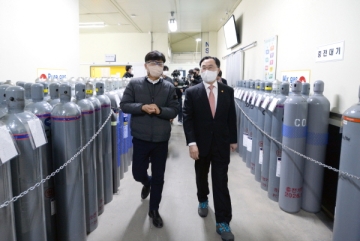
“Semiconductor rare gas supply instability, semiconductors will stop without it”
As Russia and Ukraine entered into war, an emergency alert was sounded for the semiconductor industry, which is a cornerstone of our nation's economy. The reason is that xenon (Xe), neon (Ne), and krypton (Kr) are essential core materials in semiconductor processes, and supply disruptions could cause delays in semiconductor manufacturing. Accordingly, the semiconductor industry is reportedly mobilizing all efforts to secure these rare gases, regardless of price.
2022.03.02by 배종인 기자
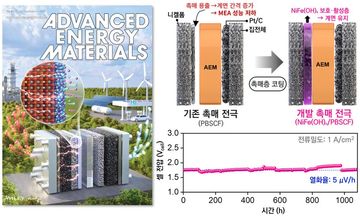
Materials Research Institute Develops Ultra-thin Coating Water Electrolysis Catalyst Technology
The Korea Institute of Materials Science has simultaneously resolved the performance and durability trade-off problem in water electrolysis catalysts by applying ultra-thin surface coating technology. Achieving 1.9 times higher performance compared to conventional catalysts while demonstrating 1,000-hour long-term stability, the institute has developed technology scalable to industrial water electrolysis systems through a simple process.
2026.10.07by 배종인 기자
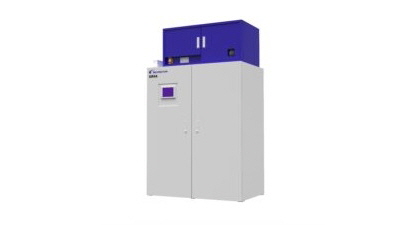
Gigaphoton Develops Neon Gas Recycling System for ArF Excimer Lasers...Achieves 50% Recycling Rate
Gigaphoton announced that it has developed a gas recycling system for ArF excimer lasers and achieved a 50% neon gas recycling rate.
2026.10.02by 배종인 기자











