


UNIST on the verge of commercializing 6G devices
 Published2022.03.22 14:52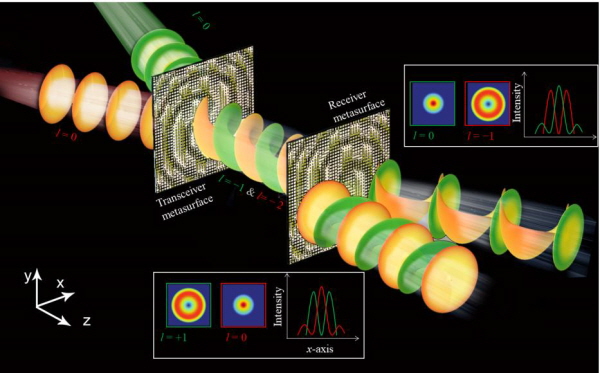
▲ Conceptual diagram of an E-band metasurface-based OAM communication system
A UNIST research team has proposed a communication device technology that can rapidly distinguish these OAM signals using a self-designed metasurface, raising expectations that it will accelerate the commercialization of 6G communication.
Professor Lee Jong-won's team at UNIST announced on the 22nd that they have developed a new communication device technology that will accelerate the commercialization of 6G communication.
It is a technology that utilizes a proprietary metasurface to generate and rapidly receive orbital angular momentum (OAM) signals, which are next-generation radio resources for 6G communication.
Professor Lee said, “Metasurface is a material designed to control the characteristics of radio waves, including light. The characteristics of light that can be controlled vary depending on the shape and arrangement of the two-dimensional structures placed on the surface.” "It was designed to simultaneously perform the roles of an OAM signal generator and receiver, and has been experimentally verified, which will help in the commercialization of OAM-based 6G communication technology," he explained.
Communication technology utilizing the physical quantity called OAM of light (radio waves) is considered a technology capable of efficiently using frequency resources.
This is because multiple orthogonal signals can be generated within the same wavelength (frequency) depending on the number of phase twists (OAM modes).
Thanks to this, the amount of data that can be transmitted at once can be increased, enabling faster communication.
On the other hand, unlike the beam used in general communication (Gaussian beam), OAM is characterized by a weak central beam intensity and strong intensity in the surrounding concentric regions.
For this reason, as the number of modes increases, the concentric circles spread out widely, requiring the size of the receiving antenna to increase, and it is also difficult to quickly separate and recover multiple incoming signals from the actual receiving antenna.
The research team proposed a communication device technology capable of rapidly identifying these OAM signals by utilizing a self-designed metasurface.
This metasurface can generate two types of OAM modes in the E-band frequency range and has a steering function to send the beam in a desired direction and lens characteristics that can reduce the beam divergence angle.
In particular, if this metasurface is flipped 180 degrees, it can be used as a receiver capable of rapidly separating and recovering OAM signals. Previously, OAM modes could only be distinguished by scanning the entire wide area of a concentric OAM beam, but this technology allows for mode differentiation within a short time simply by knowing the presence or absence of a signal entering the detector. The signal processing time becomes shorter.
Professor Lee Jong-won said, “This study presents the most realistic method to quickly identify metasurface-based OAM modes using a minimal number of detectors,” and expressed his expectation that “by adding OAM modes to metasurfaces, the channel capacity of 6G communication can be dramatically increased.”
Meanwhile, compared to the existing spiral phase plate (SPP) capable of generating OAM, the developed metasurface has the advantage of being thinner, allowing for weight reduction, and does not require a separate beam integrator, which can simplify the communication system.
The results of this study were published online on March 17 in Laser & Photonics Reviews, a world-renowned academic journal published by Wiley. The research was conducted with support from the Samsung Future Technology Development Program.

Comments
Related news
UNIST, AI World Stage ‘Top’ Recognition
A graduate student Yun Tae-hyun from UNIST's Graduate School of Artificial Intelligence (advisor: Prof. Lim Sung-bin) achieved the top position in the student category at a prestigious global artificial intelligence conference competition. The achievement was recognized for delivering the highest program performance in an emerging field that has recently attracted significant academic attention.
2021.12.06by 배종인 기자
UNIST Challenges Development of 35% Efficiency Super Solar Cells
UNIST challenges the development of a super solar cell achieving 35% efficiency over five years, contributing to carbon neutrality and the advancement of Korea's photovoltaic industry.
2021.12.22by 배종인 기자
UNIST and Yonsei Medical Center Join Hands for Smart Healthcare
UNIST (President Yong-Hoon Lee) and Yonsei University Health System (Director Dong-Seop Yoon) will strengthen research capabilities and contribute to advances in medical technology through the joint promotion of research in the smart healthcare field.
2022.01.10by 배종인 기자
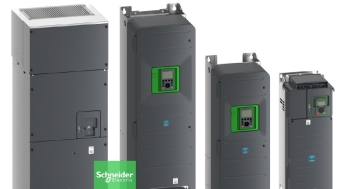
Schneider Aims for Building Energy Savings and Operational Stability with Next-Generation HVAC Drives
Schneider Electric has unveiled its next-generation HVAC drive product line 'Altivar HVAC'. The new product line's key features center on enhanced energy savings, system operational stability, and building management system integration. The products are divided into 'ATH200' for OEM and small equipment applications, and 'ATH600' for environments requiring continuous operation and advanced control. The company plans to expand the application scope from commercial buildings to facilities where HVAC system stability is critical, such as hospitals, airports, and data centers. The announcement includes over 30% energy savings, operation from -10°C to +60°C, Modbus and BACnet support, and compatibility with low global warming potential refrigerants.
2026.03.26by 명세환 기자
Ecolab Expands AI Data Center Cooling Business Through Acquisition of CoolIT
Ecolab has agreed to acquire CoolIT Systems, a liquid cooling company for AI data centers, for approximately $4.75 billion. The transaction is expected to close by Q3 2026, subject to regulatory approvals. CoolIT has been supplying direct-to-chip cooling-based coolant distribution units, cold plates, and manifolds, serving hyperscale data centers and colocation operators as customers. This acquisition is a measure to address the high-heat and high-density server environments created by AI proliferation. Ecolab plans to combine its water management and digital monitoring capabilities with CoolIT's hardware technology to expand its data center cooling business.
2026.03.26by 명세환 기자











