


'5G Specialized Networks and Edge Computing' Key to Overcoming Smart Manufacturing Limitations
 Published2022.03.22 21:48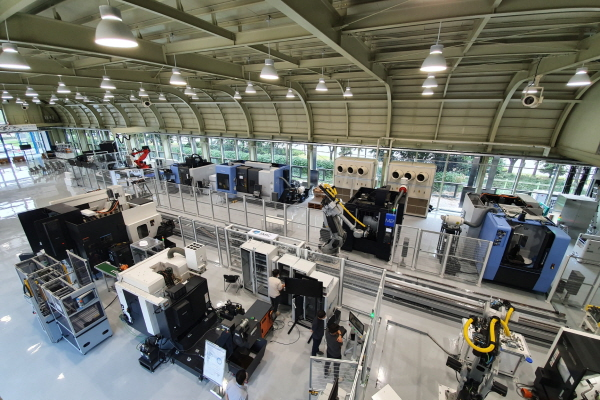
Large-scale investment by major companies in developed countries and global corporations
To overcome existing limitations such as data processing speed, weak security, and rapidly increasing data volume that were problematic for the transition from existing automated processes to modern smart manufacturing, 5G specialized networks and edge computing are emerging as key keywords for new smart manufacturing innovation.
■ Evolving manufacturing processes for 5G specialized network IoT equipment into a more automated operating environment
Recently, the government named the specialized 5th generation mobile communication network 'Eum 5G' and completed the frequency allocation and registration of telecommunications business operators. In addition, they are actively working to expand the reach through meetings between supply and demand companies.
Meanwhile, Minister of Science and ICT Lim Hye-sook also mentioned the activation of Eum 5G at the MWC held in Barcelona on March 1.
A 5G specialized network is a service network available only in specific areas, referring to a customized network specialized for the services intended to be introduced in those areas.
In past smart factory processes, wired systems were difficult to use where needed and fixed locations connected by several kilometers of cables became an obstacle to the placement of production equipment.
In addition, when connected via Wi-Fi, operational limitations occurred, the number of sensors and the amount of data exceeded network capacity limits, and excessive latency was experienced when applying video analytics.
According to Nokia, using a 5G specialized network allows for flexible adjustment of field deployment and facilitates the transmission and reception of location and gripper status information from robots, etc. IoT devices can connect various sensors, record the assembly process with cameras, perform real-time analysis, transmit data to operators via tablets and AR glasses, and enable quality assurance.
These specialized 5G networks can evolve the manufacturing processes of IoT equipment into a more automated operating environment, enable ultra-high speed, ultra-low latency, and simultaneous multiple connections, accelerate digital transformation, and realize the vision of future IoT.
Accordingly, Nokia is supplying services to numerous companies worldwide, including Toyota, KUKA, and Nippon Steel, and various companies such as the American agricultural machinery company John Deere, Bosch, Lufthansa Technik, Airbus in Germany, and Fujitsu in Japan have built 5G specialized networks.
Domestically, Naver Cloud is supplying services to organizations such as the Korea Airports Corporation, and LG CNS has also recently successfully completed the Eeum 5G demonstration project.
It is reported that Samsung SDS, Kakao Enterprise, Samsung Electronics, and Qualcomm Korea are reviewing whether to adopt it in Korea.
■ Edge computing is experiencing rapid growth in industries requiring very fast response times.
With 5G specialized networks available for network speeds, edge computing is emerging as a key keyword for smart manufacturing to increase data processing speeds.
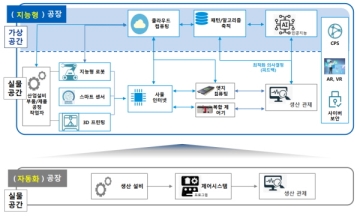
Edge computing is a computing technology at the network edge designed to link intelligent equipment elements, which operate by incorporating self-diagnostic or intelligent control functions within the device, with the optimal operation of the upper system layer.
Tasks are performed by IoT devices that include a computer, storage, and network connectivity in a small size and transmit data to local devices.
As data-producing devices increase due to smart manufacturing innovation, the amount of data that needs to be processed is increasing exponentially, and the central processing systemThe need for distributed systems is growing compared to traditional systems.
Edge computing enables data processing directly on IoT devices, so while its computational power is lower than that of cloud computing, it offers faster response times and eliminates the need for broadband communication.
In addition, edge computing is more efficient than cloud computing in industries that require very fast response times.
In addition, storage for storing vast amounts of data needs to be increased, and computational performance to process it needs to be higher; however, edge computing can transmit only the essential results to the central cloud after primary preprocessing of the data.
Due to these advantages, as smart manufacturing advances, the need for building and integrating manufacturing application systems is increasing, and the demand for flexibility, intelligence, and real-time capabilities between systems is also growing.
Consequently, as data generated in factories increases exponentially and concerns about server load arise, edge computing, which processes data quickly and efficiently, is expected to receive even more attention in smart manufacturing.
By utilizing edge computing, data generated from sensors does not need to be sent to a central data center, and only the data reduced by edge computing needs to be transmitted to the central data center, thereby reducing network and storage resource costs. In addition, edge computing embeds the latest cybersecurity features into the system to reduce data security threats and the risk of data contamination during the transmission phase.
Furthermore, while cloud computing suffers a fatal blow if the server goes down, edge computing allows for effective response to failures because it performs computing tasks internally.
According to a 2021 report by Grandview Research, the global edge computing market is projected to grow at an average annual rate of 38.4% from $4.6 billion in 2019 to $32.3 billion in 2025.
Edge computing was selected by Gartner as one of the top 10 strategic technologies in 2018 and is being applied in various fields, with companies such as Microsoft, Dell, and Hewlett-Packard investing billions of dollars.
In particular, while the U.S. and Germany are taking a step ahead in edge computing, Japanese companies such as Toshiba, Mitsubishi, and Fujitsu are focusing on edge computing by developing various solutions utilizing it.
In Korea, SKT, KT, LG Uplus, and others are collaborating with German and American companies to expand their market in fields such as autonomous driving and smart factories.
Meanwhile, e4ds news will host the '2022 IIoT Innovation Day' on April 8th at COEX Hall D and e4ds.com, simultaneously online and offline, under the theme of 'Building Industrial Communication Networks for Digital Twins.' At this seminar, Lee Soon-yeol, CEO of I2, is scheduled to present on 'The Importance and Preparation for Securing Industrial Trustworthiness for Industrial Digital Transformation.' We look forward to your participation. You can register to participate at https://www.e4ds.com/seminar_introduce.asp?idx=129 .

Comments
Related news

Full-scale expansion of 5G specialized networks at home and abroad
5G specialized network operators can build 5G communication networks directly without going through the three major mobile carriers, and have the advantage of being able to construct optimized network environments for specific environments, applications, and coverage areas, enabling utilization across various fields such as smart cities, which is drawing considerable industry attention.
2022.03.07by 성유창 기자
Smart Manufacturing, 'Interconnection and Data' are the Keys
To equip advanced data-centric smart manufacturing that goes beyond conventional factory automation, it is analyzed that interconnection between production equipment and efficient management and utilization of data generated based on this interconnection are essential.
2022.03.15by 배종인 기자
.jpg)
A place to share new technologies in industrial communication networks
e4ds news will hold the '2022 IIoT Innovation Day' event at COEX D Hall starting at 10:00 AM on April 8th.
2022.03.22by 배종인 기자
Korea Instrument, KOLAS Accredited Calibration Agency First to Simultaneously Acquire ISO/IEC 27,001·27,701
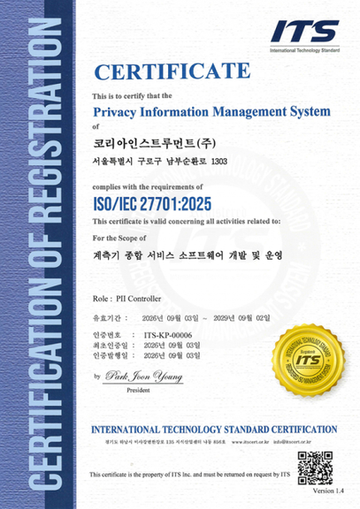
Korea Instrument has become the first among KOLAS accredited calibration agencies to simultaneously acquire ISO/IEC 27,001 and ISO/IEC 27,701 certifications. Through its proprietary platforms CWIZ Enterprise and CWIZ Partners, the company has embedded information security and personal data protection requirements across all business processes including customer information, equipment data, and calibration reports, with plans to continuously advance its management system through regular audits and security inspections.
2026.10.12by 배종인 기자
TeamViewer One, IT Incident Automation Workflow and Resolution Center Enhanced
TeamViewer has added IT incident automation capabilities and an advanced Resolution Center to its integrated digital workplace management platform 'TeamViewer ONE'. Recurrent service disruptions, configuration errors, and capacity shortages are automatically handled according to preset policies, and device status verification through script deployment can be managed in a unified interface, significantly reducing repetitive tasks for IT teams.
2026.10.12by 배종인 기자











