


KIMS Localizes Nano Ribbon Materials for Electric Vehicles
 Published2022.03.24 14:22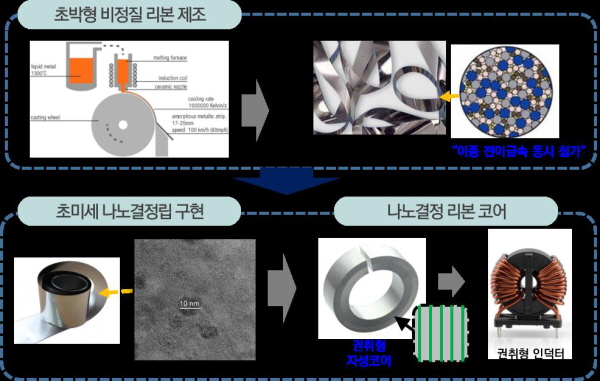
Key material for eliminating EMI noise in power converters
Import substitution effect and overseas export prospects upon successful localization
A research team led by Dr. Jaewon Jeong at the Metal Powder Research Laboratory of the Korea Institute of Materials Science has succeeded in developing a technology to localize high-saturation magnetization and high-permeability soft magnetic nanocrystalline ribbon materials used in electric vehicle power converters.
The technology developed this time is a manufacturing technology for ultra-thin soft magnetic materials that increases saturation magnetization by more than 30% compared to existing materials currently entirely dependent on imports, while exhibiting permeability characteristics at an equivalent level.
Ultra-thin nanocrystalline alloy ribbon material is a key material for eliminating EMI noise in power converters installed in rapidly growing electric vehicles.
Currently, due to the lack of domestic technology and industrial infrastructure to manufacture the material, imported materials also rely on existing alloys. Even these exhibit low saturation magnetization characteristics, making it difficult to meet the future demand for component miniaturization.
For miniaturization, the saturation magnetization of the material must be higher than that of existing commercial materials; however, increasing the iron content to achieve this lowers the material's amorphous formation ability, leading to higher losses. For this reason, simultaneously increasing high saturation magnetization and high permeability characteristics has long been considered a technical challenge.
Dr. Jeong's research team was able to achieve nanocrystals of the 10–20 nm level by controlling the diffusion rate within the alloy through increasing the iron content of existing alloy materials and simultaneously adding heterogeneous transition metals.
In addition, a manufacturing technology for ultra-thin soft magnetic materials was developed that increases saturation magnetization by more than 30% compared to existing materials while maintaining equivalent permeability characteristics. This material reduces the content of high-cost elements, such as niobium (Nb), which were essential in existing nanocrystalline ribbon alloys, by more than 30%, thereby enabling a reduction in manufacturing costs. It is also expected that price competitiveness can be secured upon future commercialization.
The domestic market size for nanocrystalline ribbon materials for electric vehicles is approximately 2 billion won annually as of 2021. Due to the recent rapid growth of the electric vehicle market, it is projected to reach 22.5 billion won annually by 2025. However, as the entire supply is currently imported from overseas due to a lack of domestic technology and manufacturing infrastructure, it is expected that successful localization through the development of this technology will not only have an import substitution effect but also enable exports to overseas markets. With annual global car sales reaching 80 million units, the market for nanocrystalline alloy ribbon materials for electric vehicles is expected to reach 1.5 trillion won annually once the transition from conventional internal combustion engines to electric vehicles is fully realized.
"Senior Researcher Jaewon Jeong, the principal investigator, stated, 'While extensive research is being conducted both domestically and internationally to develop nanocrystalline alloys to replace existing materials, actual commercialization has not been achieved because it has been difficult to realize materials that simultaneously satisfy high saturation magnetization and high permeability characteristics.' He added, 'If this technology is commercialized, it will enable the localization of nanocrystalline ribbon materials, which are currently entirely imported. We expect this will significantly contribute to reducing import dependency for manufacturers of electric vehicle power converters, which require this material.'"
Meanwhile, this research achievement was carried out with support from the Ministry of Science and ICT's Materials Innovation Leading Project. The research team is currently transferring the developed high-saturation magnetization/high-permeability alloy material and pilot-scale ribbon manufacturing technology to relevant companies and continuing to support their mass production, with the goal of establishing a domestic ribbon manufacturing industry and achieving complete localization of the material. The research team predicts that if mass production is achieved, it will generate approximately 20 billion won in revenue by 2025 through the production of 1,500 tons of ribbon annually.
Comments
Related news
KIMS Establishes New Quarantine System Using Plasma Technology
The Korea Institute of Materials Science (KIMS, President Lee Jeong-hwan), a government-funded research institute under the Ministry of Science and ICT, has agreed with Korea Technology Co., Ltd., Daewoo Shipbuilding & Marine Engineering Construction Co., Ltd., and Pureun Light Co., Ltd. to establish a plasma technology-based disinfection and air conditioning system to effectively respond to the coronavirus pandemic situation.
2022.03.03by 배종인 기자
The Korea Institute of Materials Science (KIMS) has developed a low-reflective, high-absorbency material for 5G electromagnetic waves.
The Korea Institute of Materials Science (KIMS, President Lee Jung-hwan) has developed absorption shielding materials for the 5G band that are difficult to develop globally, which is expected to enable import substitution and overseas exports for smartphones, autonomous vehicles, communication satellites, and other applications.
2022.03.08by 배종인 기자
Materials Research Institute's "Comprehensive Service Business Support Project" Results in Sales and Employment
The Korea Institute of Materials Science (KIMS, Director Lee Jeong-hwan), a government-funded research institute under the Ministry of Science and ICT, has been found to contribute to generating direct economic and social outcomes for participating companies through its "Comprehensive Service Business Support Project" funded by its own budget.
2022.03.15by 배종인 기자
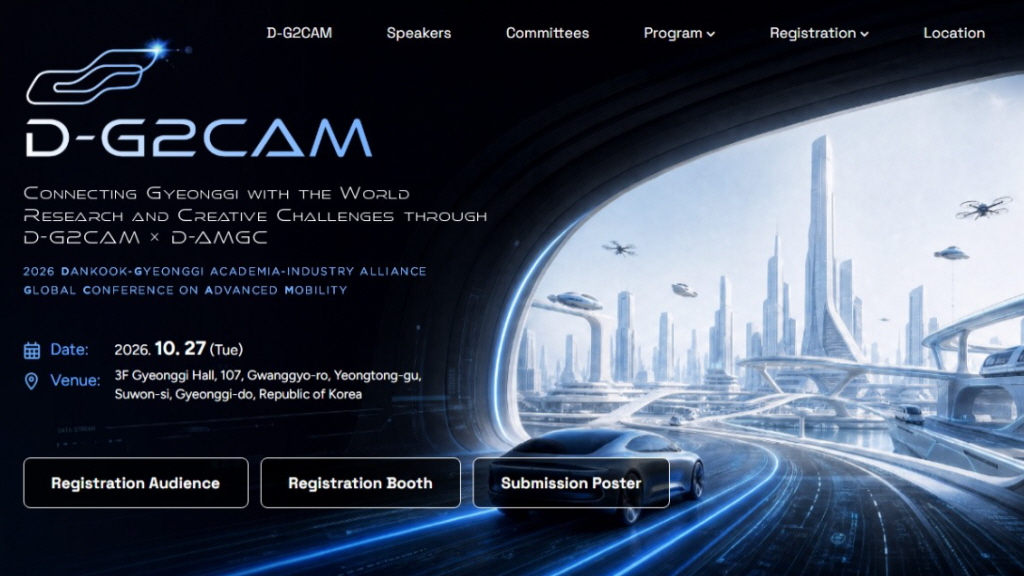
GAIA-Festa 2026, Autonomous Driving, AI, and Aerospace Experts Gather…Discussing Global Cooperation in the 'Silicon Intelligence Era'
GAIA-Festa 2026, which will be held in Suwon on October 27, is an industry-academia-research exchange event that explores the present and future of future mobility and AI technology through the global conference D-G2CAM 2026 and the international contest D-AMGC 2026. Domestic and international experts will share the latest research in autonomous driving, 5G/6G mobility, space technology, and data protection fields, while university students will showcase robots and physical AI prototypes that they have independently developed. Additionally, through poster presentations, corporate exhibitions, international cooperation meetings, and signing ceremonies, a platform will be established to connect the research capabilities and industrial needs of the Gyeonggi region with a global cooperation network.
2026.10.13by 배종인 기자

[e4ds Tech Day 2026 ⑨] Sim Sang-gyu, Autocrypt CTO: "In the Physical AI Era, Automotive Security Must Extend Beyond the Vehicle"
At e4ds Tech Day 2026, Sim Sang-gyu, CTO of Autocrypt, explained automotive cybersecurity strategies in the era of Physical AI and SDV (Software-Defined Vehicle). Automobiles are evolving as part of an ecosystem connected to AI, cloud, chargers, IoT, and robots, and he emphasized that the scope of security must expand beyond the vehicle interior to the entire connected environment. In particular, AI model tampering, adversarial attacks, OTA updates, and EV charger hacking were identified as major threats. He explained that response measures require zero trust, AI model integrity protection, intrusion detection, Security by Design and Default, and full lifecycle security management, and that proactive security system establishment beyond regulatory compliance is critical for securing future mobility competitiveness.
2026.10.12by 배종인 기자











