



Korea Institute of Materials Science Develops Rare Earth Reduced Permanent Magnet
 Published2022.03.29 09:38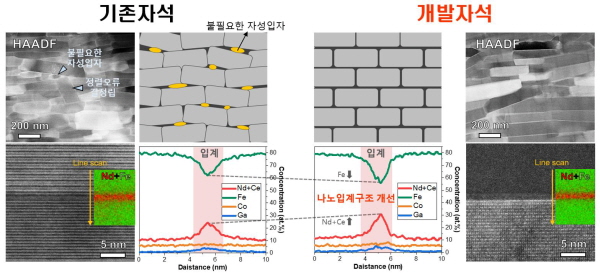
▲ Photographs and schematic diagrams of the actual microstructure (HAADF-STEM) of a conventional magnet and a magnet developed by the Korea Institute of Materials Science (The alignment of crystal grains within the magnet has been improved by suppressing the formation of unnecessary magnetic particles (line 1), and the crystal boundary composition and microstructure at the nanometer level have been improved (line 2))
A permanent magnet has been developed that achieves performance equivalent to commercial magnets currently used in the industry while reducing the use of expensive rare earth elements, raising expectations that it will contribute to the future development of the domestic permanent magnet industry.
The Korea Institute of Materials Science (KIMS, President Lee Jeong-hwan), a government-funded research institute under the Ministry of Science and ICT, announced on the 29th that a research team led by Dr. Lee Jeong-gu and Dr. Kim Tae-hoon of the Magnetic Materials Research Laboratory at the Powder Materials Research Division has succeeded in developing a rare-earth-reducing permanent magnet material technology capable of achieving performance levels comparable to commercial magnets (Grade 42M) while reducing the use of the expensive rare-earth element neodymium (Nd) by approximately 30%.
The technology holds significant technical value in that it achieves performance equivalent to commercial magnets currently used in the industry, while reducing the use of expensive rare earth elements.
Although neodymium (Nd) is expensive and its supply is highly unstable, it has been used without choice until now because it is essential for realizing the performance of rare-earth permanent magnets.
For the development of neodymium (Nd)-reducing permanent magnets, neodymiumInstead of reducing the content of Nd, the content of low-cost cerium (Ce) must be increased, but existing research has not been able to prevent the deterioration of the magnetic properties of the magnet as the cerium (Ce) content increases.
Our research team began by focusing on clearly identifying the cause and mechanism of the deterioration of magnetic properties of magnets due to increased cerium (Ce) content. Based on this, we were able to successfully resolve the problem of magnetic property deterioration in rare-earth reduced permanent magnets through atomic-scale microstructure control.
During the research process, the research team discovered that unwanted magnetic particles are formed within rare-earth reduced permanent magnets manufactured using conventional processes and identified that these particles are the cause of the deterioration of the magnet's microstructure and magnetic properties. Accordingly, they conducted research to improve the magnet's microstructure and enhance its magnetic properties by inhibiting the diffusion of atoms constituting the unwanted magnetic particles to hinder their formation.
The research team applied the melt-spinning and hot-deformation methods, which enable processing with very rapid cooling speeds, to the manufacture of rare-earth reduced precursors and final permanent magnets, respectively, instead of the conventional process.
As a result, they succeeded in optimizing the microstructure of the magnet by suppressing the formation of unnecessary magnetic particles within the magnet.
In addition, this made it possible to simultaneously improve the remanent magnetization and coercivity, which are key characteristics of permanent magnets.
Generally, since the characteristics of residual magnetization and coercivity of a magnet have a trade-off relationship, this technology, which improves both major characteristics simultaneously, can be said to have very high technical utility and value.
The domestic market size for rare earth permanent magnets for high-efficiency motors amounts to 186 billion won as of 2021, but almost all of it is imported from overseas. Considering China's recent weaponization of rare earth resources, Japan's export restrictions on materials, and global carbon reduction issues, the localization of rare earth permanent magnet material technology is a task that must be accomplished.
Once this technology is commercialized, it is expected to be utilized in high-value-added industrial sectors requiring high-efficiency motors, such as electric vehicles, drones, flying cars, and electric ships.
Kim Tae-hoon, a senior researcher at the Korea Institute of Materials Science (KIMS) who led this study, stated, “Once this technology is commercialized, it will be a highly successful case of technological development that simultaneously resolves resource issues and material, component, and equipment challenges in the domestic rare earth permanent magnet sector using purely domestic technology.” He added, “As this research result is just the beginning, I will devote myself further to future research to solidify KIMS’s role and do my utmost to lead the development of Korea’s rare earth permanent magnet industry.”
This research achievement was carried out through the Korea Institute of Materials Science's major project, 'Development of Performance-Oriented Composite Magnetic Structure Magnetic Powder Material Technology,' with support from the Ministry of Science and ICT.
In addition, the research results were published on March 17 in Scripta Materialia, one of the world's top 5 journals in the field of metallic materials (First author: PhD student Gayoung Kim, Title: High-performance Ce-substituted (Nd0.7Ce0.3)-Fe-B hot-deformed magnets fabricated from amorphous melt-spun powders).

Comments
Related news
The Korea Institute of Materials Science (KIMS) has developed a low-reflective, high-absorbency material for 5G electromagnetic waves.
The Korea Institute of Materials Science (KIMS, President Lee Jung-hwan) has developed absorption shielding materials for the 5G band that are difficult to develop globally, which is expected to enable import substitution and overseas exports for smartphones, autonomous vehicles, communication satellites, and other applications.
2022.03.08by 배종인 기자
Materials Research Institute's "Comprehensive Service Business Support Project" Results in Sales and Employment
The Korea Institute of Materials Science (KIMS, Director Lee Jeong-hwan), a government-funded research institute under the Ministry of Science and ICT, has been found to contribute to generating direct economic and social outcomes for participating companies through its "Comprehensive Service Business Support Project" funded by its own budget.
2022.03.15by 배종인 기자
KIMS Localizes Nano Ribbon Materials for Electric Vehicles
The development of localization technology for nanocrystalline ribbon materials for electric vehicles, which were previously dependent on imports, is expected to significantly contribute to reducing the import dependency of electric vehicle power conversion device manufacturers.
2022.03.24by 성유창 기자
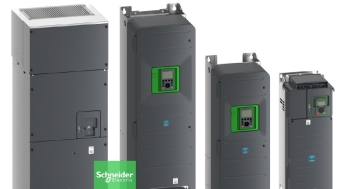
Schneider Aims for Building Energy Savings and Operational Stability with Next-Generation HVAC Drives
Schneider Electric has unveiled its next-generation HVAC drive product line 'Altivar HVAC'. The new product line's key features center on enhanced energy savings, system operational stability, and building management system integration. The products are divided into 'ATH200' for OEM and small equipment applications, and 'ATH600' for environments requiring continuous operation and advanced control. The company plans to expand the application scope from commercial buildings to facilities where HVAC system stability is critical, such as hospitals, airports, and data centers. The announcement includes over 30% energy savings, operation from -10°C to +60°C, Modbus and BACnet support, and compatibility with low global warming potential refrigerants.
2026.03.26by 명세환 기자
Ecolab Expands AI Data Center Cooling Business Through Acquisition of CoolIT
Ecolab has agreed to acquire CoolIT Systems, a liquid cooling company for AI data centers, for approximately $4.75 billion. The transaction is expected to close by Q3 2026, subject to regulatory approvals. CoolIT has been supplying direct-to-chip cooling-based coolant distribution units, cold plates, and manifolds, serving hyperscale data centers and colocation operators as customers. This acquisition is a measure to address the high-heat and high-density server environments created by AI proliferation. Ecolab plans to combine its water management and digital monitoring capabilities with CoolIT's hardware technology to expand its data center cooling business.
2026.03.26by 명세환 기자











