



ETRI successfully conducted real-time remote control of a smart factory between Korea and Finland.
 Published2022.03.30 09:11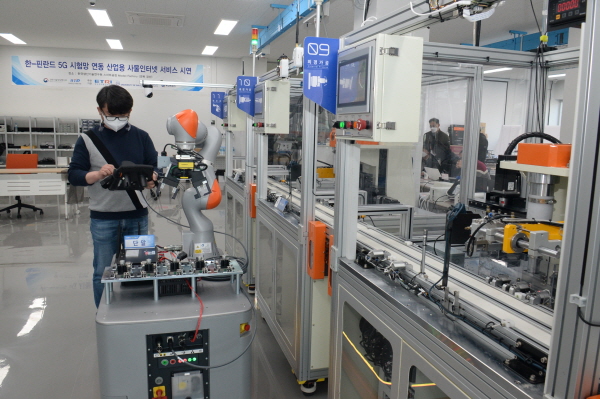
▲ETRI researchers control a mobile robot in a smart factory in real time using domestic 5G technology.
Low-latency, high-reliability communication of less than 0.3 seconds ushering in an era of collaborative remote manufacturing.
A domestic research team has presented a technology that allows for the simultaneous remote control of a single factory from both domestic and international locations, using 5G technology developed through international joint research and an intercontinental wired network.
The Electronics and Telecommunications Research Institute (ETRI) announced on the 29th that it had successfully demonstrated an Industrial Internet of Things (IIoT) service that simultaneously controls and monitors smart factory equipment and robots in real time both domestically and internationally.
The key to a successful technology demonstration is ultra-low latency communication technology.
It handles communication delays of over 10,000 kilometers (km) within 0.3 seconds.
The University of Oulu, Finland, demonstrated that it is possible to control factory facilities in Gyeongsan, Gyeongbuk Province, in real time and without interruption.
A smart factory is an intelligent factory that applies information and communication technology (ICT) throughout the manufacturing process, increasing productivity and reducing defect rates to enhance industrial competitiveness.
The key is to automate tasks using robots while remotely controlling various processes.
> In order to prevent damage caused by communication errors, data transfer speed is important, but communication delay and data loss must be minimized.
The longer the communication distance and the more complex the communication network, the higher the delay and loss. The technology needed in this case is low-latency, high-reliability communication technology.
Based on this technology, ETRI connected the smart factory of the Korea Institute of Industrial Technology located in Hayang-eup, Gyeongsan-si, Gyeongsangbuk-do, using the 5G test network of the University of Oulu, Finland and the domestic test network (KOREN).
This demonstration showcased a new remote manufacturing diversification service that allows a single factory to be independently controlled from both domestic and international locations.
This is the world's first attempt to increase the scope and usability of smart factory services.
The ETRI Control Center showcased services such as remote production management system (MES) operation and ordering, and real-time equipment control and status monitoring through a remote SCADA control panel.
At the Oulu Control Center, demonstrations were held on remote control and status monitoring of mobile manufacturing robots, remote manufacturing process control using virtual reality (VR) equipment, and remote manufacturing process monitoring using wireless sensor data collection based on narrowband Internet of Things (NB-IoT).
In particular, it is significant that they successfully demonstrated real-time remote control and monitoring services with a round-trip delay of less than 0.01 seconds domestically and less than 0.3 seconds overseas while connecting a wired network exceeding 10,000 km.
This demonstration is expected to increase the potential for remote smart manufacturing services based on stable communication quality, thereby activating international sharing and cooperation in the manufacturing and production sectors.
This makes it easier to control from the other side of the world without having to visit the site.
The idle facilities of each industry can be efficiently utilized through remote control, which is beneficial for global resource management and industrial management of small and medium-sized enterprises.It is expected that the competition will also gain momentum.
Kim Il-kyu, head of ETRI's Mobile Communications Research Center, said, "As smart factories can now be remotely controlled not only domestically but also internationally, we expect this to revitalize the stagnant industry by meeting the demand for non-face-to-face activities in the industry that has spread due to COVID-19."
In the future, the research team plans to conduct follow-up research to ensure connectivity and mobility and implement hyperspace services through research on low-orbit satellite communications, which are considered core to 6G communication technology.
In addition, we plan to work towards realizing a future factory completed with 6G through continued collaboration with the 6G flagship program hosted by the University of Oulu.
This technology was developed in collaboration with the University of Oulu, Finland, as part of the Ministry of Science and ICT's 'International Joint Research and Cooperation for 5G+ High-Reliability, Low-Latency Core Technologies' project.
Last December, ETRI built a 5G industrial IoT system and demonstrated real-time remote monitoring and control services with a round-trip delay of less than 0.01 seconds between Daejeon and Gyeongsan.
This demonstration is the result of expanding the scope of remote services overseas.
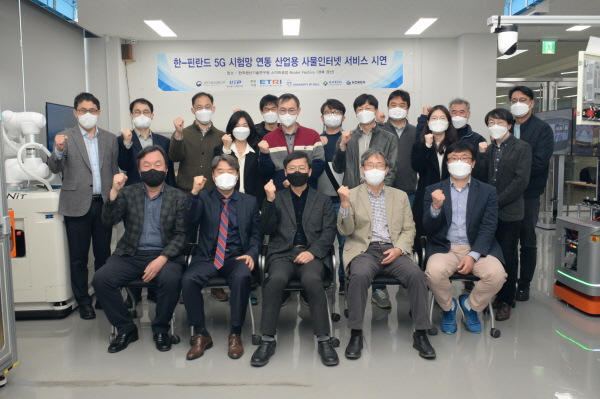
▲ETRI researchers pose for a commemorative photo after completing the 'Korea-Finland Industrial Internet of Things Service Demonstration.'

Comments
Related news
.jpg)
ETRI Protects National Infrastructure with Digital Twin Technology
Domestic researchers have developed a system that enables effective management of national infrastructure by utilizing digital twin technology. This is expected to significantly contribute to preventing disasters and maintaining national infrastructure in a smart and safe manner.
2021.04.28by 배종인 기자
ETRI ushered in an era of real-time remote control over hundreds of kilometers.
Domestic researchers have developed technology that enables real-time remote control of smart factories (Model Factory) located hundreds of kilometers away using 5G and wired networks, generating expectations that it will contribute to strengthening the competitiveness of the domestic manufacturing industry.
2021.12.16by 배종인 기자
ETRI succeeds in intercontinental linkage of 5G satellite multi-connection networks.
Domestic research teams have developed infrastructure technology that can expand 5G service coverage through international joint research with the European Union (EU). Upon commercialization of this technology, uninterrupted communication services are expected to be provided even in remote and maritime areas with insufficient communication infrastructure, as well as in disaster situations.
2022.01.07by 배종인 기자
Korea Instrument, KOLAS Accredited Calibration Agency First to Simultaneously Acquire ISO/IEC 27,001·27,701
Korea Instrument has become the first among KOLAS accredited calibration agencies to simultaneously acquire ISO/IEC 27,001 and ISO/IEC 27,701 certifications. Through its proprietary platforms CWIZ Enterprise and CWIZ Partners, the company has embedded information security and personal data protection requirements across all business processes including customer information, equipment data, and calibration reports, with plans to continuously advance its management system through regular audits and security inspections.
2026.10.12by 배종인 기자
TeamViewer One, IT Incident Automation Workflow and Resolution Center Enhanced
TeamViewer has added IT incident automation capabilities and an advanced Resolution Center to its integrated digital workplace management platform 'TeamViewer ONE'. Recurrent service disruptions, configuration errors, and capacity shortages are automatically handled according to preset policies, and device status verification through script deployment can be managed in a unified interface, significantly reducing repetitive tasks for IT teams.
2026.10.12by 배종인 기자











