


Ministry of Trade, Industry and Energy pushes to establish safety standards for electric vehicle charging facilities
 Published2022.03.31 08:46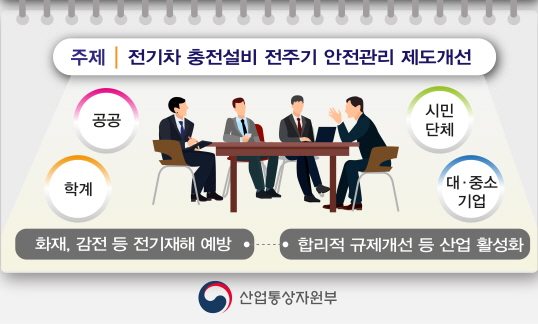
Meeting Held on Improving Safety Management Systems for Electric Vehicle Charging Facilities
Public discussion on the current status and problems of safety management for charging facilities throughout their entire lifecycle
On the 30th, the Ministry of Trade, Industry and Energy held a meeting to formulate 'safety management measures for electric vehicle charging facilities' by gathering opinions from field stakeholders, including large, medium, and small enterprises, civic groups, academia, and public institutions.
This meeting was held to drive the widespread adoption of electric vehicles by preventing electrical hazards, such as fires and electric shocks, that may occur at charging facilities.
As the number of electric vehicles is expected to increase to 1.13 million and charging facilities to 510,000 by 2025, the current status and problems of safety management across the entire lifecycle of charging facilities (manufacturing, certification, installation, and maintenance) were brought to public attention, and measures to introduce reasonable safety standards were discussed and proposed.
At the meeting, the results of the policy research on 'Improvement Measures for Safety Management of Electric Vehicle Charging Facilities' (Seoul National University), conducted from September of last year to the end of February this year, were shared, and opinions were gathered from large and small businesses, academia, and civic groups, followed by a free discussion (Q&A) among the attendees.
In the industry's opinion It includes △establishment and proposal of safety standards to promote the widespread adoption of ultra-fast chargers (over 200kW) following their development △establishment and proposal of waterproof and dustproof standards to prevent safety accidents such as electric shock caused by external environments like rainwater △response measures in case of fire during electric vehicle battery charging △improvement measures regarding defects in batteries and other components from manufacturers.
In his opening remarks, Yang Byeong-nae, Director General of Hydrogen Economy Policy, stated, “We plan to formulate government policies that actively reflect the opinions of large, medium, and small enterprises by proactively presenting reasonable standards for safety management in the field of electrical safety, which has previously been perceived solely as a regulatory burden, so that safety standards can accelerate industrial and technological development.”
The Ministry of Trade, Industry and Energy stated, “Through this industry meeting, we plan to listen to the opinions of manufacturers in the electric vehicle charging equipment sector regarding on-site difficulties and formulate practical support measures, such as R&D necessary for global technological leadership.” The ministry added, “We will proactively establish safety standards by reflecting the opinions of experts from various fields through technical standards subcommittees, expert committees, and the Standards Committee, and strive to promote the widespread adoption of electric vehicles and charging facilities.”
Comments
Related news
NXP and Hitachi Energy Partner to Develop SiC Power Modules
NXP Semiconductor announced on the 22nd that it is collaborating with Hitachi Energy to accelerate the adoption of silicon carbide (SiC) power semiconductor modules in the electric vehicle sector.
2022.03.22by 성유창 기자
KIMS Localizes Nano Ribbon Materials for Electric Vehicles
The development of localization technology for nanocrystalline ribbon materials for electric vehicles, which were previously dependent on imports, is expected to significantly contribute to reducing the import dependency of electric vehicle power conversion device manufacturers.
2022.03.24by 성유창 기자
[Interview] Lee Cheol, Infineon Vice President - “Electric Vehicle OBC Development, Optimal System Design Required”
We met with Lee Chul, assistant manager at Infineon, to learn about the principles and advantages of onboard chargers, and to hear about Infineon's onboard charger system solutions.
2022.03.24by 성유창 기자
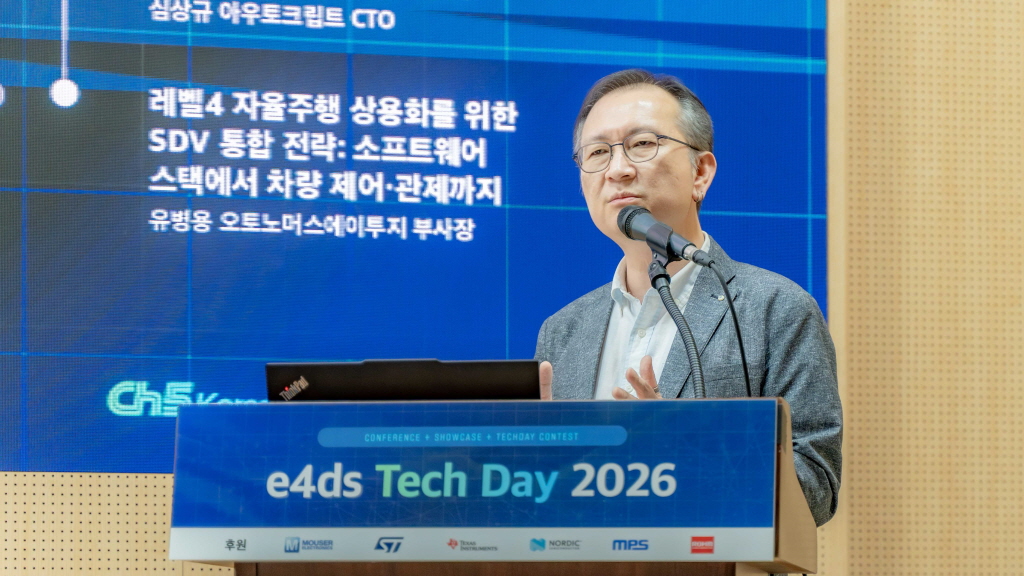
[e4ds Tech Day 2026 ⑨] Sim Sang-gyu, Autocrypt CTO: "In the Physical AI Era, Automotive Security Must Extend Beyond the Vehicle"
At e4ds Tech Day 2026, Sim Sang-gyu, CTO of Autocrypt, explained automotive cybersecurity strategies in the era of Physical AI and SDV (Software-Defined Vehicle). Automobiles are evolving as part of an ecosystem connected to AI, cloud, chargers, IoT, and robots, and he emphasized that the scope of security must expand beyond the vehicle interior to the entire connected environment. In particular, AI model tampering, adversarial attacks, OTA updates, and EV charger hacking were identified as major threats. He explained that response measures require zero trust, AI model integrity protection, intrusion detection, Security by Design and Default, and full lifecycle security management, and that proactive security system establishment beyond regulatory compliance is critical for securing future mobility competitiveness.
2026.10.12by 배종인 기자

Practical HIL Construction Strategy for Automotive and Off-Highway Controller Validation
As vehicle E/E architecture transitions to zonal structures and shifts to software-defined vehicles (SDV), the number of controllers (ECUs) requiring validation and software complexity are surging dramatically. Meanwhile, real vehicle testing cannot provide repeated verification under identical conditions and entails lead time and safety concerns. This white paper explains the principles of HIL (Hardware-in-the-Loop) validation and the structure of the NI platform composed of PXI, SLSC, and VeriStand, and through two actual implementation cases—Camera Record & Replay HIL for In-Cabin Monitoring Controller (ICMU) and Forklift Controller (VCU) HILS—describes how controller-level regression testing becomes possible. Additionally, it explicitly states application boundaries and limitations, such as lack of A2B support.
2026.10.12by 편집부











