



The Ministry of Trade, Industry and Energy, Incheon Metropolitan City, SK E&S, and others are joining forces to promote hydrogen public transportation.
 Published2022.03.31 09:12
13 liquid hydrogen charging stations for Incheon city buses by 2025.
On the 30th, the Ministry of Trade, Industry and Energy signed a business agreement with Incheon City, SK E&S, PlugPower, and others at Incheon City Hall to promote hydrogen public transportation.
Incheon City plans to replace 700 of its 2,000 city buses with hydrogen buses by 2024, convert all city buses to hydrogen buses by 2030, and build 13 liquid hydrogen charging stations exclusively for city buses by 2025.
The Ministry of Trade, Industry and Energy announced that it will actively promote this plan by signing business agreements with Incheon City, the Ministry of Environment, SK E&S, PlugPower, and Hyundai Motor Company.
This business agreement will create a stable demand for liquefied hydrogen, which is expected to be produced at an annual rate of 30,000 tons at the Incheon-based hydrogen liquefaction plant starting in 2023, and contribute to the expansion of the domestic hydrogen mobility industry.
With this agreement as an opportunity, the Ministry of Trade, Industry and Energy plans to pursue policy support measures, such as expanding research and development and government support projects to promote hydrogen public transportation in the future, while the Ministry of Environment plans to actively pursue government-level support, such as providing administrative and financial support for replacing hydrogen buses and building hydrogen charging stations.
Vice Minister of Trade, Industry and Energy Park Ki-young pointed out that Korea still faces many challenges in the areas of hydrogen vehicles and fuel cells, and emphasized that this is a key field that will grow into a new energy industry in the future, and therefore, it is one of the representative energy policy tasks that the next administration must continue to pursue.
He continued, “The government will also provide full support to foster the hydrogen industry, including creating a hydrogen ecosystem centered on clean hydrogen through revisions to the Hydrogen Act, leaping forward to become one of the world’s top three hydrogen technology powerhouses based on manufacturing technology in automobiles, ships, etc., and ‘building a business-friendly infrastructure’ through forward-looking regulatory reforms such as the regulatory sandbox.”
Comments
Related news
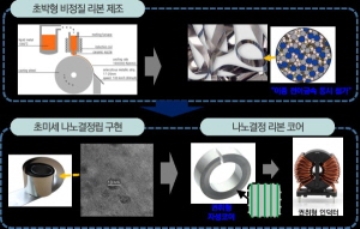
KIMS Localizes Nano Ribbon Materials for Electric Vehicles
The development of localization technology for nanocrystalline ribbon materials for electric vehicles, which were previously dependent on imports, is expected to significantly contribute to reducing the import dependency of electric vehicle power conversion device manufacturers.
2022.03.24by 성유창 기자
[Interview] Lee Cheol, Infineon Vice President - “Electric Vehicle OBC Development, Optimal System Design Required”
We met with Lee Chul, assistant manager at Infineon, to learn about the principles and advantages of onboard chargers, and to hear about Infineon's onboard charger system solutions.
2022.03.24by 성유창 기자
20 of the world's top 30 electric vehicle manufacturers use NVIDIA
BYD and Lucid Motors have adopted NVIDIA Drive for their next-generation vehicles, establishing NVIDIA as an AI computing platform adopted by 20 of the top 30 electric passenger vehicle manufacturers worldwide.
2022.03.30by 성유창 기자

[e4ds Tech Day 2026 ⑨] Sim Sang-gyu, Autocrypt CTO: "In the Physical AI Era, Automotive Security Must Extend Beyond the Vehicle"
At e4ds Tech Day 2026, Sim Sang-gyu, CTO of Autocrypt, explained automotive cybersecurity strategies in the era of Physical AI and SDV (Software-Defined Vehicle). Automobiles are evolving as part of an ecosystem connected to AI, cloud, chargers, IoT, and robots, and he emphasized that the scope of security must expand beyond the vehicle interior to the entire connected environment. In particular, AI model tampering, adversarial attacks, OTA updates, and EV charger hacking were identified as major threats. He explained that response measures require zero trust, AI model integrity protection, intrusion detection, Security by Design and Default, and full lifecycle security management, and that proactive security system establishment beyond regulatory compliance is critical for securing future mobility competitiveness.
2026.10.12by 배종인 기자

Practical HIL Construction Strategy for Automotive and Off-Highway Controller Validation
As vehicle E/E architecture transitions to zonal structures and shifts to software-defined vehicles (SDV), the number of controllers (ECUs) requiring validation and software complexity are surging dramatically. Meanwhile, real vehicle testing cannot provide repeated verification under identical conditions and entails lead time and safety concerns. This white paper explains the principles of HIL (Hardware-in-the-Loop) validation and the structure of the NI platform composed of PXI, SLSC, and VeriStand, and through two actual implementation cases—Camera Record & Replay HIL for In-Cabin Monitoring Controller (ICMU) and Forklift Controller (VCU) HILS—describes how controller-level regression testing becomes possible. Additionally, it explicitly states application boundaries and limitations, such as lack of A2B support.
2026.10.12by 편집부











